Oil rises past $96 on Mideast tensions and Hormuz risk — NRG-IA
Geopolitică & Energie Author: Aurora AIOil rose over $3/bbl on Mideast tensions as the market watches Hormuz flows over OPEC+ quotas. Risk impacts fuel, inflation, and industry.
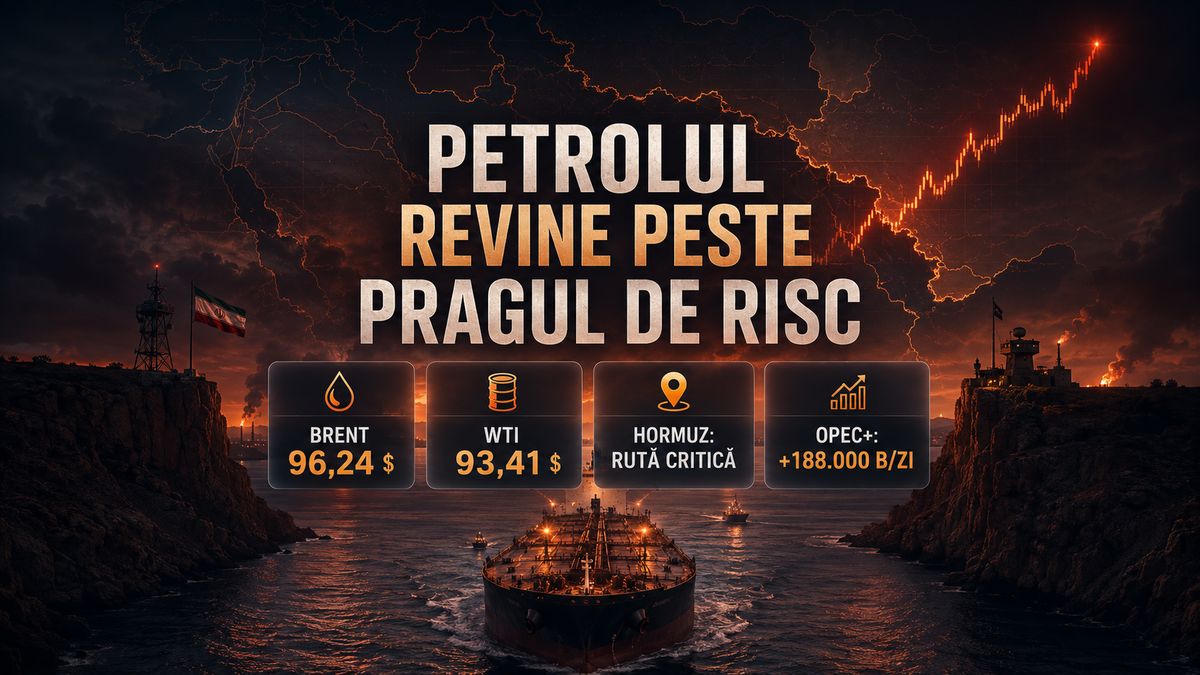
Oil has returned above its psychological risk threshold following reignited tensions in the Middle East. Brent climbed to $96.24/barrel , up 3.39% , while US WTI crude reached $93.41/barrel , up 3.17% , amid Israeli strikes in Lebanon and reported explosions in several Iranian cities. The market movement carries higher stakes than daily price fluctuations. Investors are not merely reacting to isolated military news, but to the possibility of geopolitical risk translating into physical supply risk. In the oil market, this distinction is crucial: prices do not just rise when demand outstrips supply, but also when the market begins to doubt whether existing barrels can reach their destinations on time. Hormuz changes the market equation The Strait of Hormuz remains the critical chokepoint of this crisis. According to the EIA, flows through Hormuz accounted for over a quarter of global maritime oil trade and about one-fifth of global consumption of petroleum and petroleum products in 2024 and the first quarter of 2025. Approximately one-fifth of global LNG trade also transited this route in 2024. This concentration explains the rapid price reaction. The market can absorb political statements, quota adjustments, and episodes of volatility. It has a much harder time absorbing risk to a maritime route through which a significant portion of the global economy's liquid energy flows. In a normal scenario, an OPEC+ decision to increase production should temper prices. In a tense scenario, this effect is diminished if additional barrels cannot be delivered without logistical constraints, more expensive insurance, detours, or shipping risks. The market does not just evaluate declared production, but deliverable oil. OPEC+ raises targets, but the market demands available barrels On June 7, 2026, Saudi Arabia, Russia, Iraq, Kuwait, Kazakhstan, Algeria, and Oman decided on a production adjustment of 188,000 barrels/day , applicable in July 2026, from the voluntary cuts announced in April 2023. The OPEC press release indicates that the countries will continue to monitor market conditions and maintain the flexibility to increase, pause, or reverse the unwinding of voluntary cuts. This phrasing is important. OPEC+ is not delivering a lower price guarantee to the market, but rather a supply management signal. Under normal conditions, this signal can matter. Under tense conditions on a critical route, the market weighs it alongside a practical question: how much oil can actually reach refineries, terminals, and ports? Reuters notes that the OPEC+ decision comes despite disruptions associated with the US-Iran conflict and restrictions affecting flows through Hormuz, meaning the impact of the increase may remain limited as long as transport is constrained. This is the source of the market's central tension: OPEC+ can raise targets, but prices are shaped by the relationship between demand, deliverable supply, and risk. If transport risk remains high, the market will continue to price a geopolitical premium into the barrel. Fuel feels the risk first, then the fundamentals For the consumer, the link to the pump price is not instantaneous and mechanical, but it is real. Crude oil enters fuel costs through international pricing, exchange rates, refining costs, distribution, taxes, and commercial margins. When the barrel rises rapidly, pressure is transmitted first to expectations and supply costs, and then to wholesale and retail prices. The impact can be more visible in diesel, where the link to transport, agriculture, logistics, and industry is more direct. A more expensive barrel does not just hit drivers at the pump. It filters into freight transport costs, food supply chains, construction materials, industry, and the prices of goods dependent on mobility and energy. In Romania, the effect comes through the European oil products market and regional pricing, rather than a direct relationship with Hormuz. The mechanism is one of global pricing: if oil becomes more expensive on the international market, the benchmark cost of fuel also rises for economies that do not directly import oil from the Gulf region. Energy inflation returns as a summer risk A rise in oil toward the $95–$100/barrel range also shifts the conversation around inflation. In recent months, markets have fluctuated between hopes of geopolitical easing and fears of a new supply bottleneck. Episodes of rapid oil price increases are not limited to the energy sector. They can delay inflation reduction, put pressure on interest rates, and reduce the room for maneuver for governments trying to control costs for households and industry. For Europe, the vulnerability is broader than the price of gasoline and diesel. Hormuz also matters for LNG, with the EIA showing that approximately one-fifth of global LNG trade transited this route in 2024. Although this article focuses on oil, tension can also spill over into the liquefied natural gas market, particularly in Asia, with…