Hormuz Crisis Spreads Risk to Saudi Oil and Red Sea — NRG-IA
Geopolitică & Energie Author: Ioana BuzoaicaThe Hormuz conflict is spreading to the entire Saudi oil export system, as China negotiates Red Sea passage and attacks keep the market under pressure.
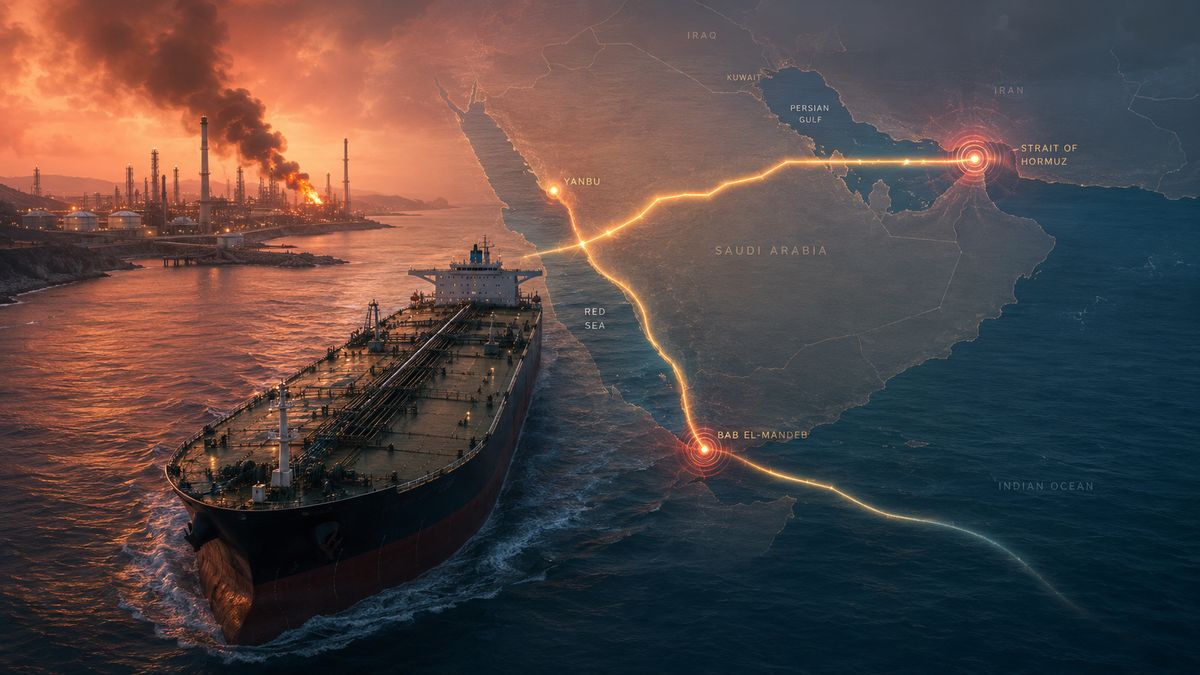
The US and Saudi Arabia have launched strikes against targets in eastern Iraq that they claim were used by Iran-backed groups for drone attacks against Saudi oil facilities. The operation came after Saudi air defenses intercepted several drones headed toward energy infrastructure in the Eastern Province, and after Iran launched ballistic missiles at US military targets in the region. Iraqi authorities within the Popular Mobilization Forces claimed that official headquarters were hit, resulting in deaths, injuries, and material damage. Iran denied any connection to the projectiles launched from other states against Saudi Arabia and warned that attributing these operations to Tehran is a miscalculation. Direct responsibility for the drone attacks thus remains contested among the involved actors. On the same day, Iran's Revolutionary Guards claimed they had struck three tankers in the Strait of Hormuz and forced them to halt after the vessels allegedly ignored warnings regarding the use of a route deemed 'unsafe and illegal' by Iranian authorities. The account had not been independently verified at the time of publication, but the statement confirms that the dispute over navigation through the strait remains one of the primary sources of escalation. The market reaction was immediate. On the morning of July 29, Brent crude rose by $3.30 to $87.39 per barrel, while US crude increased by $3.05 to $82.31. The move reflected the resurgence of geopolitical risk, but was also supported by estimates of an approximately 3.3 million-barrel draw in US commercial inventories and the prospect of the alliance of major oil producers temporarily pausing production increases starting in October. Pressure shifts from Hormuz to the Red Sea Prior to the conflict, approximately 20 million barrels of oil and petroleum products passed through the Strait of Hormuz daily, equivalent to about one-fifth of global consumption. The route was equally vital for liquefied natural gas: nearly 20% of global trade utilized the strait, primarily for Qatari exports to Asian markets. The de facto closure of the route at the start of the conflict severely reduced shipments from the Gulf. An interim agreement reached between Washington and Tehran in June allowed for a partial recovery, with total Gulf oil exports, including volumes shipped via alternative routes, rising to 16.1 million barrels per day. However, this level remained well below the pre-war average of approximately 24 million barrels per day. Saudi Arabia compensated for part of the bottleneck through the East-West pipeline, which traverses the kingdom from oil facilities near the Persian Gulf to the Yanbu terminal on the Red Sea. The pipeline has a maximum capacity of approximately seven million barrels per day, of which nearly five million can be designated for export, depending on the availability of terminals and tankers. While this infrastructure allows Saudi Arabia to bypass Hormuz, it does not eliminate maritime risk. Oil loaded at Yanbu for Asian buyers must traverse the southern Red Sea and the Bab el-Mandeb strait, between Yemen and Djibouti. After the Houthi movement announced restrictions on July 20 on vessels using Saudi ports, the alternative built to bypass Hormuz became vulnerable itself. Attacks hit pipeline, terminals, and Jazan refinery The Houthis claimed attacks against oil facilities in Jazan and Yanbu, as well as points along the transport system linking eastern Saudi Arabia to the Red Sea coast. Saudi Arabia has not confirmed all the targets indicated by the group, and the claims cannot be automatically treated as proof that every mentioned facility was hit. In Jazan, however, verified footage showed a thick plume of smoke rising from the direction of the energy complex. A note from consulting firm Industrial Info Resources, seen by Reuters, indicated that the refinery was shut down after the attack allegedly affected the integrated gasification combined cycle (IGCC) power plant, as well as the tank farm area. Aramco had not publicly confirmed either the extent of the damage or the restart date, which was preliminarily estimated for mid-August. The Jazan complex is designed to process up to 400.000 barrels per day. It includes the refinery, hydrogen and industrial gas production facilities, and an integrated power plant capable of supplying the energy required for operations and delivering electricity to the region. Its shutdown represents not only the temporary loss of refining capacity but also impacts an industrial hub that processes crude oil into diesel, gasoline, and other petroleum products. The attacks on Jazan and threats against Yanbu have shifted the geography of risk. In the first phase of the crisis, the main question was how much oil could be moved out of the Gulf without passing through Hormuz. Currently, the issue is whether volumes transported overland to the Red Sea can still reach Asian markets safely and at acceptable costs. China negotiates…