Houthi Saudi Blockade: Risks for Oil, Yanbu & Bab el-Mandeb — NRG-IA
Geopolitică & Energie Author: Ioana BuzoaicaHouthis declared a blockade on Saudi Arabia as Yanbu became the main alternative to Hormuz. Enforcing it would hit exports to Asia and raise global costs.
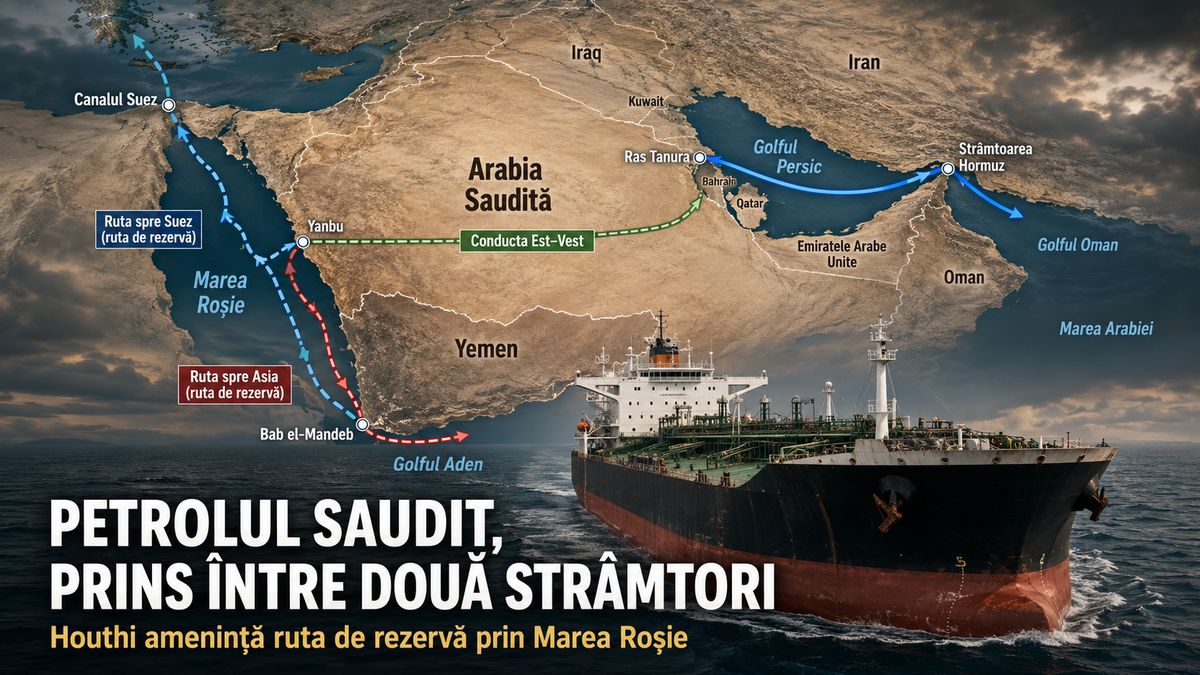
Yemen's Houthi forces announced on July 20 the immediate imposition of a 'maritime embargo' against Saudi Arabia, in response to what the group describes as the Saudi blockade on Yemen. The declaration opens a new risk front for energy shipping, but does not, at this stage, equate to a physical closure of the Bab el-Mandeb Strait. The Houthis have not publicly detailed the mechanism by which they intend to enforce the measure, the criteria used to identify Saudi-associated vessels, or the geographical limits of the operation. At the time of the announcement, no attack under the new blockade had been confirmed, and Riyadh had not issued an official response. However, uncertainty can trigger commercial consequences well before the first attack. Shipowners, tanker operators, insurers, and crews do not require a fully closed strait to avoid a route. It is enough for the risk of a strike, seizure, or detention to become too high relative to the voyage's value. The timing is critical as Saudi Arabia uses the Red Sea as its primary alternative to traffic disruptions through Hormuz. A credible threat at Bab el-Mandeb would pressure not just another shipping route, but the very corridor that has kept a significant portion of Saudi oil flowing to the global market. Yanbu has become Saudi oil's emergency exit Saudi Arabia possesses an advantage that other major Gulf producers lack on the same scale: the East-West pipeline, also known as the Petroline. This infrastructure transports crude from the Abqaiq processing facility near the Persian Gulf to the Yanbu terminal on the Red Sea coast. The pipeline has a permanent capacity of approximately 5 million barrels per day (bpd) and can temporarily reach around 7 million bpd by utilizing converted pipelines and additional technical workarounds. However, the actual export capacity through Yanbu remains constrained by terminals, berths, tanker availability, and flow logistics. Following the severe reduction of transit through Hormuz, Saudi Aramco accelerated crude shipments to the Red Sea. Loadings from Yanbu neared 4–4.6 million bpd during certain periods, up from much lower levels prior to the conflict. Over 70% of Saudi exports were redirected to this port, transforming it from a strategic alternative into a central component of global supply. Saudi Arabia's total crude and condensate exports stood at approximately 5.29 million bpd in the first half of July, with about three-quarters of these volumes departing via Yanbu. This shift allowed the kingdom to reduce its immediate reliance on Hormuz, but concentrated an increasing share of flows within a system exposed to the Houthi threat in the Red Sea. Geography separates exports to Europe from those to Asia The impacts of a blockade at Bab el-Mandeb differ depending on the loading port and the cargo's destination. Yanbu is located in the Red Sea, north of Bab el-Mandeb. Tankers loading there and heading to Europe sail north through the Suez Canal. They do not need to transit Bab el-Mandeb. However, vessels departing Yanbu for China, India, Japan, or South Korea must sail south and pass through the strait geographically flanked by the coasts of Yemen and Djibouti. An effectively enforced blockade would therefore primarily hit exports redirected from Yanbu to Asia. The situation is reversed for cargoes loaded at Saudi Persian Gulf ports, such as Ras Tanura and Ju'aymah. Oil destined for Asia must transit Hormuz, but not Bab el-Mandeb. Volumes bound for Europe via the Suez Canal must pass through both straits. If Bab el-Mandeb becomes impassable, a tanker exiting the Gulf via Hormuz and heading to Europe must circumnavigate Africa via the Cape of Good Hope. This consequence does not apply to all Saudi vessels, but specifically to cargoes originating in the Persian Gulf that normally use the Red Sea-Suez route to European markets. Saudi Arabia ships more than just crude oil Crude remains the kingdom's primary energy export. In a year without major disruptions, Saudi Arabia delivers approximately 7 million bpd to the global market, with nearly three-quarters of these volumes destined for Asia. Refineries purchase several Saudi grades, ranging from Arab Super Light and Arab Extra Light to Arab Medium and Arab Heavy. Their characteristics differ in density and sulfur content, and substituting one grade for another can require adjustments to processed blends and refinery operations. Saudi Arabia is also a major exporter of refined products: diesel and gasoil; gasoline; kerosene and jet fuel; fuel oil; naphtha; liquefied petroleum gases and other liquids. Refined product exports stood at approximately 1.3 million bpd in 2023. These flows hold particular significance in a market where diesel and jet fuel are already impacted by refinery issues in the Middle East, Russia, and Asia. Furthermore, Saudi ports handle exports of petrochemicals, polymers, fertilizers, and other industrial goods. A disruption to shipping would not…
Ioana Buzoaica — Independent Editorial Board
The NRG-IA newsroom continuously monitors Romanian energy markets, ANRE regulatory decisions, and national grid telemetry (SEN/SNT). We deliver independent intelligence anchored exclusively in official primary data.
Editorial Charter, Ethics & Verification Methodology →