Petroline Shut After Attacks: Saudi 4-5M Bpd Hormuz Bypass — NRG-IA
Geopolitică & Energie Author: Ioana BuzoaicaSaudi Arabia shut the East-West Pipeline after drone attacks. The 4-5M bpd bypass is at risk, but actual market loss depends on the shutdown's duration.
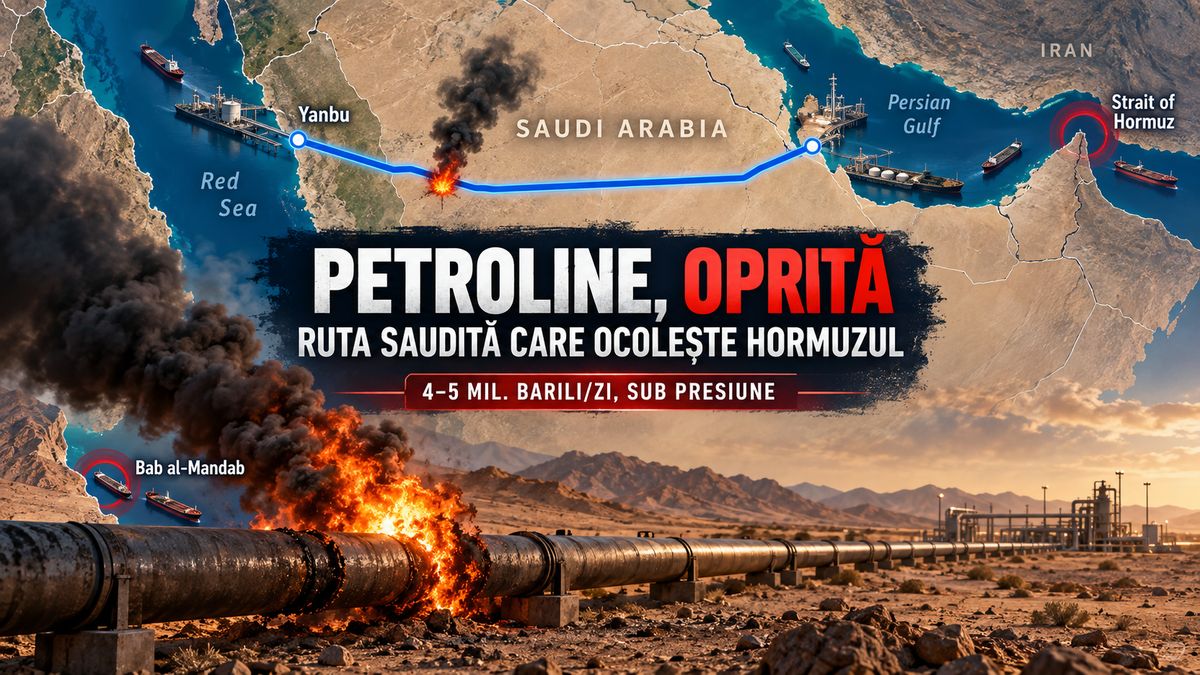
Saudi Arabia has temporarily shut down one of the global oil market's most critical safety valves. The East-West Pipeline, also known as Petroline, was closed as a precautionary measure following several attacks on the morning of September 10 in the Riyadh and Medina regions, just as the pipeline was transporting approximately 4–5 million barrels of oil per day to the Red Sea to bypass heavily restricted traffic through the Strait of Hormuz. This figure is massive: the pipeline's recent flow is equivalent to roughly 4–5% of global oil supply. However, the distinction between "exposed volume" and "oil lost to the market" is essential. Saudi Arabia has not announced that 5 million barrels per day have been removed from global supply, and the actual impact on exports has not yet been quantified. The market is thus facing a more subtle and potentially more significant issue than a fire at a single oil facility: the infrastructure used to reduce dependence on Hormuz has itself become unavailable, at a time when oil has returned to over $100 per barrel and Saudi flows are already well below normal levels. Petroline has become the critical Hormuz bypass The East-West Pipeline spans approximately 1,200 kilometers across the Arabian Peninsula, allowing crude oil to be transported from eastern Saudi Arabia to Yanbu on the Red Sea coast. Its role has grown significantly as tensions between the United States and Iran have reduced oil traffic through Hormuz to a fraction of normal levels. In recent months, Petroline was carrying about 4–5 million barrels per day, according to vessel-tracking data and analyst estimates cited by Reuters. The pipeline's closure temporarily removes the very infrastructure that allowed Saudi Arabia to move massive volumes of oil to the Red Sea without passing through Hormuz. The Saudi Ministry of Energy stated that the shutdown was decided "as a precautionary measure." Technical and emergency response teams are verifying the pipeline's safety, and authorities reported injuries following the attacks. The Ministry of Foreign Affairs later confirmed that damage was being repaired. At the time of publication, there is no official timeline for restarting the pipeline. Satellite imagery analyzed by Reuters shows black smoke rising from a section of the pipeline south of Medina, physically confirming the incident. However, the exact extent of the damage and its effect on pumping capacity have not been made public. The 5 million barrels per day are exposed, not confirmed lost Herein lies the difference between a major logistical crisis and an immediate supply shock of the same magnitude. The 4–5 million barrels per day represent the flow that Petroline was recently carrying. Shutting down the pipeline cuts off this transport route, but it does not automatically prove that every barrel flowing through it has vanished from the global market. The net impact depends on the duration of the shutdown, available inventory levels, loading schedules at Yanbu, the possibility of delaying some shipments, and the speed with which Saudi Aramco can restore pumping. The Saudi ministry has not yet published any figures on lost export volumes. This is an important distinction for a market where large numbers can quickly turn risk into panic: 5 million barrels per day represents roughly the upper limit of the recent flow under pressure, not a measured 5 million barrels per day reduction in global supply. Duration thus becomes the decisive variable. A brief shutdown can be absorbed much more easily by the logistical system and inventories. A prolonged outage of a pipeline carrying up to 4–5% of global supply would carry an entirely different weight. Drones were launched from Iraq, but the perpetrator is not publicly identified Riyadh confirmed that Petroline was targeted by several drones coming from Iraq. However, the Saudi government has not publicly attributed the attack to any specific group. The Saudi Ministry of Foreign Affairs announced that, at the request of the Iraqi Prime Minister, Saudi Arabia decided not to respond militarily at this stage, giving Baghdad the opportunity to take action against attacks launched from its territory. Riyadh also stated that it reserves the right to protect its territory and infrastructure. Iraq dismissed the military commander responsible for operations in Maysan province and launched an operation to identify those involved, according to Reuters. Maysan lies on the border with Iran and is an area where Tehran-backed Shiite militias operate. However, the exact perpetrator of the pipeline attack remains unclear. Direct attribution of the Petroline strikes to the Houthis is not supported by available official confirmations at this time. Pressure simultaneously shifts toward the Red Sea The attack on Petroline comes alongside a rapid deterioration of security in the southern Red Sea. Yemeni government sources told Reuters that Houthi forces have seized the strategic island of…