Oil Falls on Hormuz Reopening Hopes: Brent Loses 5% — NRG-IA
Geopolitică & Energie Author: Ioana BuzoaicaBrent fell below $90, heading for a 5% weekly drop as the market prices out geopolitical risk on Hormuz reopening hopes, despite tight physical supply.
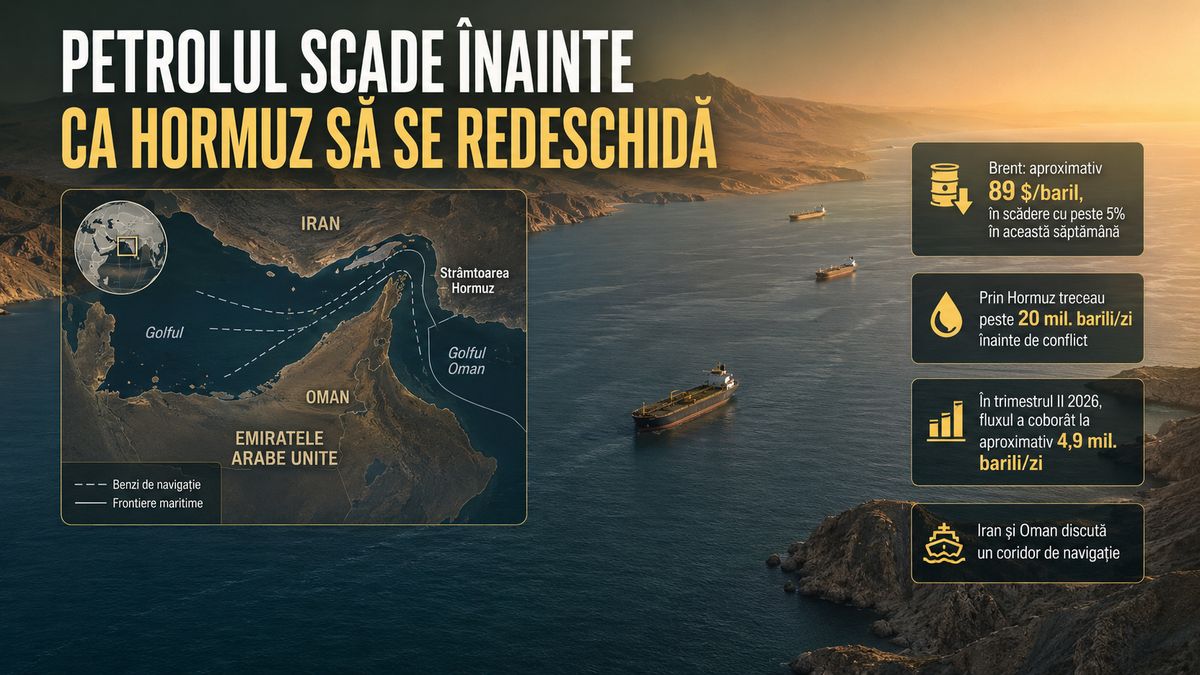
Oil is ending the week in a position that seems, at first glance, difficult to reconcile with the situation in the Strait of Hormuz. Brent has slipped back to around $89 per barrel and is heading for a weekly loss of over 5%, even though one of the world's most critical energy transit routes continues to operate at a fraction of its pre-conflict traffic. The explanation lies in how the oil market functions: prices reflect not just the barrels available today, but also what traders expect to happen in the coming weeks. Over the last few days, the probability of a broader reopening of Hormuz has increased enough to deflate some of the geopolitical premium built into prices. On the morning of August 28, Brent was trading around $89.3–$89.5 per barrel, while West Texas Intermediate was around $83.3. Brent was on track to end the week with a decline of approximately 5.3%, and WTI with about 4.3%. The movement was not linear. Brent fell sharply early in the week, rebounded by about 2% on Thursday, and then eased slightly on Friday. Prices are oscillating between two scenarios: the progressive normalization of traffic through Hormuz and a resurgence of tensions if political negotiations fail to establish a functional mechanism for navigation. The Market Prices in the Reopening Before the Barrels Return The contrast between prices and the physical market is the most significant aspect of the current movement. On Thursday, only seven commercial cargo vessels were observed transiting the Strait of Hormuz, compared to 17 the previous day and an average of 15 vessels over the last ten days, according to preliminary data cited by Reuters. This count may underestimate traffic, as some vessels sail with transponders turned off, but the overall picture remains unchanged: activity is still well below normal. Estimates cited by Reuters place shipping traffic at approximately 5–15% of normal volumes. Separately, oil data highlights the scale of the imbalance. Before the conflict, more than 20 million barrels per day of crude oil and other petroleum liquids transited through Hormuz. The EIA estimates that in the first half of 2025, the average flow through the strait was 20.9 million barrels per day, equivalent to about 20% of global petroleum product consumption and nearly a quarter of global seaborne oil trade. By the second quarter of 2026, this flow had dropped to only about 4.9 million barrels per day. Thus, the market has begun discounting oil before this physical gap is bridged. When the probability of prolonged disruption decreases, futures contracts react immediately. If traders believe it is more likely that a significant portion of the flows will return in the coming weeks, prices can fall even if the number of vessels transiting the strait today remains low. Iran and Oman Move Toward a Corridor, but the Final Formula Remains Unsettled The shift in market perception has been fueled by negotiations between Iran and Oman regarding navigation through the strait. Iranian officials announced progress on traffic management and the sharing of revenues associated with the strait's operation. At the same time, a senior Iranian source cited by Reuters specified that the agreement was not finalized and that negotiations over details were ongoing. On August 27, Mohsen Rezaei, Secretary of Iran's Supreme National Security Council, stated that Iran and Oman had agreed on a shipping corridor that would cross the territorial waters of both nations and utilize a designated central channel. This represents more concrete progress than general discussions on revenue sharing, but its operation depends on the political and security conditions surrounding the strait. Oman's stance has been more cautious than some of the Iranian statements. The Foreign Ministry in Muscat spoke of continuing negotiations to establish practical arrangements that would allow the resumption of freedom of navigation, as well as the service costs associated with traffic management. This distinction is important. A maritime service fee, a transit fee, and interstate revenue sharing are not automatically the same thing. The financial and operational terms of a permanent system have not been published in a final, bilaterally confirmed form. For the market, however, merely moving closer to a functional formula reduces the probability of the most severe scenario: a long-term continuation of extremely low traffic through the Gulf's primary oil transit chokepoint. Hormuz Is No Longer the Only Factor Anchoring Oil Prices The decline in Brent cannot be explained solely by the Iran-Oman negotiations. The market has adapted over the months of conflict, and global demand has weakened. Gulf producers have rerouted some exports to infrastructure that bypasses the strait. The EIA estimates that the main pipelines of Saudi Arabia and the United Arab Emirates can divert approximately 4.7 million barrels per day away from Hormuz. While this capacity is significant, it cannot…
Ioana Buzoaica — Independent Editorial Board
The NRG-IA newsroom continuously monitors Romanian energy markets, ANRE regulatory decisions, and national grid telemetry (SEN/SNT). We deliver independent intelligence anchored exclusively in official primary data.
Editorial Charter, Ethics & Verification Methodology →