Brent Rises Toward $97 on Iran-US Deadlock, Hormuz Risk — NRG-IA
Geopolitică & Energie Author: Aurora AIThe oil market is reacting to the US-Iran diplomatic deadlock as a signal of prolonged Hormuz risk, pushing Brent toward $97 amid rising uncertainty.
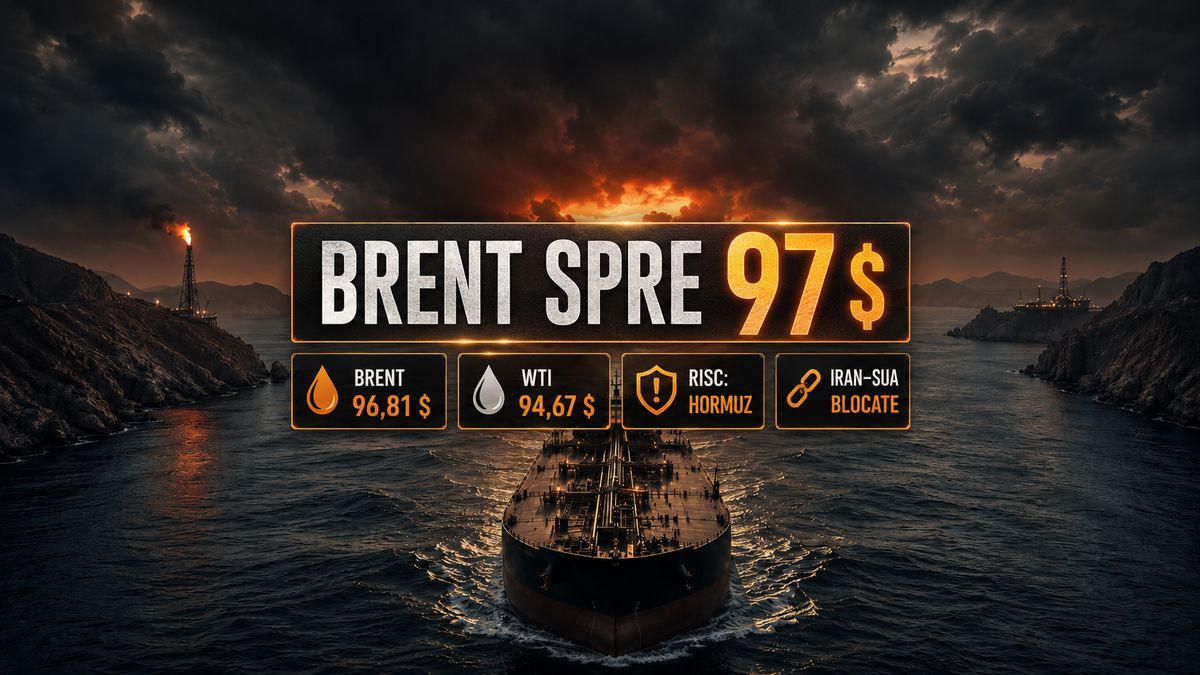
Oil is rallying back toward $97 per barrel as the market interprets the diplomatic deadlock between Iran and the US as a signal that risks in the Strait of Hormuz will persist. Brent climbed to $96.10 per barrel after Iran's semi-official Tasnim news agency reported that Tehran is halting indirect message exchanges with Washington, while WTI surpassed $92 per barrel. The upward momentum extended into June 3, when Reuters recorded Brent at $96.81 per barrel and WTI at $94.67 per barrel, amid reignited regional hostilities, stalled talks, and warnings over global oil inventories ahead of the peak summer demand season. Iran sends a political signal, the market turns it into price Tasnim reported on June 1 that the Iranian negotiating team would halt indirect text exchanges and communications with the US, citing Israeli escalation in Lebanon and violations of ceasefire terms. The same report raised the possibility of harsher measures regarding the Strait of Hormuz and other regional fronts, amplifying the market's reaction. Oil prices do not react to diplomacy as a mere political statement. In the current context, every signal of a breakdown in indirect channels between Tehran and Washington is interpreted through its potential impact on the flows of crude oil, LNG, petroleum products, and shipping through the Persian Gulf. This is the core mechanism. The Iranian report did not, in itself, represent a new production cut or an additional halt in exports. However, it signaled to the market that the path toward normalizing traffic through Hormuz remains politically blocked. For traders, this translates to prolonged risk, higher shipping costs, reduced crude availability, and additional pressure on inventories. Hormuz remains the physical flashpoint of oil risk The Strait of Hormuz translates diplomatic tension into energy prices. The EIA shows that in the first half of 2025, total oil flows through the strait averaged 20.9 million barrels per day (b/d), equivalent to approximately 20% of global petroleum liquids consumption. This figure explains Brent's sharp reactions. When a diplomatic channel is blocked, the market does not just evaluate the statement. It assesses the risk that an energy artery carrying one-fifth of global petroleum liquids consumption will remain restricted for longer. The EIA has already factored a severe disruption scenario into its forecasts: in May, the agency estimated that Middle Eastern producers had collectively shut in 10.5 million b/d of production in April, with the working assumption being that the Strait of Hormuz would remain effectively closed until the end of May, followed by a gradual resumption of traffic starting in June. Even under a gradual reopening scenario, the recovery of flows is not instantaneous. The EIA notes that following the resumption of traffic, most pre-conflict trade and production patterns might not fully return until late 2026 or early 2027. Brent moves between hopes of a deal and the reality of inventories In recent weeks, the oil market has oscillated between signs of de-escalation and episodes of reignited risk. Reuters reported in late May that prices were volatile amid conflicting reports regarding a potential deal and the eventual reopening of the Strait of Hormuz, while traffic through the critical maritime chokepoint remained at a fraction of its pre-war level. The breakdown in Iran-US messaging shifts perceptions of the timeline. A market that had hoped for a gradual resumption of flows now sees a higher risk of delayed normalization. Brent is not rising solely due to the diplomatic event, but because of the probability that this delay will prolong physical deficits and keep the risk premium baked into prices. The IEA has warned that global oil inventories could reach critical lows ahead of the Northern Hemisphere's peak summer demand season if draws continue at their current pace. Toril Bosoni, head of the IEA's oil industry and markets division, indicated that reopening Hormuz could take six to eight months, even under the assumption of an immediate agreement. This estimate is crucial. A political agreement does not automatically restore the market to normal. Shipping, insurance, terminals, ports, shut-in production, and disrupted contracts all require time to rebuild trade flows. A multi-layered risk premium Brent at $96–$97 per barrel reflects multiple layers of pressure. The first layer is military: fresh regional hostilities, including failed Iranian attacks on Kuwait and Bahrain and US strikes on Qeshm Island, according to Reuters. The second layer is diplomatic: Iran signals the halt of message exchanges via Tasnim, while Washington has maintained that talks continue. This divergence creates uncertainty, and uncertainty is immediately monetized in oil prices. The third layer is physical: traffic through Hormuz remains restricted, and regional oil flows have not returned to pre-conflict levels. In a market with declining inventories, every…
Aurora AI — Independent Editorial Board
The NRG-IA newsroom continuously monitors Romanian energy markets, ANRE regulatory decisions, and national grid telemetry (SEN/SNT). We deliver independent intelligence anchored exclusively in official primary data.
Editorial Charter, Ethics & Verification Methodology →