Hormuz: Brent Falls to $86.28, but Traffic Remains Low — NRG-IA
Geopolitică & Energie Author: Ioana BuzoiacaOil is shedding its risk premium before Hormuz returns to normal. Investors price in a new corridor, but physical traffic and shipping costs lag behind.
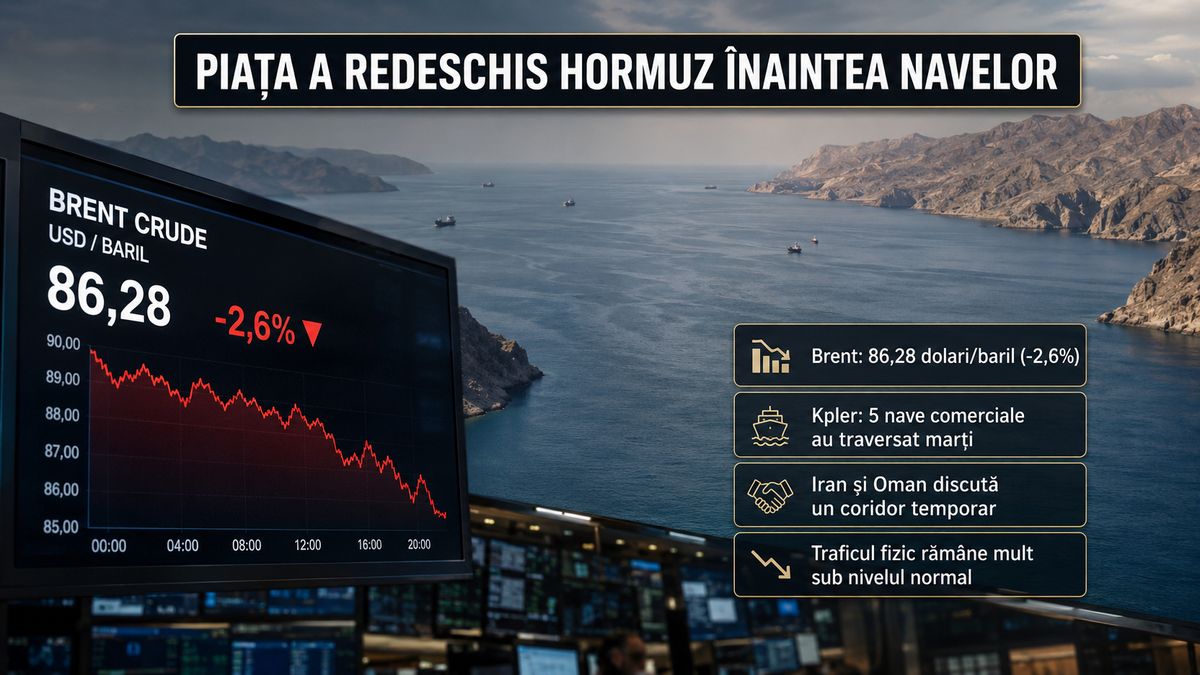
Brent crude fell by 2.6% on Wednesday morning, August 26, to $86.28/barrel , after closing the previous session down 3.9% at $88.58/barrel. The price movement reflects hopes that negotiations between Iran and Oman can reopen a safer passage through the Strait of Hormuz. However, the reality on the water is much slower: preliminary Kpler data indicated only five commercial vessels transited the strait on Tuesday, compared to an average of 15 over the previous ten days and well below pre-war levels. This contrast speaks louder than daily oil price fluctuations. The market has begun unwinding the geopolitical risk premium before tankers, insurers, and maritime operators confirm physical normalization. Investors are trading the probability of a reopening, not a reopening that has already occurred. The five transits preliminarily identified by Kpler on Tuesday included two LPG carriers and one bitumen tanker exiting the Gulf, as well as two empty refined product tankers entering. However, AIS data does not capture the full picture: some vessels reduce or turn off their position transmissions, and Vortexa estimates indicated Monday's oil transits were around 5 million barrels per day , compared to over 20 million barrels per day before the conflict . The difference between these two metrics is important. The five vessels represent identified commercial transits in a preliminary dataset, while the 5 million barrels per day is an estimate of oil volumes. They do not describe the same indicator and cannot be directly compared. Iran and Oman Negotiate the Next Phase, Rather Than Announcing Normalization The joint statement issued by Iran and Oman on August 25 outlines a phased process. The two nations discussed a joint temporary corridor and a mine-clearing project, with technical negotiations set to continue on a permanent mechanism, traffic management, information sharing, and navigation and security services. Oman indicated it hopes the temporary route can be announced soon. Consequently, the oil market's reaction anticipates the outcome of a diplomatic and technical process that has yet to be translated into a functional navigation regime secure enough for shipowners, traders, and insurers. Herein lies the gap between the financial and physical markets. For Brent, it is enough for the probability of a prolonged disruption to decrease. For a shipowner sending a vessel worth hundreds of millions of dollars through the area, what matters is whether the actual risk of attack, seizure, mining, or detention has decreased, and whether insurance can be secured at a bearable cost. Hormuz Has Had a Temporary Corridor Before. The Recovery Did Not Last The current attempt is not the first. On June 24 , Oman and the International Maritime Organization established a temporary route through Hormuz for shipping. The mechanism was designed to facilitate the movement of vessels stranded in the Gulf and was followed by a visible increase in traffic. S&P Global counted 78 total transits on that day, 33 of which used the Oman-managed route. For a brief period, the corridor demonstrated that a controlled opening could quickly bring ships back to the strait. However, the result was not sustainable. Following the resumption of attacks in July, oil traffic contracted severely once again. On July 9, Reuters identified only two tankers in the early hours of the day, and the level of approximately 40 ships per day from the preceding period remained far below the roughly 125–140 daily transits recorded before the war. The June experience changes the stakes of the current negotiations. It is not enough for a route to be administratively open for a few days. The physical market needs this opening to withstand military tensions long enough for shipowners and insurers to return to near-normal conditions. It is precisely this possibility that Brent is currently pricing in. Iran Opens Negotiations While Simultaneously Tightening Control Over Vessels Signals from the Gulf remain contradictory. While discussing a safer corridor with Oman, Iran blacklisted 45 vessels for alleged violations of its transit rules, threatening fines, vessel detentions, and cargo seizures. The commercial fallout was swift. Reuters reported on August 26 that at least three Indian refiners and a major international energy group plan to avoid vessels on the Iranian blacklist. Reducing the pool of mutually acceptable vessels could drive up shipping and compliance costs, even if the prospect of a temporary corridor lowers the risk premium in oil prices. The same disconnect appears regarding the issue of mines. US President Donald Trump declared on August 25 that mines in the strait's international waters had been cleared or detonated. On the same day, Iran and Oman included a joint mine-clearing project in their negotiation framework. Until these assessments translate into a stable shipping regime, the safety perceived by the financial market and the safety required by…
Ioana Buzoiaca — Independent Editorial Board
The NRG-IA newsroom continuously monitors Romanian energy markets, ANRE regulatory decisions, and national grid telemetry (SEN/SNT). We deliver independent intelligence anchored exclusively in official primary data.
Editorial Charter, Ethics & Verification Methodology →