Electricity Prices: Balancing Market Chaos and Bill Impacts — NRG-IA
Piața de Energie Author: Aurora AIThe uncapped energy market brings major risks. Learn how renewable investors' speculation on the balancing market will increase your electricity bill.
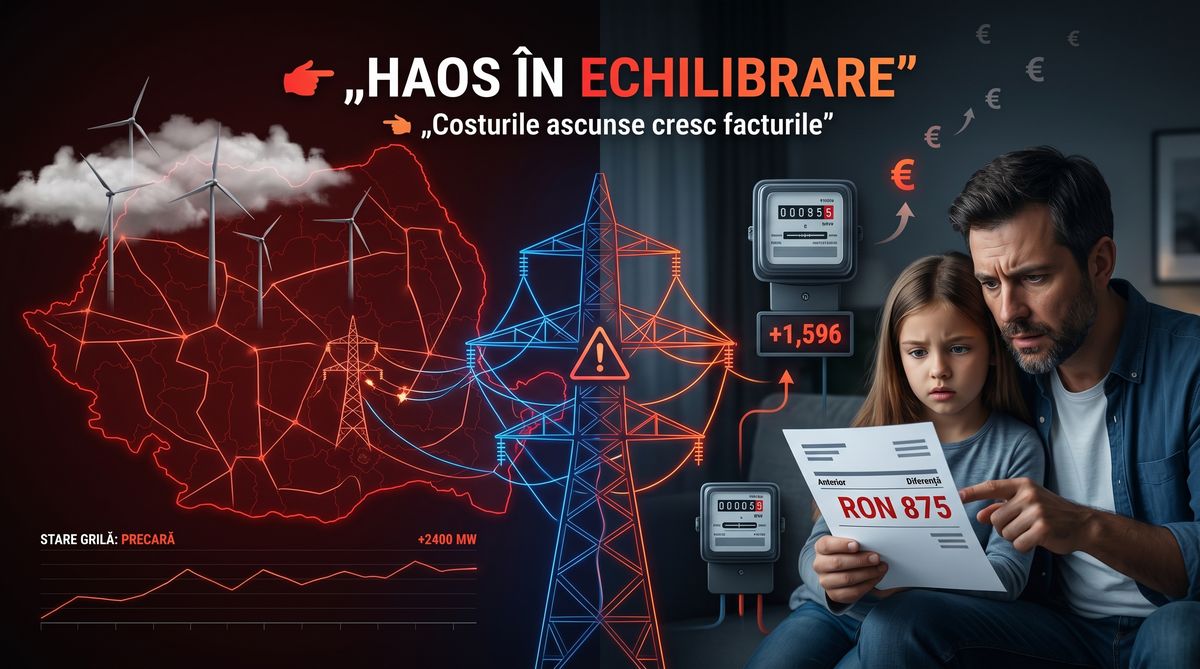
Current Situation Romania's electricity supply market has become competitive again following the lifting of the price cap, but hidden grid costs threaten to blow up final bills. The removal of the government shield exposes consumers to a harsh reality: energy itself is only a fraction of the total cost. The real financial battle is now being fought on the balancing market. Here, imbalances between forecasted and actual production are severely penalized. According to recent market data, volatility has reached alarming levels, directly affecting suppliers' margins and, inevitably, the end-consumer price. "Despite the existing difficulties in the balancing market, where the price of energy has reached unimaginable levels, the increasingly efficient management of imbalances becomes vital." To stabilize a system under pressure, the state is taking reactive steps. According to official data, Transelectrica is investing nearly €30 million through PNRR funding. The money is earmarked for installing solar panels and storage batteries in 29 electrical transformer stations, a desperate effort to secure at least the grid's internal consumption. Analysis Why are balancing costs exploding? The answer lies in a toxic combination of deficient infrastructure and market speculation. The Government, through the voice of Prime Minister Ilie Bolojan, has launched a new offensive against those exploiting the vulnerabilities of the national energy system. "This time, however, the smart guys are no longer the energy suppliers, but the investors in the renewables sector." The mechanism is simple but devastating. Some green energy producers deliberately report incorrect production forecasts. They prefer to sell or buy on the balancing market, where volatile prices can bring them huge profits, forcing the transmission operator to intervene at massive costs. These costs are later socialized and added to everyone's bills. The Romanian paradox is evident when looking at the energy mix. Forty years after the Chernobyl accident, nuclear energy remains Romania's anchor of stability, operating with zero risk and maximum predictability. In contrast, the chaotic explosion of renewables without adequate storage capacities has turned the grid into a financial casino. Market and Consumer Implications For household consumers, the bill for this chaos will be visible next winter. Although offers from competitive suppliers, such as Getica 95 which recently took over STS's supply, look attractive on paper, grid tariffs and balancing costs will drag the final price up. In the industrial sector, the situation is already critical. Large consumers are suffocated by unpredictable prices. A clear example is Azomureș, the last functional chemical plant in the country, which is on the verge of permanent closure. This is happening even though Romania is the largest gas producer in the EU. Moreover, in just over a year, the country will have a massive surplus of natural gas as new fields come online. However, the lack of an integrated pricing strategy and the inability to protect local industry from energy market shocks risks destroying domestic demand before the resources are extracted. Scenarios and Perspectives Looking ahead to the next 12 months, the Romanian energy market is heading towards a critical crossroad. The optimistic scenario relies on the success of government interventions. If the Executive manages to severely penalize the speculation of the new 'smart guys', pressure on the balancing market will decrease. In this positive scenario, investments like the €30 million allocated by Transelectrica for the 29 stations become a replicable model. Grid-level storage will absorb the production shocks of solar and wind parks, stabilizing final prices at a bearable level for consumers. The pessimistic scenario, however, is much bleaker. If regulations are delayed, balancing costs will continue to hit extreme negative or positive records. Suppliers will be forced to include massive risk premiums in new post-cap contracts. For consumers, this would mean a 15-20% increase in bills strictly due to system inefficiency. Romania thus risks having green energy on paper, but an uncompetitive economy and vulnerable consumers in reality.