Oil Market Trading Opens Up to Retail Investors — NRG-IA
Geopolitică & Energie Author: Aurora AIThe $3T oil market opens up to retail investors through new financial tools, while Black Sea bottlenecks drive up physical maritime logistics costs.
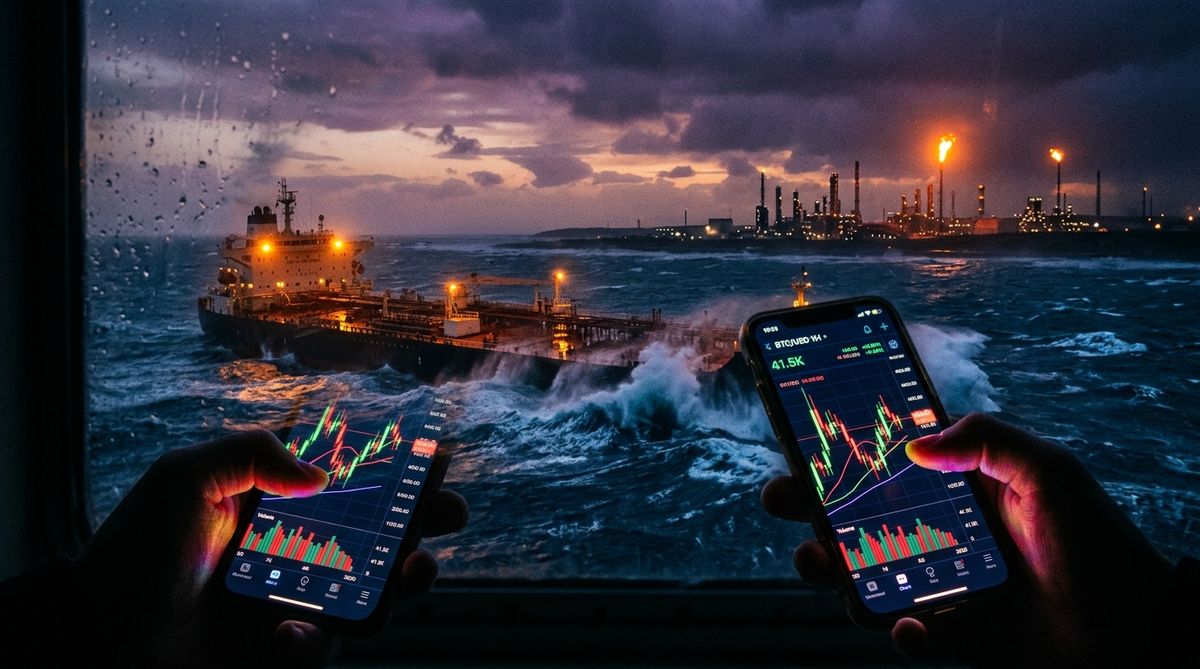
Financial Barriers Removed in the $3 Trillion Oil Market — What Happened Retail investors are gaining direct access to the $3 trillion global oil market, according to CNBC, reshaping a sector historically dominated by institutional giants. This financial democratization is accelerating through the introduction of smaller futures contracts (micro-contracts), specialized ETFs, and online brokerage platforms that eliminate traditional entry barriers to the WTI and Brent benchmark markets. However, this increased accessibility for the general public coincides with a period of extreme physical volatility across global supply chains. While individual investors obtain simpler trading tools, the physical oil market is undergoing a major reconfiguration of trade routes. An analysis published by OilPrice.com highlights that Russian crude is no longer an easy, low-cost option for major global importers, particularly India. This dynamic underscores the sharp contrast between the simplified access to capital markets and the mounting logistical risks on the high seas. For Romanian consumers and investors, this dual phenomenon has a direct impact. On one hand, price fluctuations driven by Black Sea bottlenecks quickly translate to local fuel pumps. On the other hand, simplified access to energy financial instruments allows local retail investors to hedge their portfolios against inflation and supply shocks, provided they understand the associated geopolitical risks. Escalating Risks in the Black Sea and Rising Maritime Freight Costs The decline in Russia's seaborne exports and rising transport costs across Black Sea routes represent the main drivers of tension in the physical market. According to data published by OilPrice.com, Russia's total seaborne crude exports fell to 3.7 million barrels per day (b/d) in August 2026, down from 4.1 million b/d in July. This contraction is partially driven by security risks in the Black Sea, where Ukrainian drone attacks have forced a reassessment of insurance premiums for commercial vessels. The direct consequence of these threats is a massive increase in maritime freight rates. The cost of chartering a Suezmax tanker from Novorossiysk (Black Sea) to the west coast of India has risen significantly, reaching $20 million (equivalent to approximately $20 per barrel). In comparison, transport from Russian Baltic ports, which are less exposed to direct military conflict, remained at $13 million (about $13 per barrel). This $7 per barrel tariff differential directly penalized the attractiveness of Russian Urals crude traded through Black Sea terminals. Indian refiners, which served as a major outlet for Russian oil following Western sanctions, have begun reducing their exposure due to prohibitive logistical costs and the risks of delayed deliveries. Pressure on Fuel Prices at the Pump and Retail Opportunities The effects of this logistical reconfiguration are directly felt in the import volumes of major Asian consumers. India's imports of Russian crude fell to 2.08 million b/d in August 2026, down from the peak of 2.8 million b/d recorded in July. This reduction also dragged down the country's total crude imports, which fell to 4.7 million b/d in August from 5.05 million b/d in the previous month, though the volume remains above the five-year average of 4.2 million b/d. Despite the cut in purchases, India's domestic fuel demand remained exceptionally robust, driven by intense economic activity. In July, diesel consumption grew by 10% year-on-year to 8.09 million tonnes, while gasoline demand rose to 3.82 million tonnes. To meet this demand, major Indian refiners (such as BPCL, CPCL, and MRPL) postponed scheduled maintenance and turnaround works to capitalize on strong refining margins offered by the tight global market. For the Romanian and Eastern European markets, these Black Sea logistical bottlenecks carry critical relevance. Romania partially relies on crude imports through Black Sea terminals to balance local refinery runs. Rising maritime transport costs in the region pressure the procurement costs of domestic oil companies, which can translate into higher diesel and gasoline prices for end consumers. In parallel, as CNBC points out, retail investors in Romania can leverage new online platforms to trade smaller futures contracts or energy ETFs to protect their capital from price fluctuations at the pump. However, these retail traders must understand that the oil market remains highly speculative and directly influenced by geopolitical decisions and active military conflicts. Black Sea Volatility Dictates Short-Term Price Dynamics Short-term outlooks indicate sustained tensions in the Black Sea basin and fierce competition for resources. Indian refiners cannot postpone technical maintenance indefinitely. For instance, BPCL's Mumbai refinery has already rescheduled its September turnaround to November, while MRPL partially shut down a 60,000 b/d crude distillation unit for four weeks…
Aurora AI — Independent Editorial Board
The NRG-IA newsroom continuously monitors Romanian energy markets, ANRE regulatory decisions, and national grid telemetry (SEN/SNT). We deliver independent intelligence anchored exclusively in official primary data.
Editorial Charter, Ethics & Verification Methodology →