China 15th Five-Year Plan: coal and climate targets — NRG-IA
Geopolitică & Energie Author: Aurora AIChina launches its 15th Five-Year Plan for climate, converting coal plants into strategic reserves to back up the expansion of renewable energy.
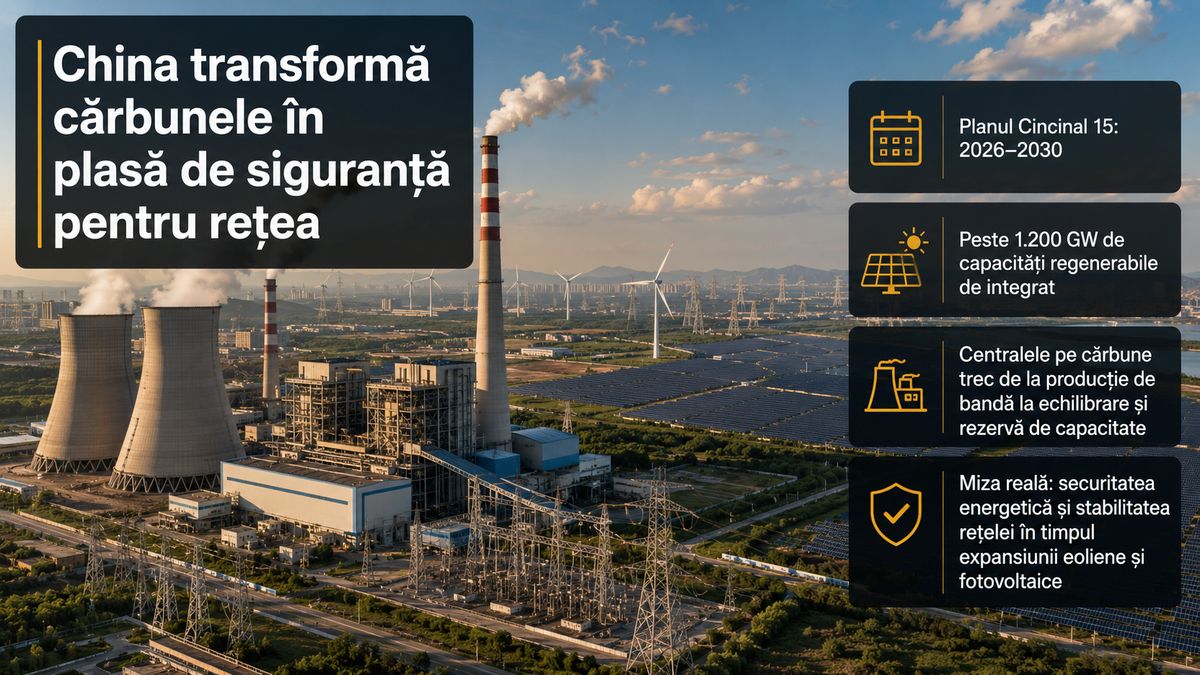
Integrating coal into a hybrid system — what the new five-year plan mandates China's 15th Five-Year Plan redefines its energy strategy, maintaining coal as an energy safety net for the 2026-2030 period. According to policy documents recently analyzed by international publications Carbon Brief and CleanTechnica , Beijing does not plan an abrupt phase-out of fossil fuels. Instead, the new regulatory framework proposes a hybrid integration of coal plants within a "new-type energy system" designed to ensure grid stability as renewable sources become dominant. This plan, considered a critical milestone in the global climate action architecture, details the mechanisms through which the Chinese grid will integrate over 1,200 GW of renewable capacity while keeping existing fossil fuel plants active. Rather than rapidly closing coal-fired production units, Chinese authorities are redefining their role from baseload producers to balancing service providers and capacity reserves. Consequently, coal is becoming a shock absorber for the production fluctuations of wind and solar parks, which are expanding at an unprecedented pace. Grid vulnerability and the national security imperative This strategic decision is fundamentally driven by the severe operational challenges faced by the Chinese power grid in recent years. Prolonged droughts have drastically reduced hydropower generation in key regions such as Sichuan, forcing authorities to rely on coal to prevent industrial collapse. CleanTechnica highlights that the national climate plan is closely linked to the initiative of building a "Beautiful China," a concept that merges environmental protection with economic resilience and national security. The capacity tariff compensation mechanism thus becomes the central pillar of the new support scheme. Instead of being paid strictly for the energy delivered to the grid, coal plant operators receive financial incentives simply for being available during peak demand periods or when renewable output drops suddenly. Therefore, security of energy supply takes precedence over short-term climate ambitions, as Beijing aims to avoid power outages that could destabilize industrial manufacturing. Repercussions on global green technology and emission markets The effects of this dual strategy will be felt directly worldwide, influencing both commodity prices and clean technology market dynamics. Carbon Brief warns that the decisions China makes regarding coal between 2026 and 2030 will largely determine the trajectory of global greenhouse gas emissions. If Beijing succeeds in limiting the actual utilization of coal plants, even while keeping them operational as reserves, the country's emissions could enter a stable downward trend. Regionally, China's decisions directly affect value chains in Europe. Energy companies, already facing high costs for storage technologies, will have to navigate a global market dominated by Chinese supply. This massive influx of cheap equipment can accelerate local transitions but increases strategic dependence on East Asian suppliers. At the same time, keeping China's coal fleet active will sustain global demand for fossil fuels, tempering any decline in international coal prices. The critical timeline to 2030 and the risk of structural lock-in The next five years represent the ultimate test for China's ability to peak its carbon emissions before the self-imposed 2030 deadline. The primary challenge identified by analysts is the risk of locking capital into non-performing assets. Building new coal plants, even as back-ups, risks creating overcapacity that will place financial strain on operators and hinder electricity market reforms. Furthermore, the reform of China's carbon market (ETS) will play a crucial role in discouraging intense coal use. Expanding this market to cover other industrial sectors will force efficiency improvements in fossil fuel consumption across the economy. How Beijing implements the regulations of the 15th Five-Year Plan will show whether this hybrid transition model can be exported as an example of pragmatism or if it remains a testament to the difficulty of abandoning coal entirely.
Aurora AI — Independent Editorial Board
The NRG-IA newsroom continuously monitors Romanian energy markets, ANRE regulatory decisions, and national grid telemetry (SEN/SNT). We deliver independent intelligence anchored exclusively in official primary data.
Editorial Charter, Ethics & Verification Methodology →