Poland Imposes 60% Windfall Tax on Oil Companies — NRG-IA
Geopolitică & Energie Author: Ioana BuzoaicaPoland introduces a 60% windfall tax on oil profits amid the Iran war supply crisis, shifting consumer protection costs from the state to energy firms.
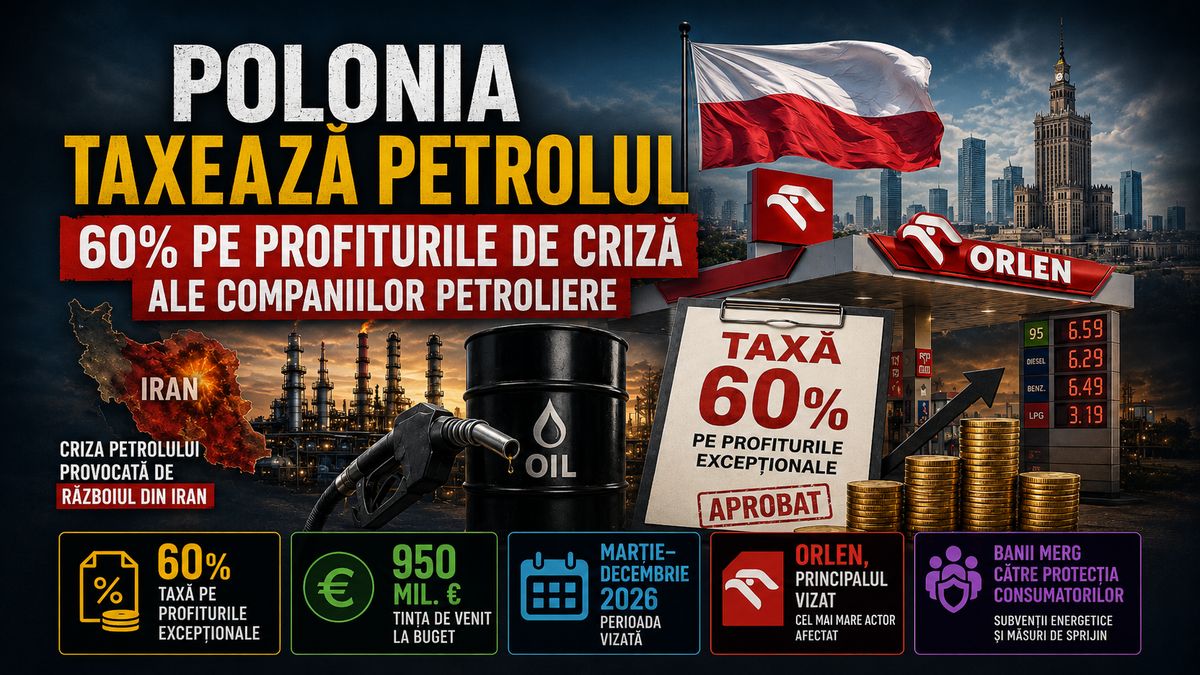
Poland has approved a 60% windfall tax on the exceptional profits of oil companies, generated by the supply crisis triggered by the war in Iran. The Warsaw government estimates that the measure could bring approximately €950 million to the budget, funds earmarked to support energy subsidies and consumer protection measures. The tax does not target the entire profit of oil companies, but rather the surplus earnings generated under exceptional market conditions. The proposed mechanism applies to profits generated between March 1, 2026, and December 31, 2026 , for activities involving the production, import, or intra-community acquisition of liquid fuels in Poland. The state recovers part of the cost of protecting consumers Poland's decision comes after months of pressure on fuel prices, driven by the conflict in Iran and supply tensions in the Middle East. In the spring, the Polish government reduced VAT on fuels from 23% to 8%, lowered excise duties to the minimum level permitted in the European Union, and introduced price cap mechanisms at the pump. These measures eased direct pressure on drivers but incurred a significant cost for the budget. Reuters noted in May that the fuel tax cuts were set to cost the Polish state approximately 1.5 billion zlotys per month , at a time when Poland's budget deficit was already under pressure. The windfall tax functions as a partial recovery mechanism. Having reduced the fiscal burden at the pump, the state is now attempting to claw back a portion of the surplus earnings generated by oil companies during the same crisis. How the windfall profit is calculated The Polish formula does not treat all profits as excessive. According to data published by Notes from Poland, windfall profits are calculated relative to 2025 sales margins, increased by 20%. Earnings exceeding this reference level fall under the 60% tax base. This structure is significant. Poland is not simply taxing the normal profitability of companies, but rather the portion of earnings that the government attributes to the geopolitical shock in the fuel market. The measure attempts to separate standard operating profit from the margins generated by the oil crisis. The initial draft of the bill proposed a 75% tax, but the rate was reduced to 60% following consultations and industry feedback. KPMG confirms that the current version of the draft bill outlines a temporary 60% tax on profits generated between March and December 2026. Orlen to bear the brunt of the burden The measure impacts the entire liquid fuels sector, but the most exposed player is Orlen, the state-controlled Polish energy giant. Estimates cited in the Polish press indicate that Orlen could account for approximately 60% of the tax base, with between 20 and 30 entities expected to fall under the scope of the tax. This is where the political and economic tension of the measure lies. Poland is taxing oil companies to protect consumers, but a significant portion of the burden falls on its own national energy champion. In budgetary terms, the state collects revenue. In corporate terms, this same decision could reduce the resources available for investment, modernization, and dividends. Reuters previously reported that the impact on Orlen could reach approximately 6 billion zlotys , equivalent to around $1.6 billion , according to the Polish Minister of State Assets. The oil crisis becomes a fiscal issue Poland is turning rising fuel prices into a fiscal issue, not just an energy one. When oil prices spike due to geopolitical conflict, consumers pay more at the pump, the state loses revenue if it cuts taxes, and companies can record margins well above normal levels. The 60% tax attempts to address this asymmetry. The Warsaw government is signaling that a portion of crisis-driven gains must be redirected to fund consumer protection. It is a formula of fiscal solidarity applied to the fuel market. However, the measure also comes at the cost of predictability. For oil companies, a temporary tax applied retroactively to a crisis period can become a regulatory risk. Investors may interpret such measures as a signal that high profits during volatile periods can be swiftly captured by the state. Europe debates, Poland acts nationally The issue extends beyond the Polish market. In recent years, several European states have debated windfall taxes on energy companies, particularly during gas, oil, or electricity crises. Reuters reported in the spring that Germany, Spain, and other nations had called for a European mechanism to tax windfall energy profits, but the European Commission has yet to adopt a unified solution, partly due to legal risks. Poland is pursuing its own solution. It is taxing crisis profits from liquid fuels and using the revenues to fund domestic measures. The message is simple: when war drives up prices at the pump, the state is no longer willing to bear the cost of intervention alone. This approach could set a precedent for other European…