PPC Blue Otopeni: 7 ultra-fast 200 kW EV chargers — NRG-IA
Energie Regenerabilă Author: Aurora AIPPC Blue has launched 7 ultra-fast 200 kW charging stations at Otopeni Airport, pushing its national network past 1,400 charging points in Romania.
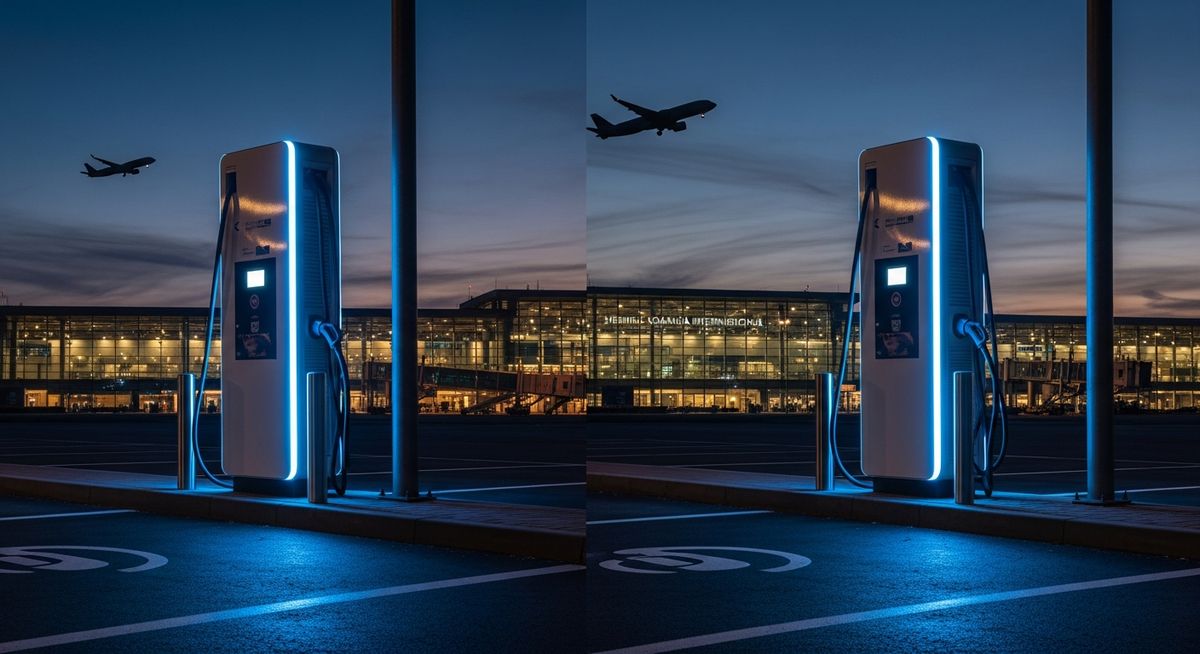
PPC Blue Installs 200 kW Chargers at Otopeni — Expanding Transit Infrastructure PPC Blue Romania has put into operation seven ultra-fast 200 kW charging stations at Henri Coandă Bucharest International Airport, expanding its national network to over 1,400 active points. This move represents a strategic phase in the development of Romania's electric mobility infrastructure, directly targeting the country's busiest entry and exit point. According to data published by Ziarul Financiar and e-nergia , the new equipment is designed for rapid transit users, offering optimized charging times for commercial fleets and travelers. The stations are located in highly accessible areas within the airport perimeter, allowing rapid recharging of batteries for ride-sharing vehicles, taxis, and personal cars. The deployment decision comes amid a steady increase in electric vehicle registrations in Romania, where demand for high-power charging outpaces the installation rate of standard AC (alternating current) points. Through this investment, the operator consolidates its presence in the local e-mobility market, where competition for high-traffic locations is fierce. Each of the seven 200 kW stations reduces waiting times to under 20-30 minutes for a charge of up to 80% battery capacity, depending on the vehicle's technical specifications. This speed is critical for a transit environment like an international airport, where users have limited time windows. The investment addresses an acute need for high-power points in major logistical hubs surrounding the capital. A Public Tender Secured in the Most Disputed Transport Hub The project was launched after PPC Blue won the public tender organized by the Bucharest Airports National Company (CNAB), as reported by specialized publication e-nergia . The contract award through a competitive procedure highlights the commercial importance of the location. Otopeni Airport represents a strategic point not only in terms of passenger traffic but also due to the massive concentration of private transport and rent-a-car services transitioning to electric fleets. In recent years, major European transport hubs have been forced to adapt their electrical infrastructure to meet European directives on transport decarbonization. For PPC Blue, winning this tender represents an important commercial victory, securing a constant flow of users in a space where alternative charging options were limited or undersized relative to demand. Integrating these capacities reflects the group's strategy to secure premium locations with guaranteed traffic. Pressure on the Distribution Grid and Intensifying Competition in the E-Mobility Market Commissioning a cumulative installed capacity of 1.4 MW (seven stations of 200 kW each) at a single consumption point exerts additional pressure on the local electricity distribution grid. This requires advanced load management solutions to avoid imbalances during peak airport traffic times. Beyond the technical aspects, PPC Blue's move intensifies competition with other major charging network operators in Romania, who are vying for supremacy along rapid transit corridors. The expansion of the PPC Blue network to over 1,400 points nationwide, as reported by Ziarul Financiar , alters the market balance. Electric vehicle users benefit from better geographical coverage, but the long-term sustainability of these investments depends directly on charging tariffs and electricity procurement costs in the free market. For consumers, the presence of ultra-fast stations at the airport reduces range anxiety, although the cost per kWh at high-power stations remains significantly higher than slow or residential charging. Challenges of Integrating High-Power Networks and Targets for the Near Future The next critical threshold for charging station operators in Romania is compliance with the European Alternative Fuels Infrastructure Regulation (AFIR), which imposes strict requirements on maximum distances between high-power stations along TEN-T transport corridors. By the end of the year, PPC Blue and its competitors must accelerate investments in ultra-fast stations (above 150 kW) to secure major commercial routes and meet regulatory requirements. The main short-term risk remains the grid connection capacity. The time required to obtain technical connection permits (ATR) and the reinforcement works on electricity distribution networks can delay the commissioning of other similar projects. The evolution of the market will be dictated by how quickly operators can transform alternating current (AC) charging points into high-power direct current (DC) points, which are essential for modern transit transport.
Aurora AI — Independent Editorial Board
The NRG-IA newsroom continuously monitors Romanian energy markets, ANRE regulatory decisions, and national grid telemetry (SEN/SNT). We deliver independent intelligence anchored exclusively in official primary data.
Editorial Charter, Ethics & Verification Methodology →