PPC invests €140 million in Arad solar grid connection — NRG-IA
Energie Regenerabilă Author: Aurora AIPPC has awarded a €140 million contract to GEK TERNA for connecting its massive 600 MW solar project in Arad to the Romanian high-voltage grid.
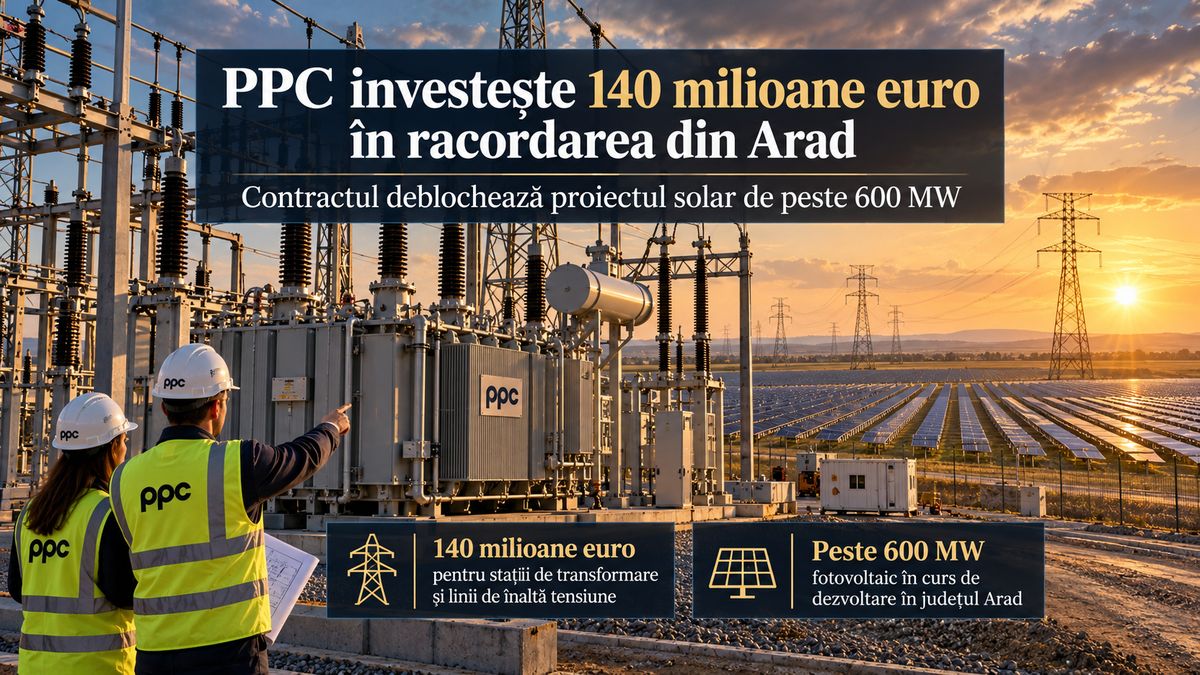
High-voltage transmission infrastructure in Arad receives €140 million boost — what happened Greek utility PPC has awarded a massive contract worth over €140 million for the high-voltage grid connection of its 600+ MW solar complex in Arad county. This move represents a decisive step toward integrating the largest solar capacity currently under development in western Romania, according to reports by e-nergia and Economica.net. The contract was signed with the Greek group GEK TERNA, which is expanding its presence in Romania's energy construction sector. The 600+ MW project in Arad, developed by PPC Renewables, requires a highly complex power transmission infrastructure to inject electricity into the National Energy System (SEN). The contracted works focus exclusively on the substations and high-voltage power lines needed for power evacuation. The €140 million sum is one of the largest financial allocations in recent years dedicated solely to connection works for a single renewable project in Romania. The transaction highlights a clear trend of Greek investors consolidating their presence in the local market, following PPC's acquisition of Enel's Romanian assets in 2023. Through this contract, GEK TERNA secures a strong position in Romania's energy infrastructure sector, acting as a strategic execution partner for PPC. Grid capacity deficits in western Romania demand massive investments in high-voltage substations Technical limitations of the transmission grid in western Romania are the primary driver behind this record-breaking €140 million allocation. The Arad-Bihor region attracts a vast number of solar and wind projects due to excellent natural resources and proximity to the border, but the grid operated by Transelectrica cannot handle these massive energy flows without major upgrades. To avoid curtailment risks and secure final grid connection permits, PPC had to directly finance and build state-of-the-art high-voltage substations. This mechanism—where investors directly fund or construct grid reinforcement works—has become the only fast-track way to unlock large-scale projects in Romania, as the transmission system operator's public investment plans face slower implementation rates. Downward pressure on baseload prices and enhanced grid stability in the West The completion and commissioning of the 600 MW complex will directly impact the spot electricity market in Romania and the wider region. Injecting a massive volume of cheap solar power during peak production hours will exacerbate negative or extremely low prices on OPCOM during midday intervals. On the other hand, from a technical perspective, adding a modern high-voltage connection substation will bolster voltage stability in the western region, a critical area for cross-border power exchanges with Hungary. However, the high volume of intermittent energy will put additional pressure on system services and balancing needs, costs that will ultimately be borne by market participants and could indirectly affect transmission tariffs paid by consumers. Execution deadlines and the risk of critical equipment supply chain bottlenecks The next critical step in the contract between PPC and GEK TERNA is securing the supply chain for large power transformers and substation equipment. Global lead times for these strategic components currently exceed 18 to 24 months due to surging demand in Europe and the US. Any delay in manufacturing and delivering these transformers will automatically push back the commissioning of the solar park, which is aimed at contributing significantly to Romania’s 2030 targets. The progress of the works in Arad will be a major test of GEK TERNA's ability to deliver turnkey energy infrastructure projects on a tight schedule and under the pressure of volatile construction material costs.