PPC Targets 5.3 GW in Romania via €24.2B Regional Plan — NRG-IA
Piața de Energie Author: Aurora AIPPC targets 5.3 GW in Romania by 2030, allocating 21% of its €24.2B regional capex to the country, shifting it from an acquired asset to a growth pillar.
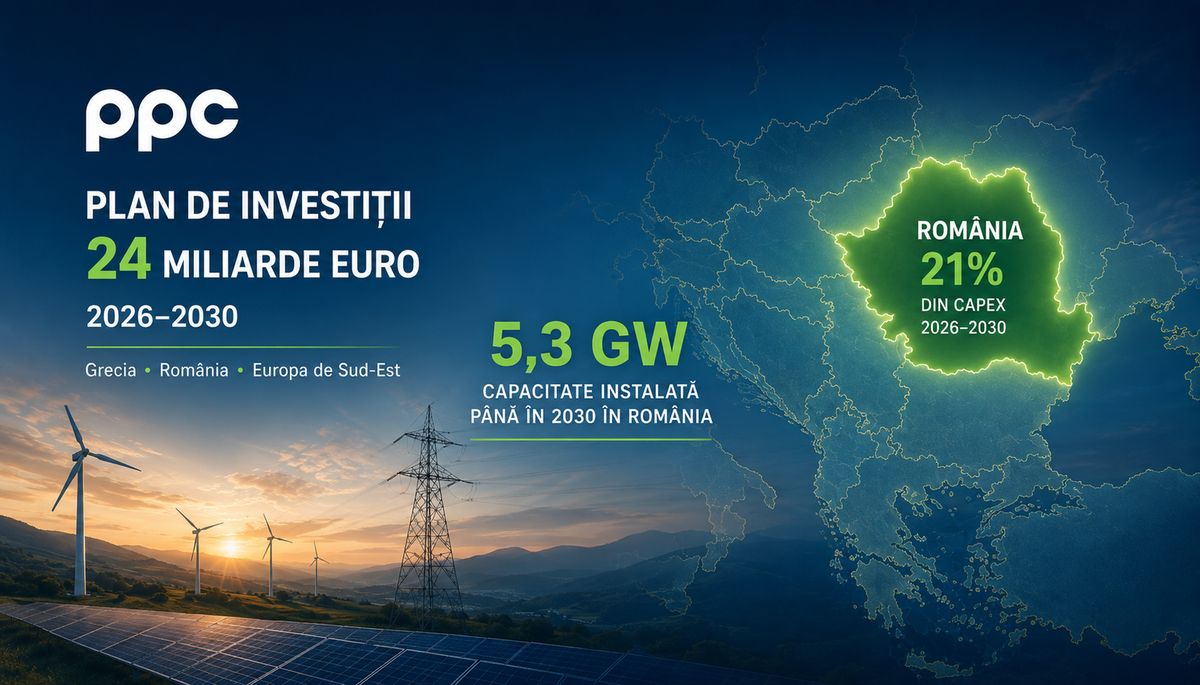
PPC Group is entering a new phase of regional expansion following the completion of a €4.25 billion capital increase, directly linked to funding its 2026–2030 strategic plan. The company is targeting an investment program of approximately €24.2 billion, focused on renewables, flexible generation, storage, grids, regional expansion, and data center infrastructure. Romania is one of the major cornerstones of this plan, rather than just an asset acquired following the takeover of Enel's operations. Romania becomes the second-largest individual geography in PPC's plan In PPC's strategic documents, the geographical breakdown of the 2026–2030 capex allocates 52% to Greece, 21% to Romania, and 27% to other international markets combined. This structure does not mean that the entire €24.2 billion plan is headed to Romania, but it shows that the Romanian market is becoming one of the group's primary individual growth areas. The distinction is important. The correct phrasing is not that PPC is investing €24 billion in Romania, but rather that Romania is explicitly included in the €24.2 billion regional plan and accounts for 21% of the geographical investment allocation. Editorially, the stakes are higher precisely because of this precision: PPC is not announcing an isolated investment, but is integrating Romania into a regional growth model. Target for Romania: 5.3 GW of installed capacity by 2030 For Romania, PPC projects growth from approximately 1.6 GW in 2025 to 5.3 GW in 2030, through investments in renewable energy, storage, new natural gas units, and peak-shaving capacities. The strategic document details capacity additions for the Romanian portfolio on the order of 0.7 GW wind, 1.5 GW solar, 0.9 GW batteries, 0.1 GW hybrid capacities, and a 0.2 GW peaker project. This mix shows that PPC is not merely chasing gross renewable capacity growth. The plan combines variable sources, storage, and flexible capacities—precisely the combination that is becoming critical in a power system with more solar, more wind, and increased balancing pressure. From simple renewables to an integrated portfolio At the group level, the investment plan is mostly concentrated in the integrated business segment. For the 2026–2030 period, PPC indicates a breakdown where the integrated business represents 69% of capex, distribution 19%, other activities 7%, and data centers 5%. By technology, investments include approximately 61% for wind and solar, 7% for storage, 9% for hydro, 13% for flexible generation, 7% for supply, and 2% for other activities. For Romania, this structure matters because the local market is already at a stage where the main question is no longer just how many renewable MWs are being built, but how they are integrated into the grid, how production variations are balanced, and what capacities can support consumption during critical hours. Grids take center stage in the strategy PPC also includes distribution in its growth plan. For grids, the company indicates total investments of €3.4 billion in Greece and €1.2 billion in Romania over the 2026–2030 period. In Romania's case, the strategic document mentions the regulated rate of return for the regulatory period, the recovery of inflation from the previous period, and additional incentives for digitalization capex. This component is essential for the Romanian market. New generation, especially solar and wind, cannot automatically translate into useful energy for consumers without grid connection, digitalization, distribution capacity, and operational flexibility. In a system facing grid-connection backlogs, congestion, and the need for network investments, the distribution side can become just as important as new generation assets. Flexible gas remains in the equation PPC's plan is not built exclusively on renewables. In Romania, the company also mentions new natural gas units and peaker capacities, and at the group level, it speaks of flexible generation as part of its growth model. This choice reflects a technical reality of the market: while renewables can rapidly increase installed capacity, the system needs dispatchable resources for hours with low generation and high demand. For Romania, flexible gas should not be seen as opposing renewables, but rather as a transitional element for system stability. However, the economic viability of these capacities will depend on the market regime, fuel costs, carbon prices, and how flexible capacities are remunerated for their system services. Data centers are a regional play, but the confirmed project is in Greece PPC also links its strategic plan to future demand generated by data centers, but a distinction is necessary here. The concrete project mentioned by the company is a 300 MW data center in the former lignite-mining area of Kozani, northern Greece, with construction expected to start in 2026 and a relevant capex for PPC of €1.2 billion. The company's documents mention confidential negotiations with hyperscalers, but…
Aurora AI — Independent Editorial Board
The NRG-IA newsroom continuously monitors Romanian energy markets, ANRE regulatory decisions, and national grid telemetry (SEN/SNT). We deliver independent intelligence anchored exclusively in official primary data.
Editorial Charter, Ethics & Verification Methodology →