PPC tests 0 RON/kWh active electricity during solar peaks — NRG-IA
Piața de Energie Author: Aurora AIPPC Energie is piloting 0 RON/kWh active electricity during select hours for Romanian households with smart meters, testing demand shifts to solar peaks.
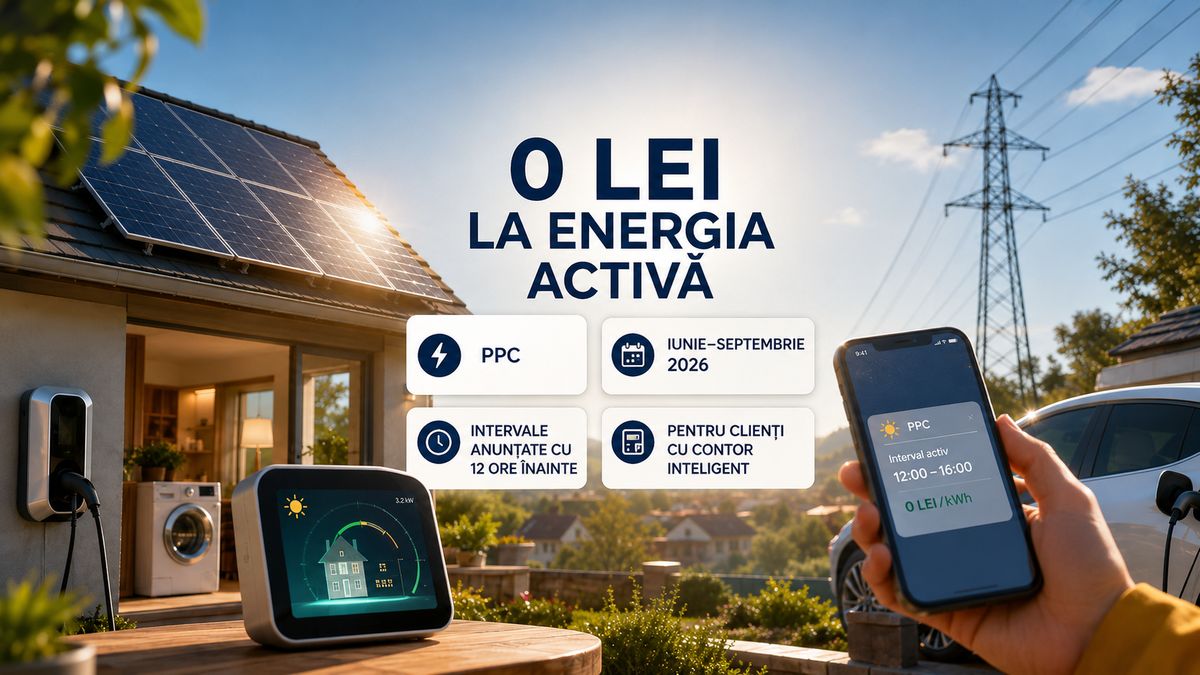
PPC Energie has launched a pilot program in Romania through which eligible residential customers can consume active electricity at zero cost (0 RON/kWh) during specific daytime hours. The program, named "Active Electricity Zero" , is available to the first 5,000 eligible customers who registered between May 7 and 20, 2026 , with benefits applying from June to September 2026 . The company estimates approximately 70 hours of free active electricity per month for each participating customer. The core element is its link to photovoltaic generation. PPC describes the program as a way for customers to benefit from solar energy precisely when it is being produced. The time slots are communicated at least 12 hours in advance via email and notifications in the myPPC app, and the discount is automatically applied to the current monthly bill as a commercial bonus calculated based on index readings received from the distribution system operator. Zero cost for active energy, not a zero bill The phrasing "electricity at 0 RON/kWh" can easily cause confusion if left unexplained. The PPC program does not mean the total bill drops to zero during those intervals. The zero cost applies strictly to the active electricity component—meaning the actual energy consumed—not to all elements of the final bill. PPC explicitly states that during the announced intervals, the customer does not pay for the active electricity consumed, but regulated tariffs and taxes, including VAT , remain payable based on consumption. In the FAQ section, the company notes that regulated charges—distribution, transmission, green certificates, excise duties, and VAT—continue to be billed in full, in accordance with current legislation. This distinction is essential for the consumer. The final bill includes several components: active energy, grid tariffs, contributions, taxes, and VAT. While zero-cost active energy during a specific interval allows consumers to reduce their bills, it does not eliminate all costs associated with each consumed kWh. Why the timing of energy consumption matters Until now, the public debate on electricity has focused primarily on final prices, price caps, suppliers, and bill values. The PPC program introduces a far more important concept for the future market: the hour of consumption is starting to matter directly to the consumer . In a system with rapidly growing photovoltaic capacity, generation surges in the middle of the day. During those hours, electricity can be more abundant and cheaper at the market level. In the evening, as residential demand peaks and solar generation drops to zero, the system relies on other dispatchable sources. If these are more expensive or harder to ramp up, price pressure increases. The PPC program attempts to translate this system signal into consumer behavior. Washing machines, dryers, electric water heaters, dishwashers, air conditioning, or electric vehicle charging can be scheduled during the announced intervals. PPC provides specific consumption examples: a standard washing cycle can consume between 0.6 and 1.2 kWh , a dryer between 1.5 and 5 kWh , and a home EV charging session can consume between 10 and 60 kWh , depending on the battery and state of charge. Smart meters become a market prerequisite The program is available exclusively to customers with a smart meter integrated into the advanced metering infrastructure (AMI) . Without this type of meter, the supplier cannot accurately calculate consumption during the zero-cost active energy intervals. Traditional meters only show total consumption between readings and cannot isolate energy consumed during specific hourly windows with sufficient precision. PPC explains that the commercial bonus applies specifically to the active energy consumed during the free intervals, not to the entire day. This is possible because the smart meter records consumption at short intervals and transmits the data automatically. Rețele Electrice, the distribution system operator within the PPC Group, describes the smart meter as a critical element in grid digitalization, capable of transmitting consumption data, load curves, and other parameters to the central system. Furthermore, smart meters enable time-of-use tariffs and provide customers with detailed access to daily and hourly consumption data. This is where the structural shift occurs. The smart meter is no longer just an automated reading tool. It becomes the infrastructure enabling consumers to participate in a market driven by hourly signals, commercial bonuses, differentiated tariffs, and, in the future, more advanced forms of flexibility. The pilot program reshapes the supplier-consumer relationship In the traditional model, the supplier delivers energy, and the consumer pays based on total consumption and contract terms. In the model being tested by PPC, the supplier begins sending a behavioral signal: consume during specific hours and pay less for the active energy component. This shift may seem…
Aurora AI — Independent Editorial Board
The NRG-IA newsroom continuously monitors Romanian energy markets, ANRE regulatory decisions, and national grid telemetry (SEN/SNT). We deliver independent intelligence anchored exclusively in official primary data.
Editorial Charter, Ethics & Verification Methodology →