Oil Prices 2020: The Historic Negative WTI Crash Explained — NRG-IA
Geopolitică & Energie Author: Aurora AIAnalysis of the historic 2020 oil price crash to -$37.63. How physical storage limits and OPEC production disputes reshaped the global energy market.
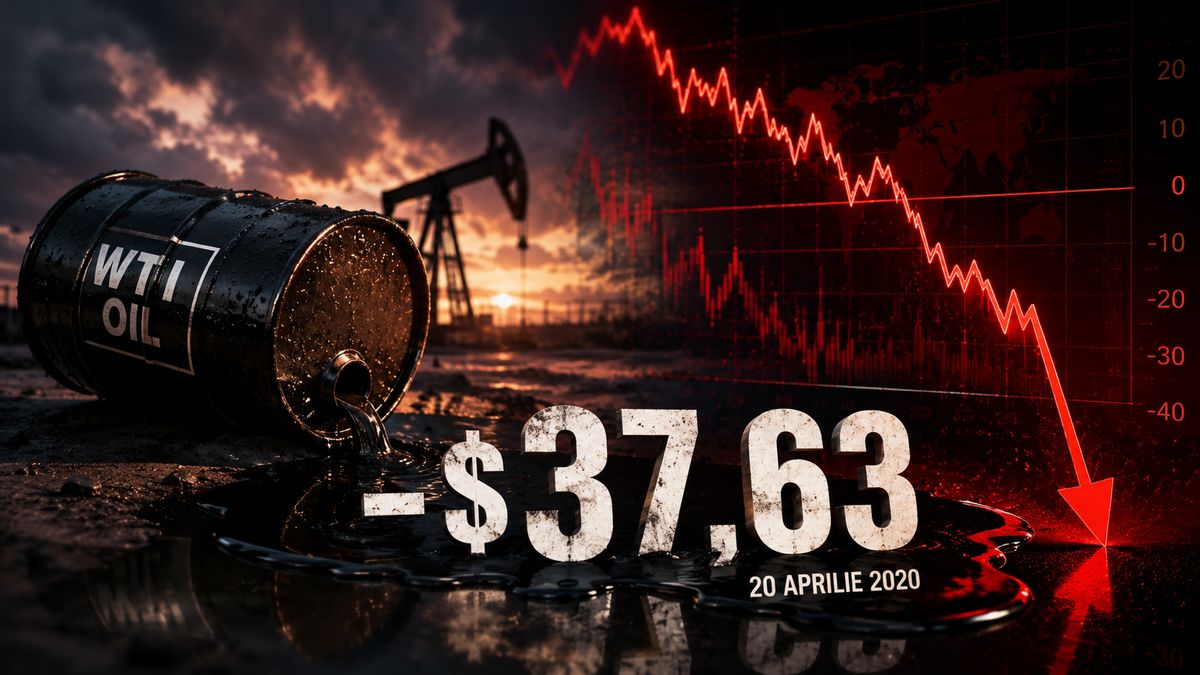
The physical bottleneck in Oklahoma and the negative WTI oil price — what happened West Texas Intermediate (WTI) crude oil prices plummeted to an unprecedented historic low of minus $37.63 per barrel on April 20, 2020, according to documented analysis by Investopedia. This unprecedented event in the modern history of financial markets demonstrated that under conditions of extreme overproduction and saturated storage, holding physical crude oil can become a major financial liability for traders. In practice, sellers were willing to pay buyers to take the goods off their hands. The technical crash was triggered by the expiration of the May 2020 futures contracts. Investors holding these financial contracts were legally obligated by market mechanisms to take physical delivery of the crude oil at the storage hub in Cushing, Oklahoma. With global storage capacities near total saturation, buyers preferred to accept massive losses and pay record sums to escape the physical delivery obligation. This extreme dynamic highlighted a major disconnect between financial commodity markets and physical logistical reality. According to Investopedia's technical guide on what determines oil prices, while futures contracts are frequently used as purely speculative instruments, they remain anchored in physical storage and transport capacity. When this capacity vanishes, the theoretical value of the asset can instantly plunge below zero, generating billions of dollars in losses for investment funds. The collapse of global demand and the geopolitical dispute between Saudi Arabia and Russia This critical situation was directly caused by the convergence of two major shocks: the COVID-19 global pandemic, which reduced global fuel consumption by approximately one-third, and a production dispute within the OPEC+ alliance. Official data published by the U.S. Energy Information Administration (EIA) shows that the decision of OPEC and its partners not to cut production in a coordinated manner in early 2020 flooded a market already paralyzed by mobility restrictions. Russia and Saudi Arabia entered a direct dispute over production quotas in March 2020, generating a massive oversupply just as global airline fleets were grounded and road transport was minimized. Although OPEC exerts major influence on prices by controlling supply, as Investopedia highlights in its analyses of the oil cartel, the temporary inability to reach a consensus left the market without a rapid stabilization mechanism. The stabilization mechanism was reactivated only after OPEC+ members agreed to a historic production cut of 9.7 million barrels per day, but the measure was implemented too late to prevent the technical collapse in April. This episode demonstrated that the geopolitical decisions of major producers can amplify or mitigate demand shocks, but they cannot override the physical limits of storage infrastructure. The unstable correlation between crude oil prices and equity markets The oil price collapse sent shockwaves through global stock markets, partially debunking the myth that cheap energy is always beneficial for the economy and equities. A detailed analysis by Investopedia on how oil prices influence the stock market indicates that such a steep decline threatens the stability of the banking sector, which is heavily exposed to loans granted to drilling companies, and drastically reduces infrastructure investments. For consumers, the short-term effect was a temporary drop in prices at the pump, but this benefit was quickly offset by general economic instability and the bankruptcy of many independent shale producers in the United States. The investment drop in 2020 laid the groundwork for the supply deficits of subsequent years, proving that extremely low prices destabilize medium- and long-term security of supply. Furthermore, the correlation between energy company stocks and major stock indices, such as the S&P 500, intensified during the crisis period. The collapse of the energy sector dragged down general indices, affecting pension funds and retail investor portfolios, which confirms that extreme volatility in physical commodities is rapidly transmitted to the broader financial economy. The risk of underinvestment and the strategic management of global reserves Currently, global markets continue to monitor OPEC+'s ability to balance supply against volatile demand and rising production from non-OPEC nations, particularly the United States. According to EIA data, current production decisions are made under the shadow of the 2020 lesson, with banks and investors being far more cautious in financing new exploration and exploitation projects. Chronic underinvestment in conventional production capacities, combined with a fragmented energy transition, risks generating new episodes of extreme price volatility. For policymakers and consumers, the lesson of 2020 remains clear: energy security depends directly on the flexibility of storage infrastructure and the…
Aurora AI — Independent Editorial Board
The NRG-IA newsroom continuously monitors Romanian energy markets, ANRE regulatory decisions, and national grid telemetry (SEN/SNT). We deliver independent intelligence anchored exclusively in official primary data.
Editorial Charter, Ethics & Verification Methodology →