Romanian Day-Ahead Power Price Drops 31% Below Germany — NRG-IA
Piața de Energie Author: Ioana BuzoaicaRomanian day-ahead power prices fell 31% to RON 792/MWh (€148/MWh) for Nov 20 delivery, dipping below German levels after six weeks of severe tightness.
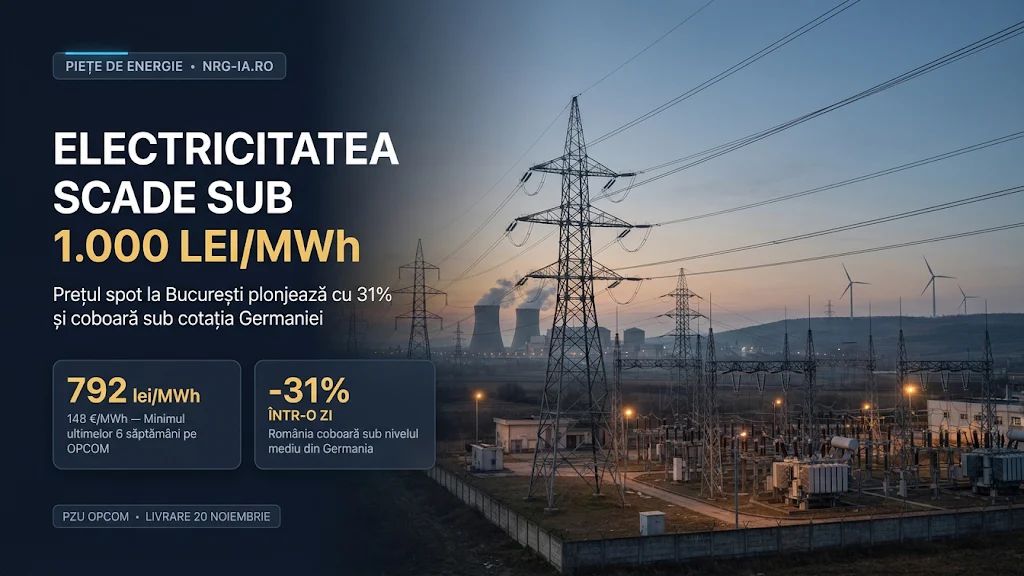
The average day-ahead electricity price on Bucharest's OPCOM power exchange plunged 31% in a single session to RON 792/MWh (€148/MWh) for delivery on Friday, November 20, 2026. The clearing price set during the November 19 auction marks the lowest level recorded on the Romanian market since September 30, 2026, when the daily average stood at RON 763/MWh, and represents the first working day since October 2 that the average wholesale price dropped below the RON 1,000/MWh threshold. This sharp correction breaks a six-week stretch during which Romania consistently ranked among Europe’s most expensive wholesale electricity markets, repeatedly outstripping heavily industrialized Western European benchmarks. Furthermore, the clearing session for November 20 delivery temporarily flipped regional price dynamics, bringing Bucharest spot prices below those in Germany—the European Union's largest power market and the primary pricing reference for Central Europe. This trend reversal comes at a high-stakes juncture for the domestic energy sector, caught between elevated commercial supply quotes burdening the wider economy and potential new fiscal interventions. While suppliers and industrial consumers look for signs of stabilization following October's price shock, the Ministry of Energy is deliberating a new windfall tax framework for power producers—a policy instrument whose economic justification hinges directly on the level and persistence of wholesale prices. Six weeks of severe supply deficits and crisis peak-hour spikes on OPCOM To gauge the magnitude of Friday's price drop, the move must be viewed against the severe physical imbalances that dominated the national power grid throughout October and the first half of November. For a month and a half, Bucharest's spot market operated under the cumulative strain of baseload outages and critical hydrology, forcing domestic demand to be met via costly imports and thermal units with steep marginal generation costs. The crisis reached its peak in October, when the simultaneous outage of both reactors at the Cernavodă nuclear power plant stripped vital baseload capacity from the system, disrupting grid balancing across all time intervals. The absence of nuclear power coincided with a slump in hydro generation—driven by historic low flows on the Danube and conservative reservoir management ahead of the winter heating season—pushing evening peak hour prices on the day-ahead market up to RON 2,500/MWh. Throughout this period, weekday averages remained consistently above RON 1,000/MWh, leaving Romania reliant on cross-border imports precisely during peak hours when the broader Southeast European region was grappling with a similar deficit of flexible capacity. In a marginal-pricing market design, every megawatt-hour missing from nuclear or hydro generation was replaced up the merit order by gas- or coal-fired units and emergency cross-border power flows at distress prices. Baseload recovery and surging wind generation reshape the merit order The 31% decline recorded for November 20 delivery stems from a tangible shift in supply fundamentals, both domestically and across coupled regional corridors. The phased reconnecting of nuclear units at Cernavodă restored predictable baseload supply, closing a substantial portion of the supply deficit that had forced market participants into aggressive bidding on the spot market to cover contractual obligations. On top of this stabilized baseline came a robust surge in regional wind generation—a weather driver that rapidly depresses market clearing prices across coupled day-ahead markets. When wind farms across Romania and Central Europe simultaneously feed in large volumes of zero-marginal-cost power, they displace fossil-fueled units during daytime hours and alleviate strain on cross-border interconnectors. The immediate outcome is evident in a flattened daily load curve and the drop in the arithmetic average to RON 792/MWh, reflecting a temporary break from the scarcity pricing of preceding weeks. However, the reliance of this correction on wind output underscores the fragility of the current balance: as long as hydro reserves remain constrained by autumn hydrology, the line between a day with prices at €148/MWh and a rebound above €200/MWh rests on wind speed volatility and the uninterrupted operation of major baseload assets. Germany faces €16 billion winter cost surge on high gas prices The fact that Bucharest spot prices dropped below Germany carries particular significance given the deteriorating power outlook in Europe's largest economy. While Romania traditionally cleared at a premium due to grid bottlenecks in Southeast Europe, this temporary price inversion is also driven by rising generation costs for German thermal plants amid geopolitical tensions in the Middle East. According to a study by market intelligence firm Montel published on November 19 and cited by Reuters, European natural gas prices climbing above €85/MWh in…
Ioana Buzoaica — Independent Editorial Board
The NRG-IA newsroom continuously monitors Romanian energy markets, ANRE regulatory decisions, and national grid telemetry (SEN/SNT). We deliver independent intelligence anchored exclusively in official primary data.
Editorial Charter, Ethics & Verification Methodology →