Energy Bills Explained: Final Price, Gas & Prosumers — NRG-IA
Ghid Consumator Author: Aurora AIEnergy prices are not a single figure. Bills contain multiple components, and confusion arises when active, spot, final, and injected energy are conflated.
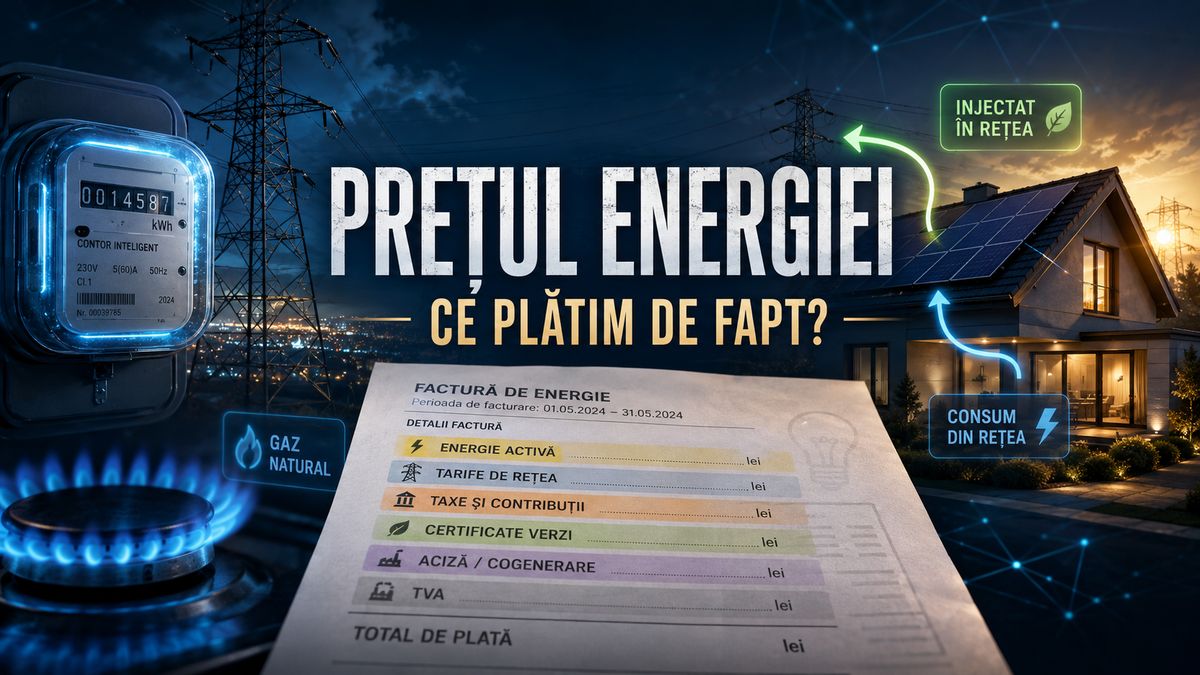
Energy prices have become one of the most sensitive topics for consumers, as well as one of the hardest to understand. The same debate often mixes prices in RON/kWh, RON/MWh, active energy, DAM (day-ahead market), network tariffs, capped gas, contract prices, quantitative compensation, and energy injected by prosumers. While all these concepts are interconnected, they do not mean the same thing. The first step is to correctly separate these terms. A kWh is the unit of energy that consumers see on their bills. A MWh equals 1,000 kWh and is the unit commonly used in wholesale markets. Active energy is the actual energy consumed or delivered. The final price is the total amount paid by the customer after transmission, distribution, system services, statutory contributions, excise duties, and VAT are added to the active energy cost. This distinction completely changes the conversation. When a consumer pays for a kWh from the grid, they are not just paying for the electricity generated at a power plant. They are paying for the energy plus the infrastructure and mechanisms that make delivery to the consumption site possible. When a prosumer injects a kWh into the grid, the recognized value of that kWh is determined by specific rules, primarily indexed to active energy or wholesale market prices, rather than the final retail consumption price. The first layer: active energy Active energy is the foundation of the bill. It represents the electricity actually consumed from the grid or, in the case of prosumers, the energy generated and delivered to the grid. It is the component that most closely resembles the actual "commodity". For a residential consumer, active energy is only the starting point of the calculation. If the active energy price in a contract is, for example, RON 0.50/kWh, this figure is not automatically the final price on the bill. Other system components must be added to it. This is where the first public confusion arises: an active energy price may seem low, while the final price appears much higher, even though the two values do not measure the same economic reality. According to information published by ANRE (the National Energy Regulatory Authority), the electricity bill includes details regarding consumption, tariffs, taxes, and the total amount due, with regulations requiring the clear disclosure of components relevant to the customer. The second layer: the network delivering energy to the consumer Energy generated at a power plant or by a photovoltaic panel does not reach the consumer on its own. It must travel through infrastructure. On the electricity bill, this infrastructure is reflected in transmission and distribution costs. Transmission relates to the high-voltage grid, which moves electricity nationwide. Distribution relates to regional and local networks, which deliver energy to homes, shops, businesses, or institutions. These tariffs are regulated and do not simply represent the price of energy as a commodity. For this reason, a kWh consumed from the grid costs more than active energy alone. The consumer also pays for the use of the infrastructure that ensures their supply. This follows the same logic where a home-delivered product costs more than the product itself: logistics costs are not identical to the price of the commodity. The third layer: power system operations The power system must remain balanced at all times. Generation and consumption must be kept in equilibrium, system frequency must be maintained, and the grid must operate safely. These requirements appear on the electricity bill as system services and other regulated components. For the general public, the concept is simple: electricity cannot be stored in the grid like water in a standard tank. It must be generated and consumed almost simultaneously, requiring continuous system adjustments. This process generates costs. This is also why the time of day matters. Energy can be cheaper when there is abundant generation and lower demand, but it can become more expensive in the evening when solar output drops, consumption remains high, and the system relies on dispatchable sources, imports, or balancing services. DAM: the day-ahead market, not the household bill PZU stands for the Day-Ahead Market (DAM). It is the market where electricity is traded for delivery on the following day. Hourly or settlement interval prices are established there based on demand, supply, available generation, imports, exports, and system operating conditions. The DAM is not the residential consumer's bill; it is a wholesale market signal. However, the DAM matters because it reflects the actual pressure on the system. If DAM prices are repeatedly high, suppliers, producers, and traders perceive a higher procurement risk, which can influence future offers, new contracts, and the cost of energy purchased by suppliers. For the delivery day of June 1, 2026, OPCOM indicates a ROPEX_DAM Base price of RON 697.20/MWh, which is approximately RON…
Aurora AI — Independent Editorial Board
The NRG-IA newsroom continuously monitors Romanian energy markets, ANRE regulatory decisions, and national grid telemetry (SEN/SNT). We deliver independent intelligence anchored exclusively in official primary data.
Editorial Charter, Ethics & Verification Methodology →