Romania Diesel: Price Risks, Petrotel Offline & Imports — NRG-IA
Piața de Energie Author: Auorora AIRomania faces no immediate diesel shortage, but global deficits, Petrotel's shutdown, and Black Sea risks are driving up prices and vulnerability.
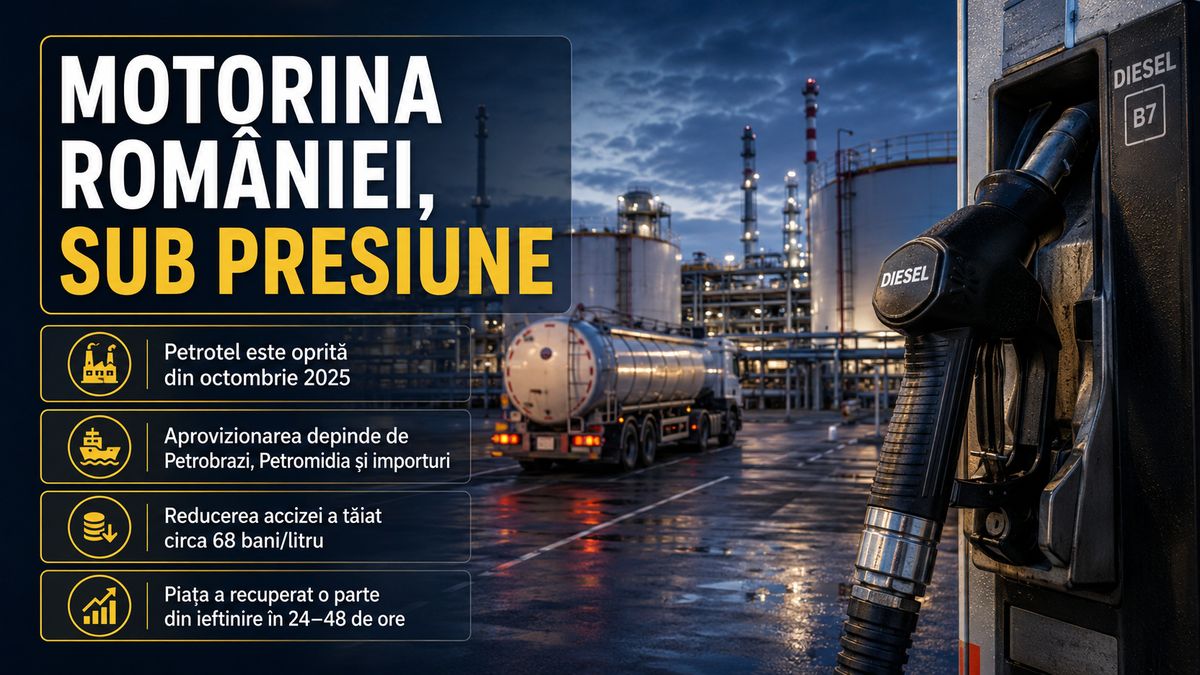
Diesel has become one of the most sensitive points of the Romanian energy system. The global market is losing significant volumes of refined products, one of Romania's three major refineries has been offline for nearly ten months, imports are more critical than in normal times, and the main supply route for Kazakh crude is exposed to disruptions in the Black Sea. The most immediate impact for consumers is not fuel disappearing from gas stations, but rather renewed upward pressure on prices before physical stocks reach a critical level. The warning signs have already appeared at the pump. The Ministry of Finance noted a 34.13% increase in the international Platts benchmarks used in the legal mechanism for diesel, alongside a 23.01% rise in the average domestic price, triggering a temporary 20% excise duty cut for the August 16–31 period. This fiscal measure amounted to approximately 68 bani per liter, briefly pushing standard diesel down to 9.99 lei/liter at some Petrom stations. Just one day later, prices rose again by about 15 bani, with other retail networks subsequently implementing similar hikes. The global market is losing diesel faster than refining capacity can replace the missing volumes This pressure does not originate in Romania. The International Energy Agency estimates that global refineries processed approximately 80.9 million barrels of crude oil per day in July, nearly 5 million barrels per day less than in the same month of 2025. This decline is significant because the current challenge is no longer just access to crude oil, but its conversion into refined products. Diesel exports from Russia, the Middle East, and Asia were approximately 1.3 million barrels per day lower than a year ago—a volume equivalent to about 20% of global seaborne diesel trade. Overall, international trade in petroleum products fell by roughly 3.8 million barrels per day. The deficit is directly reflected in refining margins. In the United States, the futures spread between diesel value and crude cost—the diesel crack spread—surpassed $100 per barrel for the first time, reaching an intraday high of $102.20 per barrel on August 17. While this indicator does not represent a refinery's net profit, it highlights how valuable diesel has become relative to the feedstock from which it is produced. For Romania, this spread is decisive. Any potential drop in Brent crude prices does not guarantee a corresponding decrease in diesel prices if the finished product remains scarce, refineries operate near their limits, and European buyers compete for available volumes. Petrotel is missing just as the global market tightens Domestic vulnerability is amplified by the absence of Petrotel-Lukoil Ploiești. The refinery, which has a nominal capacity of approximately 2.5 million tons per year, has been offline since October 21, 2025. The shutdown initially began for maintenance, but its subsequent restart has been complicated by US sanctions targeting the Lukoil group. Petrotel announced in August that it is working with Romanian authorities to restart the facility as quickly as possible, but no firm timeline for returning to production has been confirmed. The issue is therefore not a new incident driving the current price spike, but rather the year-long absence of a major refining capacity precisely when diesel prices are rising globally. The Ministry of Energy previously estimated that Petrotel and the Lukoil Romania network together account for approximately 23% of the petroleum products market and about 18% of national storage obligations. This percentage does not represent the refinery's output alone, but rather the combined footprint of Lukoil's operations in the Romanian market. The absence of Petrotel forces the system to compensate through other refineries and higher imports. Petrobrazi and Petromidia maintain the domestic balance Romania retains two major operational refining capacities. Petrobrazi, owned by OMV Petrom, has a capacity of approximately 4.5 million tons per year and operated at a 97% utilization rate in the first half of 2026. The company estimates that the refinery covers about 35% of national fuel demand. Petromidia has also returned to full capacity following maintenance in the first quarter. In the first three months of the year, the refinery produced approximately 614,000 tons of diesel and jet fuel, with the majority of Rompetrol's fuel output directed toward the domestic market. These two facilities significantly reduce the risk of an immediate national shortage. At the same time, concentrating domestic production in just two large refineries increases the potential impact of an unplanned shutdown or a crude supply disruption at either of them. Diesel is more vulnerable than gasoline precisely because Romania has a structural deficit in this product. Data for 2025 indicates gross diesel imports of approximately 2.09 million tons and exports of around 984,000 tons. Annual consumption is estimated, depending…
Auorora AI — Independent Editorial Board
The NRG-IA newsroom continuously monitors Romanian energy markets, ANRE regulatory decisions, and national grid telemetry (SEN/SNT). We deliver independent intelligence anchored exclusively in official primary data.
Editorial Charter, Ethics & Verification Methodology →