Oil Drops on US-Iran Deal: Brent, Hormuz & Romania Fuel Impact — NRG-IA
Geopolitică & Energie Author: Ioana BuzoaicaOil fell sharply after the US-Iran deal to reopen the Strait of Hormuz. The impact on Romanian pump prices depends on FX, taxes, and market confidence.
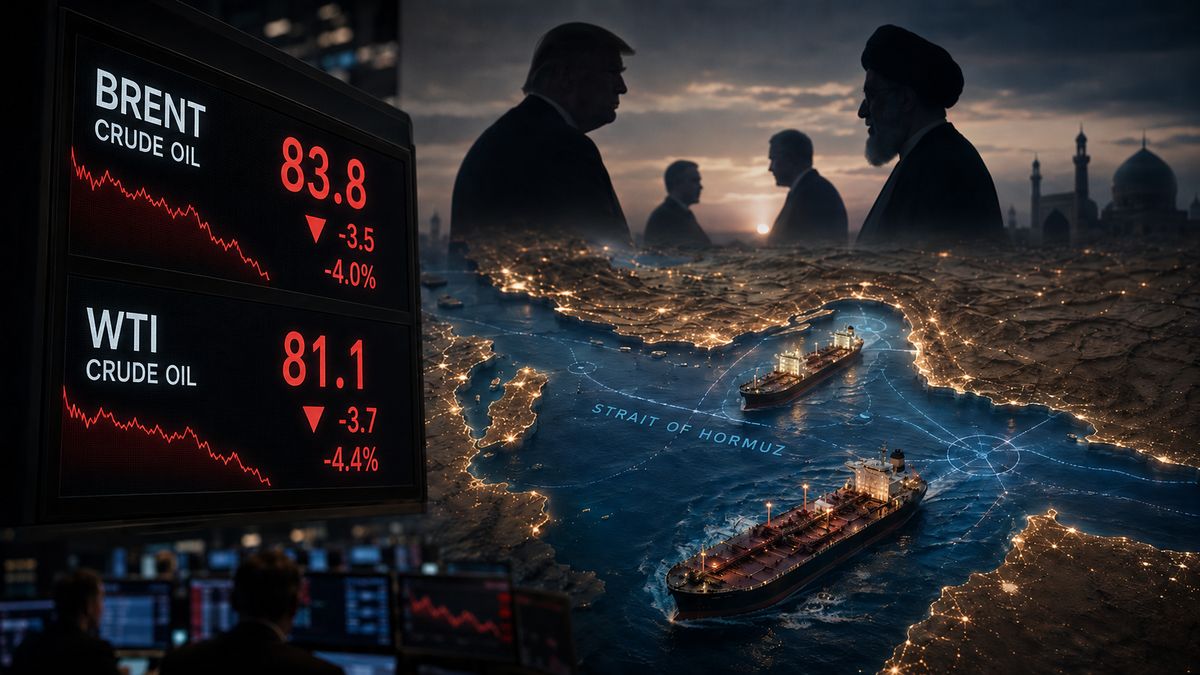
Oil reacted immediately to the preliminary agreement between the United States and Iran. Brent fell to around $83.75/barrel , and WTI to approximately $80.87/barrel , following a drop of over 4% for Brent and nearly 5% for US crude. Both benchmarks hit their lowest levels since March, according to Reuters. The move signals a rapid shift in trader sentiment. In recent months, oil prices have priced in a risk premium associated with conflict, shipping blockades, export restrictions, and uncertainty surrounding the Strait of Hormuz. The announced agreement reduces the likelihood of an immediate supply shock, and the market is adjusting prices before physical flows fully recover. Brent falls as the market sheds its risk premium Oil pricing is shaped by two major layers: supply-demand fundamentals and risk. Fundamentals reflect how much oil is produced, transported, refined, and consumed. Risk reflects how likely these flows are to be disrupted. In this case, the decline does not stem from a sudden surge in global production or an instantaneous collapse in demand. It comes from a reduced risk of the Strait of Hormuz remaining closed or severely restricted for an extended period. The preliminary agreement is expected to be formalized in Switzerland, with the reopening of the Strait of Hormuz targeted within a 30-day window. In parallel, a 60-day period is slated for broader negotiations regarding the Iranian nuclear file and sanctions. This framework explains the market's reaction. Traders received a de-escalation signal, but they also received a conditional timeline. Oil is falling because the probability of a prolonged blockade has decreased. Prices are not collapsing because the agreement must still be signed, implemented, and translated into secure maritime flows. Hormuz remains the maritime pipeline of global oil The Strait of Hormuz holds an irreplaceable position in the global energy architecture. EIA data shows that in the first half of 2025, an average of 20.9 million barrels per day passed through this route, equivalent to approximately 20% of global petroleum liquids consumption and about a quarter of the world's seaborne oil. This figure explains why the market reacts so strongly to any news regarding Hormuz. We are not talking about a marginal route or an isolated regional incident. We are talking about one of the main arteries of the global energy system. Oil from nations such as Saudi Arabia, Iraq, Kuwait, the United Arab Emirates, Qatar, and Iran flows through Hormuz. A serious disruption impacts Asian refineries, flows to Europe, shipping costs, insurance premiums, commercial inventories, and price expectations. Even when physical volumes can be partially rerouted, the cost of bypass and logistical risk are priced in. The US-Iran agreement eases pressure but does not instantly erase the market's memory. Shippers, insurers, traders, and refineries are gradually returning to a route that has just demonstrated how quickly it can become vulnerable. Reuters notes that while the agreement offers genuine relief for oil and LNG markets, it leaves open risks related to implementation, the Iranian nuclear file, and regional security. Today's decline does not mean complete normalization The oil market reacts ahead of the real economy. Futures contracts move in seconds. Ships, insurance, terminals, loading schedules, and refineries move in days, weeks, or months. Therefore, Brent's decline toward $84/barrel should be read as an adjustment of expectations, not as confirmation of a full recovery. Flows must resume, vessels must transit safely, military risk must decrease operationally, and buyers must accept that the route can be used without excessive additional costs. Reuters indicates that Gulf producing states, including Saudi Arabia and the United Arab Emirates, have already adapted a portion of their exports through alternative routes, and shipping behavior will remain cautious due to security and insurance risks. The full resumption of capacity may be gradual, even as political agreement advances. This is the zone where prices could remain volatile. If the market sees tankers passing without incident, risk premiums may compress. If delays, additional conditions, military tensions, or ambiguities regarding traffic control emerge, Brent could quickly return to a higher range. Weak demand puts a ceiling on prices The factor shifting the balance compared to other oil crises is demand. In a market with very strong demand, a crisis in Hormuz could have pushed prices much higher and for longer. In 2026, the picture is more complex. The IEA estimates in its May 2026 report that global oil demand is on track to contract by 420,000 barrels/day in 2026, down to approximately 104 million barrels/day . This estimate is below previously anticipated levels, in a context where high prices, reduced availability, and consumption adjustments are weighing on the market. The EIA has an even more severe forecast: global oil…