DAM Price Surges from 345 to 1,682 RON/MWh in Six Hours — NRG-IA
Piața de Energie Author: Ioana BuzoaicaRomania's spot market shows two realities: midday prices drop to 345 RON/MWh, but surge to 1,682 RON/MWh by evening as solar generation fades.
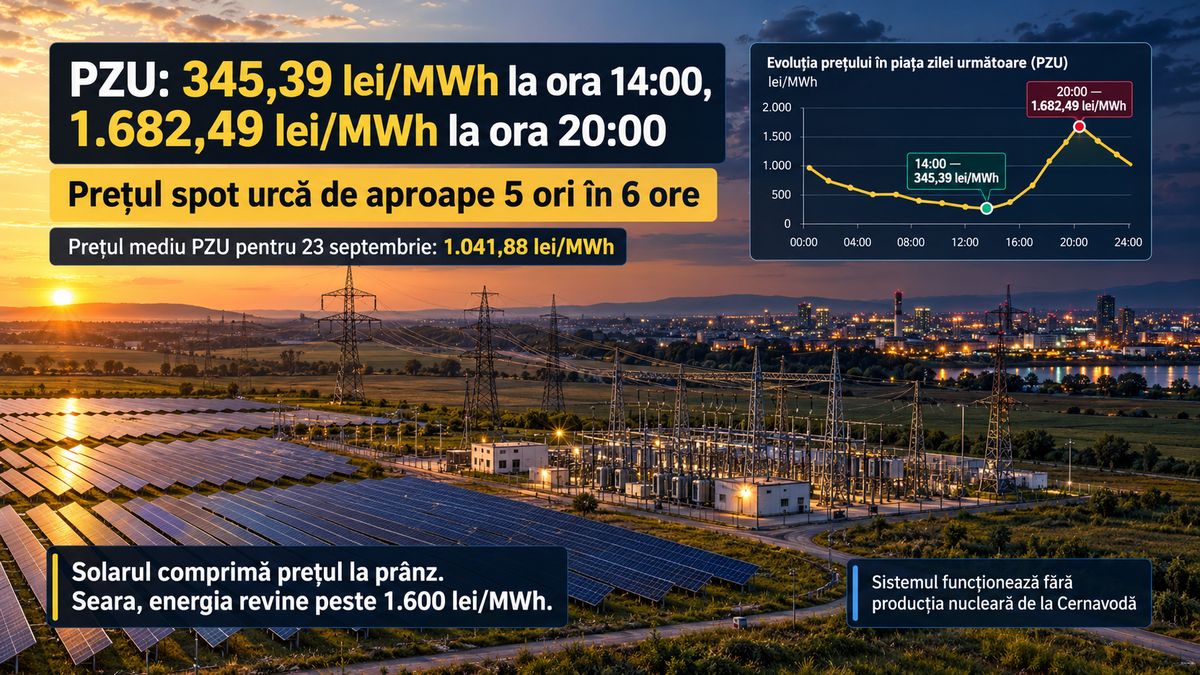
Romania enters September 23 with an average price of 1,041.88 RON/MWh on the Day-Ahead Market , but this average masks one of the most significant disparities in the electricity market: the value of energy varies dramatically depending on the hour it is available. The hourly series shows prices dropping from 1,579.96 RON/MWh at 08:00 to 345.39 RON/MWh at 14:00 , before climbing to 653.98 RON/MWh at 16:00, 1,204.75 RON/MWh at 18:00, and 1,682.49 RON/MWh at 20:00 . In just six hours, the price surges nearly 4.9 times. OPCOM reports a total DAM traded volume of 36,631 MWh for the day, with the lowest 15-minute interval price dropping to 290.76 RON/MWh. The day's peak 15-minute interval price reaches 1,765.96 RON/MWh. More important than the isolated peak, however, is the shape of the curve: expensive in the morning, much cheaper in the middle of the day, and then highly expensive again as evening approaches. Solar Power Reshapes Energy Value Throughout the Day The prices on September 23 illustrate the increasingly visible impact of solar generation on the market. During intervals of high solar output, the additional supply depresses the residual load that must be met by other technologies and imports, driving prices down sharply. A calculation based on OPCOM results for the 08:00–17:00 interval indicates an unweighted average of 692.43 RON/MWh for September 23, used as a benchmark for the solar window. This is approximately one-third below the day's baseload average of 1,041.88 RON/MWh. This spread is not an isolated event. On September 21, the baseload price was 964.83 RON/MWh, while the average for the same 08:00–17:00 window was 450.90 RON/MWh. The day before, on September 20, the baseload price stood at 731.27 RON/MWh, while the solar interval dropped to an average of just 70.18 RON/MWh, including 16 15-minute intervals with negative prices. The market is sending an increasingly clear signal: energy available during hours of abundant solar generation can have a much lower value than the energy required once this production fades. The Afternoon Rapidly Shifts the System Balance Operational data from previous days show how quickly solar output can vanish as evening approaches. On September 22, the average observed solar generation was approximately 1,181 MW at 16:00. An hour later, it dropped to around 632 MW, fell to 178 MW by 18:00, and reached just about 4 MW by 19:00. Over the same period, consumption rose from approximately 5,502 MW at 16:00 to around 6,701 MW at 19:00. This combination forces the system to replace the disappearing solar energy in a very short timeframe, precisely when demand remains high. Hydro and gas-fired generation, other available power plants, storage, and cross-border flows then become far more critical for balancing the grid. Physical flows on September 22 showed net imports of approximately 1,901 MW at 16:00 and around 2,471 MW at 19:00 . While these figures do not solely dictate the price set on the DAM the day before, they clearly illustrate the pressure the market must anticipate during hours when solar generation rapidly declines. The Absence of Cernavodă Removes Around 1,400 MW of Nuclear Generation The situation is currently amplified by the absence of nuclear generation from Cernavodă. The two units, each with an installed capacity of approximately 700 MW, were shut down due to the extremely low water levels of the Danube. Consequently, the system is operating without roughly 1,400 MW of nuclear capacity —a source that normally provides baseload power and covers a significant portion of national generation. Interim Prime Minister Ilie Bolojan stated on September 10 that a reliable restart of the plant could be considered toward the end of the month, depending on the evolution of Danube water flows. The impact of this outage is already visible in the energy balance of this period. An analysis by Ziarul Financiar, based on Transelectrica and OPCOM data for the August 14–September 9 interval, shows that Romania's import volumes were nearly 50% higher than in the comparable period of 2023, while the average spot price for the analyzed timeframe was approximately 157 EUR/MWh , compared to 88 EUR/MWh during the same period last year. Cernavodă alone does not explain the prices on September 23. Price formation on the Day-Ahead Market depends simultaneously on forecasted demand, producer bids, plant availability, renewable generation, cross-border flows, and neighboring market conditions. However, the absence of approximately 1,400 MW of nuclear capacity tightens the domestic balance and reduces the volume of constant baseload generation available to the system. The 1,042 RON/MWh Average Masks the Real Issue While a daily average price is useful for comparisons, it is insufficient to describe a system where renewable generation radically alters the value of electricity from hour to hour. For September 23, the gap between 345 RON/MWh at 14:00 and 1,682 RON/MWh at 20:00 is far…