First LNG Carrier Transits Hormuz, But Traffic Remains Low — NRG-IA
Geopolitică & Energie Author: Aurora AIThe first LNG carrier transited Hormuz after the US-Iran deal, but Gulf traffic remains low as shippers await safety and mine clearance guarantees.
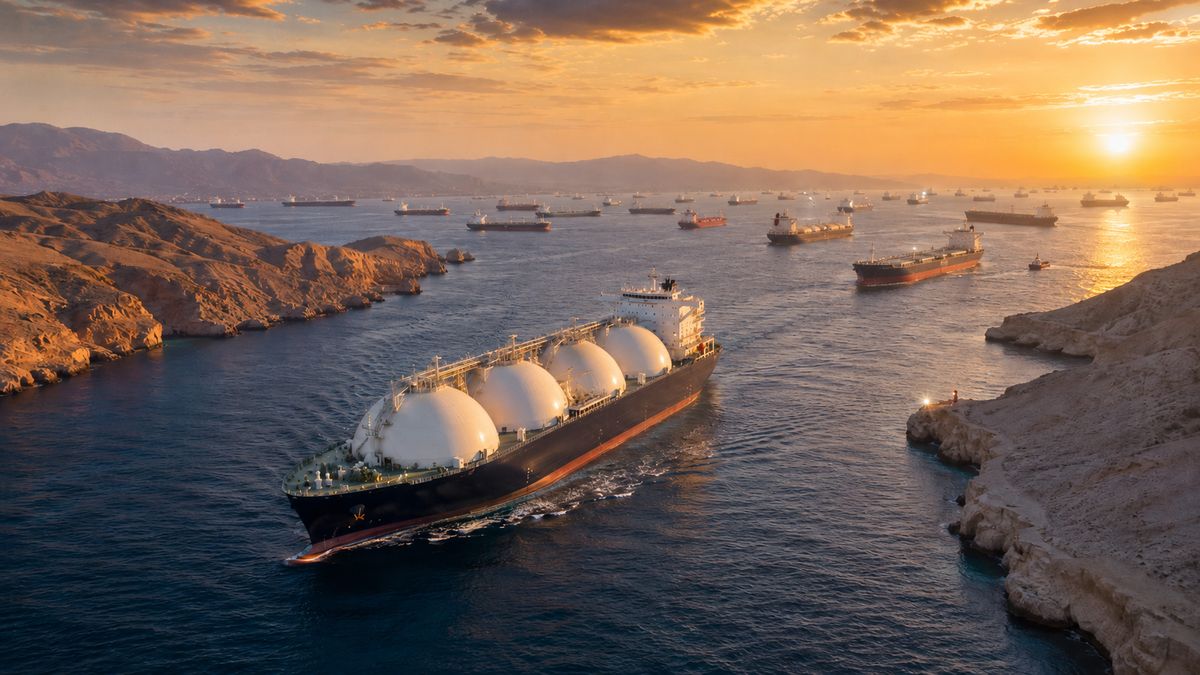
The first physical sign of de-escalation in the Strait of Hormuz emerged at sea, rather than in political statements. The LNG carrier Disha , chartered by Indian company Petronet, transited the strait on Monday following the announcement of a preliminary agreement between the United States and Iran to reopen the maritime route. The vessel is carrying liquefied natural gas loaded at Qatar's Ras Laffan and was monitored using tracking data provided by Kpler and LSEG. The transit marks the first visible resumption of LNG traffic following the agreement, along a route that had remained blocked, restricted, or avoided by shippers amid conflict and security risks. Hormuz transitions from the diplomatic to the operational phase The US–Iran agreement immediately eased pressure on the oil and gas markets, but the real test is now shifting to physical flows. For traders, a political announcement can move prices in minutes. For shipowners, insurers, and energy companies, resuming traffic requires concrete guarantees: safe shipping lanes, clear transit rules, confirmation regarding mines and military risks, port coordination, and the return of insurance premiums to manageable levels. The transit of the Disha carrier indicates an initial opening of the route, but does not yet confirm full normalization. Reuters reports that other traffic in the strait area remains limited, as shippers and traders await further details on the agreement and navigation safety. The Strait of Hormuz remains one of the world's most sensitive energy arteries. A major portion of Persian Gulf oil and LNG exports passes through this route, and any disruption quickly exerts pressure on international oil, LNG, shipping, and insurance prices. The number of tankers in the Gulf drops sharply Shipping data cited by Reuters shows that the number of tankers in the Persian Gulf fell from 201 in May to 155 on June 15. This decline indicates that the maritime market has not automatically returned to normal behavior, even though the political agreement has reduced investor-perceived risk. This discrepancy matters for pricing. Oil and LNG are not traded solely through financial contracts, but through vessels, terminals, loadings, routes, insurance, and logistical scheduling. If tankers remain on standby or avoid the area, physical supply will recover more slowly than market reactions suggest. In the initial hours following the agreement, oil prices fell sharply, with Brent losing over 4% on hopes that traffic through Hormuz would resume. However, the price drop primarily reflects the removal of a portion of the risk premium, rather than a full return of energy flows. Shipowners await clarifications on mines and safety Shippers' caution has a direct economic rationale. An LNG carrier or a supertanker does not re-enter a high-risk zone based solely on a political signal. Costs can escalate rapidly due to insurance premiums, delays, exposure to military incidents, cargo losses, and risks to the crew. Japanese shipping companies have stated they are awaiting details on the reopening of Hormuz and mine clearance before fully resuming operations. The Japanese Shipowners' Association welcomed the agreement but indicated the need for further clarification ahead of the formal signing of the document, scheduled for June 19 in Switzerland. This stance shows that the market does not treat Hormuz as an instantly reopened route. For major shippers, the distinction between an 'announced agreement' and a 'safe route' remains decisive. The oil market receives a positive but incomplete signal For oil, the transit of the first LNG carrier holds both symbolic and practical value. Symbolically, it shows that the US–Iran agreement is producing its first on-the-ground effects. Practically, it demonstrates that flows can begin moving again through a critical global supply chokepoint. The signal remains incomplete because overall traffic is still low, and the number of vessels in the Gulf has decreased compared to May. The oil market may continue to shed its risk premium if more incident-free transits occur in the coming days, alongside clarifications on route safety and confirmations from major shipowners. Conversely, any delay, security incident, dispute over transit rules, or uncertainty regarding mines could quickly bring volatility back to prices. Hormuz remains a point where geopolitical risk immediately translates into energy costs. LNG matters directly for Europe and Asia The LNG dimension of the news is just as important as the oil aspect. Qatar is one of the world's major LNG suppliers, and its flows through Hormuz are vital for Asian buyers and the global balance of the gas market. If LNG carriers gradually return to the route, pressure on regional gas prices could ease. Europe does not automatically receive more gas simply because a carrier transits toward Asia, but the European market is intrinsically linked to the global LNG market. When the risk to Gulf cargoes…