Romania Solar Hits 84.7% of Grid Demand, Prices Jump 17x — NRG-IA
Piața de Energie Author: Ioana BuzoaicaOn August 15, Romania saw its energy future: a massive midday solar surplus and 2 GW exports, followed by a steep evening price spike as solar faded.
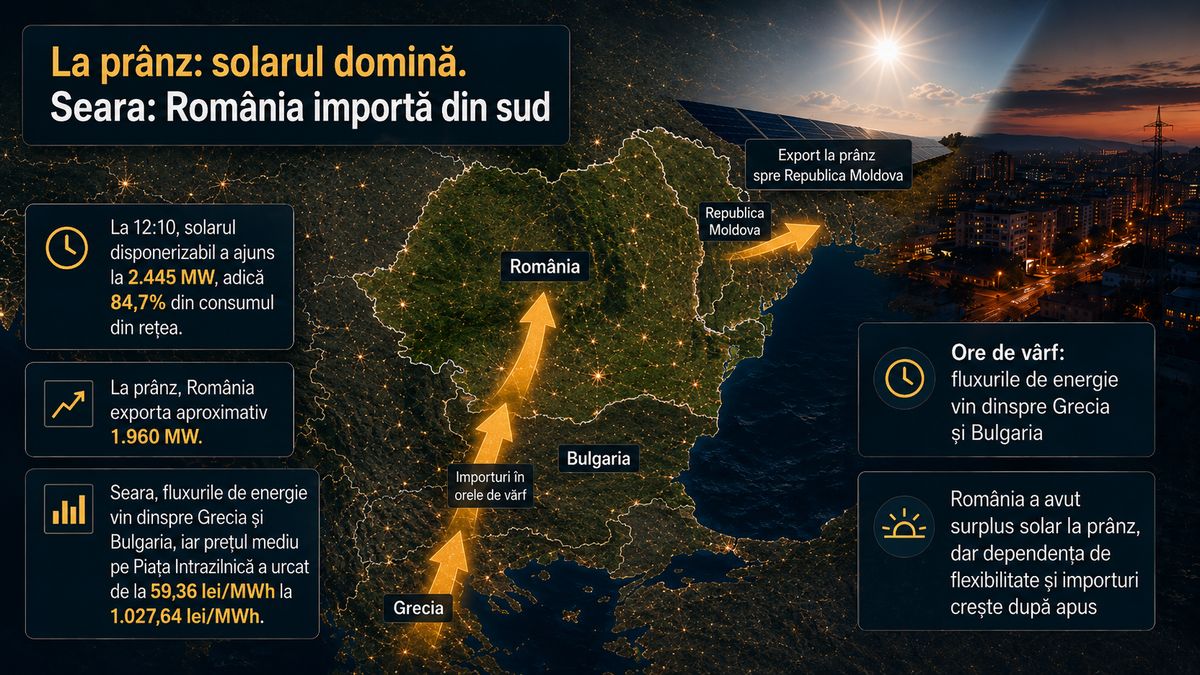
On Saturday, August 15, Romania reached a milestone that demonstrates just how much its power system has changed in only a few years. At 12:10 PM, dispatchable solar PV parks were producing 2,445 MW , equivalent to 84.69% of the instantaneous demand of 2,887 MW indicated in the system , and together with 382 MW of wind power, they covered nearly 98% of this demand. At the same moment, Romania was exporting approximately 1,960 MW . Nuclear power was at zero, following the shutdown of both units at Cernavodă due to extremely low Danube water levels. Nevertheless, at midday, the system had sufficient generation to cover grid demand and send nearly 2 GW across the border. A few hours later, the economic picture was completely different. On the Intraday Market operated by OPCOM, the weighted average price for the 14:00–15:00 interval was 59.36 RON/MWh . By the 20:00–21:00 interval, it had reached 1,027.64 RON/MWh —approximately 17.3 times higher . These two moments on the same day capture one of the major shifts occurring in the Romanian energy system. The challenge is no longer just how much generation capacity Romania can build. It is becoming increasingly critical at what hours energy is available and how effectively it can be shifted, consumed, or monetized when generation exceeds demand . Nearly 85% does not mean 85% of Romania's total gross consumption The figure of nearly 85% is striking, but its reference point is essential. The 2,445 MW produced by dispatchable solar parks represented 84.69% of the instantaneous demand of 2,887 MW indicated in the system at that moment, not 84.69% of the country's total gross electricity consumption. The difference is primarily driven by the massive growth of prosumers. A portion of the energy generated on the roofs of homes, commercial buildings, or industrial warehouses is consumed directly behind the meter. This generation reduces the amount of electricity users draw from the grid and, consequently, lowers the demand observed by the system. Around 12:10 PM, Transelectrica estimated prosumer generation at approximately 2,340 MW . At the end of June, ANRE reported 359,378 prosumers , with a cumulative installed capacity of 4,019.17 MW . However, this generation cannot be mechanically added to the 2,445 MW from solar parks and then compared to the 2,887 MW of system demand, as a portion of the prosumers' energy has already reduced that demand through self-consumption. Yet, the phenomenon remains spectacular even after this adjustment: utility-scale solar parks alone produced the equivalent of nearly 85% of the instantaneous demand observed on the grid at midday . Romania already has two solar PV segments of approximately 4 GW each The August 15 episode was not the result of a one-off solar generation record. Available data explicitly indicates that the level of around 2,450 MW did not represent a new instantaneous peak for solar PV. The change is structural. At the beginning of July, Transelectrica indicated approximately 3,840 MW of gross installed solar capacity in the national generation fleet. Separately, ANRE reported over 4,019 MW installed by prosumers at the end of June. These two figures come from distinct reporting streams with slightly different reference dates, so they should not be combined into an exact total for August 15. However, they demonstrate the scale of the transformation: Romania now has two solar components of approximately 4 GW each—utility-scale plants connected and monitored in the generation system, and the distributed installations of prosumers. This combination profoundly alters the daily demand curve seen by the grid. During sunny hours, prosumers reduce their grid consumption just as utility-scale solar parks are delivering high output. The result is a sharp compression of midday demand and, on favorable days, the emergence of large surpluses for export. Exports slightly exceeded the combined generation from gas, hydro, and coal At 12:10 PM, Romania was exporting approximately 1,960 MW . At the same moment, indicated generation from gas-fired plants was 889 MW, hydro plants were delivering 361 MW, and coal stood at 698 MW. Together, these three sources totaled 1,948 MW . Net exports were thus slightly higher than the combined generation from gas, hydro, and coal. The comparison highlights the scale of the surplus available at that hour, but exports cannot be attributed to a single technology. Electricity crossing borders is the result of the entire system's balance, not a separate physical link between a specific solar park and an external consumer. At the same time, exports are one of the standard mechanisms through which an interconnected system can absorb surpluses. The economic challenge arises when periods of abundant, cheap energy do not coincide with the hours when demand and energy value are at their highest. From 59 to over 1,027 RON/MWh in a matter of hours The market curve on August 15 illustrates this divergence far more…
Ioana Buzoaica — Independent Editorial Board
The NRG-IA newsroom continuously monitors Romanian energy markets, ANRE regulatory decisions, and national grid telemetry (SEN/SNT). We deliver independent intelligence anchored exclusively in official primary data.
Editorial Charter, Ethics & Verification Methodology →