Profit Decouples from Production for Romanian Energy — NRG-IA
Piața de Energie Author: Ioana BuzoaicaH1 results show a growing disconnect between physical volumes and profits for Romanian energy giants, driven by prices, taxes, and regulated tariffs.
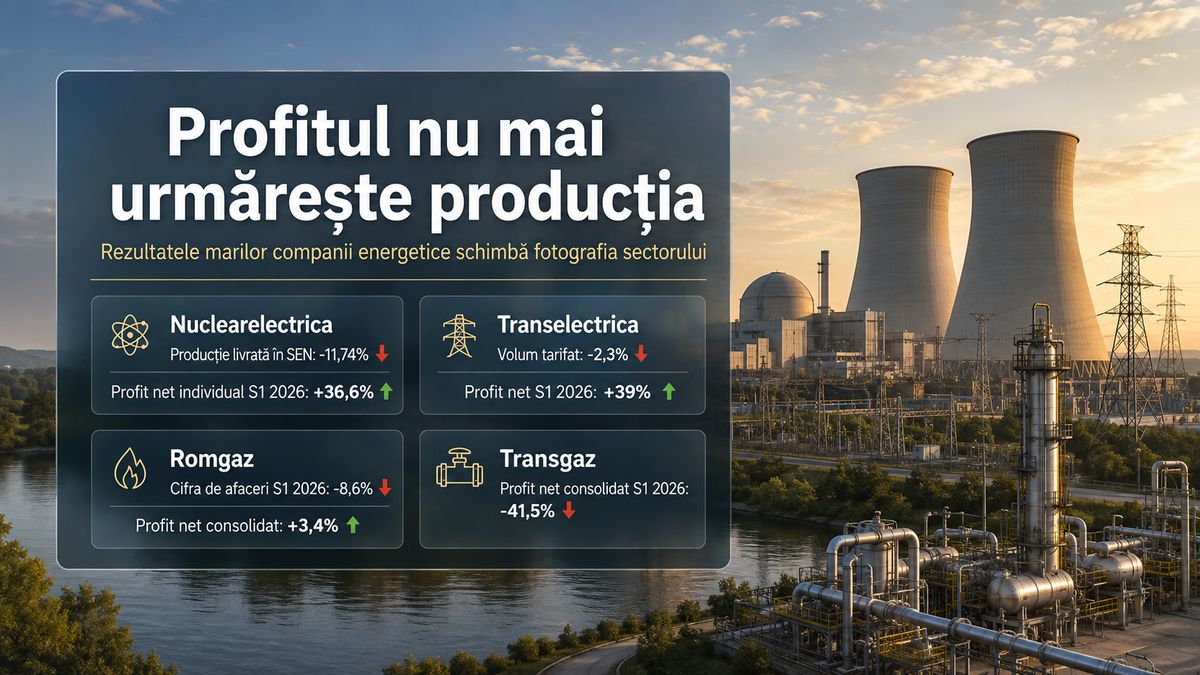
On the morning of August 14, the major energy companies listed on the Bucharest Stock Exchange published financial results depicting four almost contrasting financial models. Nuclearelectrica produced less energy but sharply increased its profit. Transelectrica transmitted a lower tariffed volume but earned 39% more. Romgaz saw its revenues and EBITDA decline, yet its net profit remained above last year's level. Transgaz recorded a severe deterioration in profitability, even though core operating revenues fell much less. Beyond the percentages in stock market headlines, the results reveal a major shift in the sector's economics: the volume of gas produced or energy transmitted is increasingly insufficient on its own to explain financial performance. Prices, taxation, regulated tariffs, price spreads between European markets, and investment costs have become variables capable of radically altering the relationship between physical activity and profit. The most spectacular divergence comes from Nuclearelectrica. The company ended the first half of the year with a standalone net profit of approximately RON 1.184 billion, up 36.6% compared to the same period in 2025. On a consolidated level, the group's net profit reached approximately RON 1.080 billion, up 30.6%. During the same period, the volume of electricity delivered to the National Energy System fell by 11.74%, from 4.706 TWh to 4.154 TWh. Nuclearelectrica earns more with lower production The apparent contradiction between production and profit has two strong financial explanations. The first is price. The weighted average selling price of electricity, excluding the balancing market, rose by 12.7%, from RON 519.57/MWh to RON 585.48/MWh. Consequently, electricity sales revenues managed to advance by approximately 2.7%, despite the lower volume delivered. The second change is fiscal and has an even greater impact. In the first half of 2025, Nuclearelectrica had recorded a contribution to the Energy Transition Fund of RON 504.9 million. In H1 2026, this expense disappeared. The effect is directly visible in profitability: standalone EBITDA increased by 33.7%, and consolidated EBITDA by 31.1%. Behind the half-year result, however, lie two very different quarters. Nuclearelectrica had reported a standalone net profit of RON 887.8 million in the first three months of the year. By subtracting this from the H1 total, the second quarter net profit comes to approximately RON 296 million, about 16% below Q2 2025. This quarterly deterioration coincides with one of the most challenging operational periods for the Cernavodă nuclear power plant. Between May 10 and 30, both units were shut down simultaneously: Unit 1 was undergoing a planned outage, while Unit 2 had entered an unplanned outage on May 4. In Q2, the electricity delivered by the company to the national grid fell by approximately 23.4% to 1.52 TWh. Nuclearelectrica was forced to buy electricity from the market to cover its commercial obligations. In H1, purchases reached approximately 474 GWh, and expenses for purchased energy rose by about 61%. Nearly half of the purchased volume came from the spot market. The half-year result remains very strong, but the source of this performance is clear: the higher electricity price and the elimination of a tax of over half a billion lei more than offset the loss of production. Transelectrica turns tariffs and interconnections into profit Transelectrica provides a second demonstration of this same disconnect between volume and profit, but through a completely different mechanism. The volume of electricity to which the company applied its transmission tariff decreased by 2.3%, from 25.87 TWh to 25.27 TWh. Net domestic consumption was almost stable at approximately 26.4 TWh. However, net profit rose by 39%, from RON 256 million to RON 356 million . The average realized transmission tariff rose by approximately 11% to RON 39.68/MWh, and revenues from the regulated transmission tariff increased by 8% to approximately RON 1.003 billion. A second driver of the result comes directly from the integration of European markets. Transelectrica's revenues from cross-border capacity allocation surged by 74%, from RON 151 million to RON 263 million . Thus, price spreads between European electricity markets and the utilization of cross-border capacities can generate a highly significant financial impact for the transmission system operator. At the same time, this same flow dynamic also generates costs. Grid loss (technological self-consumption) expenses rose by 24% to RON 356 million, and physical grid losses were 16.4% higher. However, the net balance remains strongly positive. EBITDA increased by 33% to RON 541 million. Calculated as the difference between H1 and Q1 results, the net profit for the second quarter is approximately RON 155 million, compared to around RON 98 million in Q2 2025, indicating an increase of nearly 58%. Transelectrica thus delivered one of the morning's…
Ioana Buzoaica — Independent Editorial Board
The NRG-IA newsroom continuously monitors Romanian energy markets, ANRE regulatory decisions, and national grid telemetry (SEN/SNT). We deliver independent intelligence anchored exclusively in official primary data.
Editorial Charter, Ethics & Verification Methodology →