New prosumer law brings monthly netting and multi-site use — NRG-IA
Prosumatori & Eficiență Author: Aurora AIThe new prosumer law shifts to monthly netting, allowing surplus energy to offset other consumption sites. Household savings will appear faster on bills.
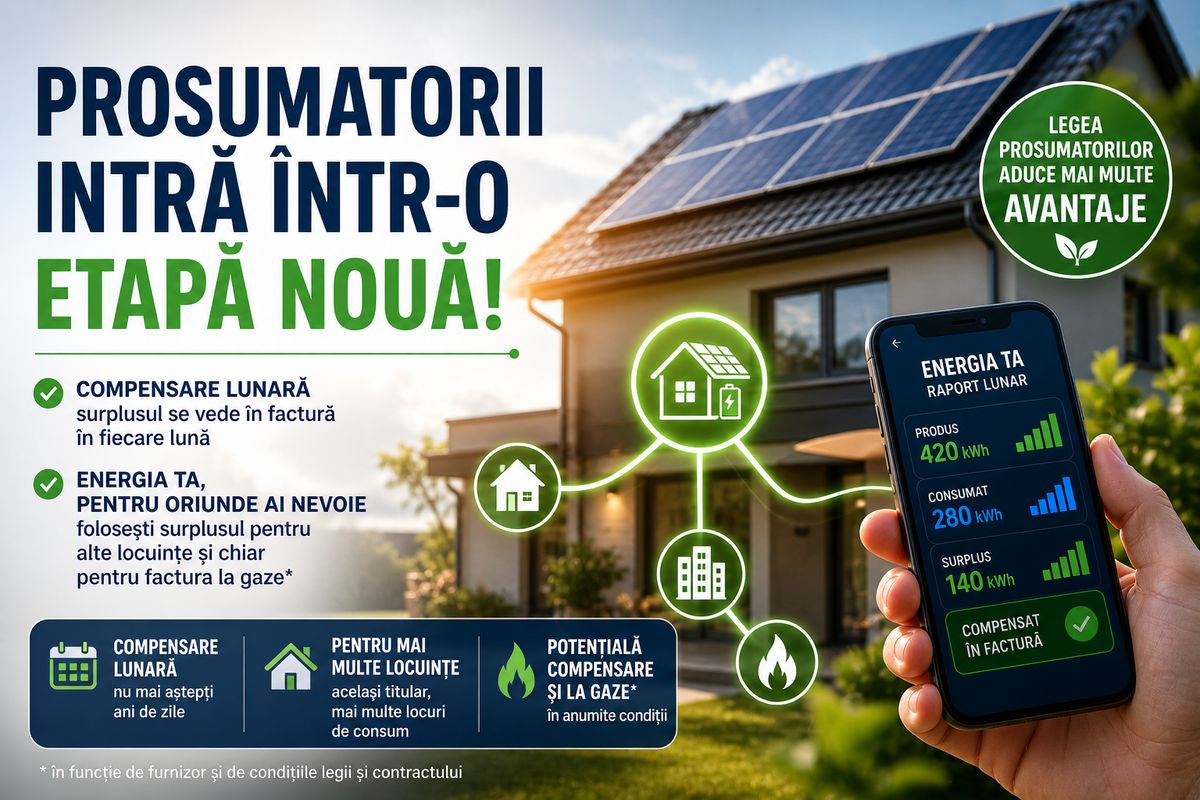
Prosumers enter a more flexible phase: surplus energy will no longer be locked in the long term The Constitutional Court has confirmed the constitutionality of the prosumer law, allowing the legislative act to move toward its final implementation phase following promulgation and publication in the Official Gazette. The stakes are high for Romanians who have invested in solar panels: surplus energy fed into the grid is set to be reflected in bills much faster, rather than after long carry-over periods. The most significant change is the introduction of a monthly netting logic. Simply put, prosumers will no longer be trapped in a mechanism where grid-injected energy accumulates in a hard-to-track manner and is settled late. Suppliers will have to calculate on a monthly basis the energy consumed from the grid, the energy produced and delivered, and the resulting differences. For households, this represents a cash-flow shift. Energy generated during the summer, particularly during peak solar production periods, should be reflected much sooner in the contractual relationship with the supplier. What prosumers actually gain The first advantage is monthly netting. Prosumers should receive a monthly breakdown of energy consumed and delivered, directly impacting their bills or the amounts owed by the supplier. The second advantage is multi-site netting. In practice, if a person has solar panels at a house and also owns an apartment, the surplus generated at one location can be used to offset consumption at the other, subject to legal conditions. The third advantage is the possibility of offsetting natural gas bills in certain situations, provided they share the same supplier and the service is available under the conditions stipulated by law and contract. For the public, the core idea is simple: home-generated energy becomes more usable. It is no longer rigidly tied to the installation site but becomes an energy asset that can be used more flexibly in relation to the supplier. Conditions matter: not every prosumer will automatically access all benefits These new benefits do not apply unconditionally. For multi-site netting, publicly available information points to requirements such as having the same account holder, the same supplier, and, under certain interpretations of the adopted text, conditions regarding the distribution system operator or the duration of the contractual relationship. For individual prosumers, one of the relevant limits under public discussion is the 27 kW threshold for certain extended netting facilities. Separately, quantitative netting for prosumers with installations of up to 200 kW remains a key pillar of the general applicable framework. This means the law should not be interpreted as an unrestricted freedom to move energy anywhere and anyhow. It introduces new flexibility, but suppliers will implement the mechanism based on contracts, metering data, and ANRE regulations that must be updated. Why the entire bill is not offset one-to-one A key point for properly understanding the mechanism is the difference between active energy and the final bill. When a prosumer feeds energy into the grid, the offset value is calculated based on the active energy component. Conversely, when they consume energy from the grid, the bill also includes transmission and distribution tariffs, taxes, VAT, contributions, and other regulated components. Therefore, netting does not automatically mean that a kWh produced at noon completely wipes out the cost of a kWh consumed in the evening. Injected energy has value, but the final bill includes more components than just the energy itself. This is one of the most important clarifications for prosumers: the new law improves the mechanism, but it does not turn the grid into a free battery. Impact on suppliers and the market For suppliers, the law brings additional operational pressure. Monthly netting, tracking multiple consumption sites, and potential natural gas offsets require more complex billing systems, accurate metering data, and adapted contracts. For the market, the effect is more profound. Prosumers are no longer just small-scale producers tolerated on the fringes of the system; they are becoming active participants demanding clear, predictable, and monthly applicable rules. This shift comes at a time when solar generation is growing rapidly, and the grid increasingly requires flexibility, storage, and digitalization. Without batteries, accurate metering, and smart billing, the benefits of the law could be delayed in practice. What comes next The law must go through the final steps to officially enter into force, and ANRE will need to update the methodology applicable to prosumers. Suppliers will have to adapt contracts, billing, and netting mechanisms. For prosumers, the coming period will be decisive. The real benefits will lie not just in the text of the law, but in how suppliers calculate, display, and apply the produced, consumed, and netted energy on…