Prosumers and Smart Grids: Avoiding the Energy Price Surge — NRG-IA
Piața de Energie Author: Aurora AIEnergy prices could rise by 24% this year. Discover how prosumer technology and energy surplus transfer can protect your monthly bill.
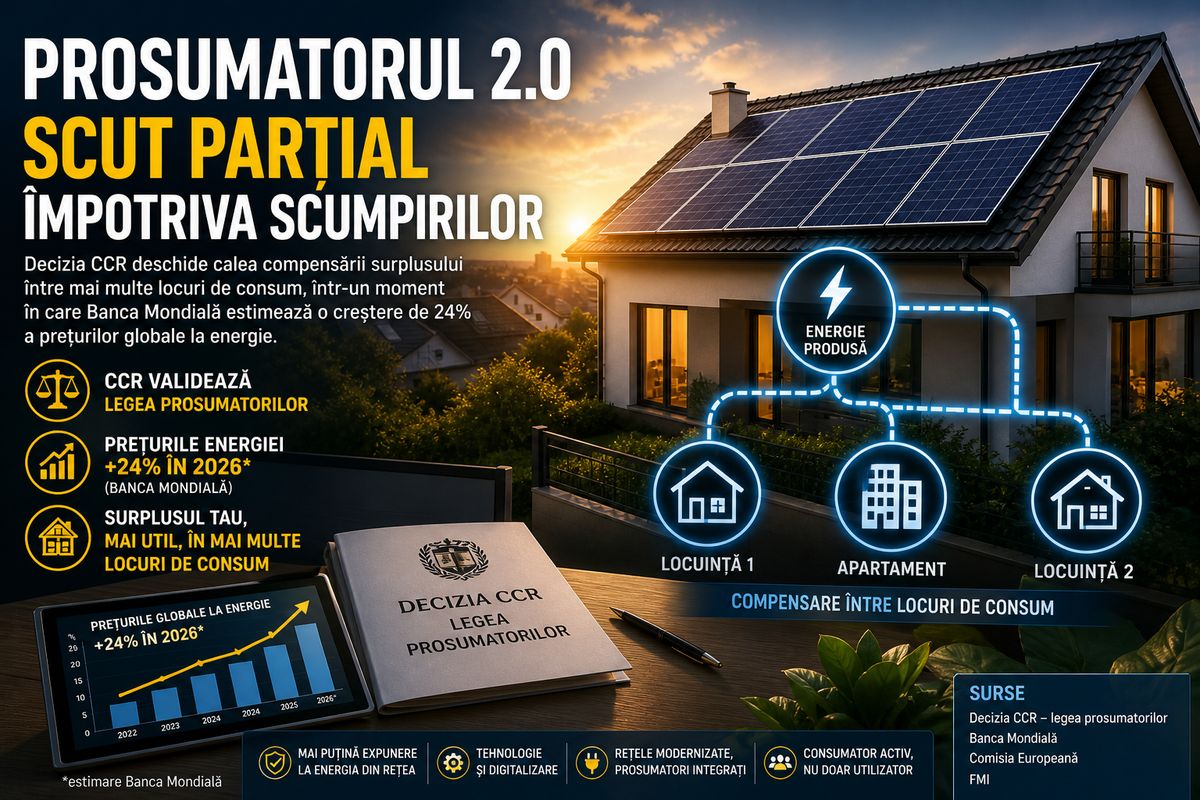
Current Situation: The Price Shock and the Technology Saving Prosumers Energy prices are expected to rise by 24% this year, according to the World Bank — and decentralized technology is becoming your only safety net. While European governments repeat past mistakes, Romanian consumers receive an unexpected digital weapon. The Constitutional Court validated the law allowing the transfer of surplus energy between locations. This legislative innovation opens the door for integrating smart technologies into the Romanian grid. The global energy market is boiling again, and the short-term outlook is highly concerning. The World Bank issued a severe warning about prices reaching their highest level since the 2022 invasion. The 24% increase is forecasted amid ongoing geopolitical tensions in the Middle East. In this context, traditional Romanian infrastructure is already operating at maximum capacity to cover domestic demand. Recent data confirms the current dependence on classic production sources. Petrom's Brazi gas power plant recorded its second-highest production in its 14-year history during the first quarter. However, the future no longer belongs solely to large power plants, but to smart grids and micro-producers. The recent Constitutional Court decision validates the right of prosumers to offset their consumption across multiple properties. "A victory for Romanians producing energy at home. The surplus energy produced in one location is no longer lost," stated former Energy Minister Bogdan Ivan. Analysis: How Smart Grids Replace IMF-Criticized Subsidies Integrating technology into energy is moving from an experimental stage to an absolute necessity for economic survival. The data shows a major divergence between state policies and current technological reality. The International Monetary Fund warns EU governments that they are ignoring the lessons of 2022 regarding price spikes. The institution emphasizes that broad measures, such as cutting fuel excises, actually encourage consumption and worsen the crisis. The real and sustainable solution lies in balancing technology and smart energy storage. When prosumers can transfer energy digitally between locations, the grid becomes an interconnected and efficient ecosystem. Smart meters and energy management software are gradually replacing manual and rigid dispatching. This decentralization reduces the pressure on large producers and limits technical losses in the transmission grid. Technology now allows the creation of Virtual Power Plants (VPPs) even in Romania. These systems aggregate the production of thousands of residential solar panels, optimizing flows through advanced algorithms. Instead of subsidizing blind consumption, the state should finance the digitalization of the distribution infrastructure. Only a technologically advanced grid can absorb price shocks without bankrupting the national budget. Market and Consumer Implications: Who Wins from Digital Energy Transfer For the household consumer, new technological integrations mean direct and transparent control over their own bill. If you own solar panels at a rural house, you will be able to power your city apartment. This virtual energy transfer eliminates dependence on volatile prices imposed by traditional suppliers. Technology transforms the passive consumer into an active player on the energy exchange. The clear winners of this paradigm are prosumers who invest in hybrid systems and smart home automation. Furthermore, companies developing software for low-voltage grid management will experience exponential growth. On the other hand, the losers will be classic suppliers who refuse to digitalize their services. Slow distribution operators, who fail to upgrade their transformers, will be overwhelmed by the new energy flows. The impact on the bill will be strictly dictated by the level of technological adoption of each household. Those who remain captive in the classic system will fully bear the 24% increases estimated by the World Bank. Conversely, users of smart technologies will be able to reduce their costs to an all-time low. Scenarios and Perspectives: The Grid of the Future vs. Systemic Collapse Risk The optimistic perspective indicates a massive adoption of storage technologies and peer-to-peer networks. If distributors rapidly integrate artificial intelligence solutions for consumption prediction, the price shock will be fully mitigated. Romania could become a regional model for integrating prosumers into the energy balancing market. Technology can transform an imminent crisis into an opportunity for national modernization. The pessimistic scenario involves bureaucratic bottlenecks, toxic subsidies, and major technical limitations in the grid. If the national infrastructure is not urgently modernized, the digitalized energy surplus will trigger chain failures. The IMF's warning will quickly materialize: governments will pump public money into inefficient measures again. The lack of…