Qatar Extends LNG Force Majeure; EU Storage at 71% — NRG-IA
Geopolitică & Energie Author: Ioana BuzoaicaQatar extends LNG force majeure to Dec 2026, affecting 35 cargoes. Europe enters winter with 71% storage amid tight global competition for supply.
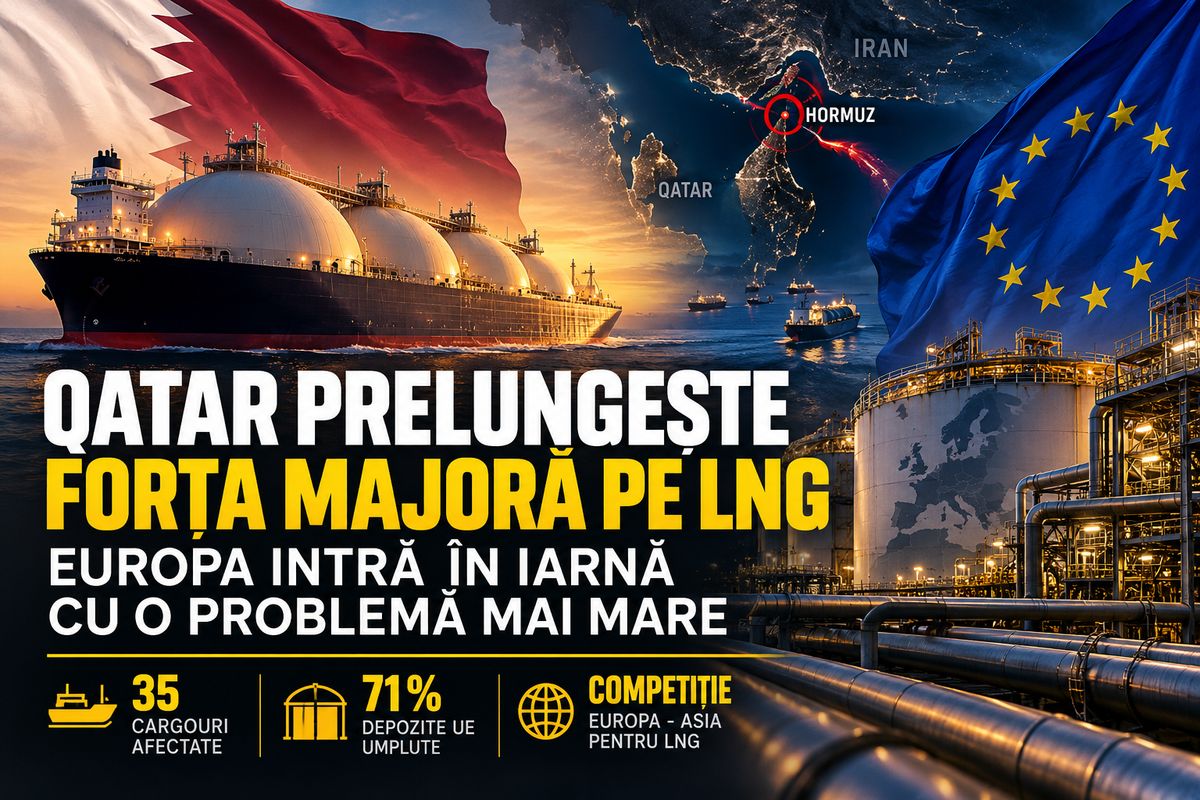
Qatar is extending the disruption of LNG deliveries to one of its main European customers until December, just as Europe enters the cold season with gas storage at approximately 71% and seeks to attract new cargoes from an already tight global market. Edison announced on September 28 that QatarEnergy has once again extended the force majeure for its supply contract to Italy. The new notification cancels another six cargoes and extends the affected period, which began in April, until early December 2026. This brings the total to 35 cargoes, equivalent to approximately 4.6 billion cubic meters (bcm) of gas. Edison had already managed to replace 23 of these, representing about 2.3 bcm, primarily through purchases from US suppliers. The contract between Edison and QatarEnergy has been in force since 2009, has a 25-year duration, and covers approximately 6.4 bcm of gas annually. The last Qatari deliveries to Edison arrived at the end of March. Developments over recent months show how long the disruption has dragged on. At the end of June, 21 cargoes were affected, equivalent to approximately 2.7 bcm. By the end of August, the tally had reached 29 cargoes and approximately 3.8 bcm. The new notification raises the total to 35 and pushes the issue into the beginning of the European winter. Qatar's Exports Have Been Drastically Reduced However, the issue extends far beyond the commercial relationship between QatarEnergy and Edison. Reuters reports that QatarEnergy has also sent force majeure notices to Asian buyers. Customers in Bangladesh and Pakistan received extensions until November, indicating that the disruption is simultaneously affecting multiple markets dependent on Qatari LNG. The scale of the shock is far larger than the 35 cargoes destined for Edison. According to ICIS data cited by Reuters, Qatar had exported only 18 LNG cargoes by the end of August, compared to 509 in the same period of the previous year. The calculated reduction for this period thus reaches approximately 96%. However, traffic has not stopped completely. In September, transits through the Strait of Hormuz by vessels associated with QatarEnergy resumed, including loaded cargoes from Ras Laffan. Flows are attempting to recover, but volumes remain insufficient to return to Qatar's normal contractual schedule. This distinction is important: the market is not facing the complete disappearance of Qatari LNG, but rather a severe and prolonged reduction in one of the world's most critical liquefied gas flows. Prior to the disruptions, LNG transported through the Strait of Hormuz accounted for nearly 20% of the global LNG supply. Qatar is one of the top three global exporters, alongside the United States and Australia, and the majority of its production traditionally goes to Asia. Europe's Problem Is the Global Market, Not Just Gas Purchased Directly from Qatar Europe is not the primary buyer of Qatari LNG. In 2025, Qatar supplied approximately 8.9% of the European Union's LNG imports, while the United States supplied more than half. However, this statistic masks the mechanism through which the Qatari disruption impacts Europe. LNG already accounted for about 45% of total EU gas imports in 2025, and the Union had become the world's largest importer of liquefied natural gas. Europe is thus increasingly dependent on a global market where cargoes can be rerouted to the buyer offering the most attractive commercial terms. When Qatar delivers less to Asia, Asian buyers must find alternative volumes. Consequently, Japan, South Korea, China, India, Pakistan, and Bangladesh end up competing for some of the same flexible cargoes that Europe needs to replenish its storage and cover consumption during the cold season. The impact of Qatar on Europe is therefore greater than its direct share of European imports. Europe and Asia Bid for the Same Volumes This competition is already visible in prices and cargo destinations. The IEA notes that following the traffic disruption through Hormuz, the spread between Asian LNG and European gas prices inverted. Between March and June, the Asian market offered an average premium of approximately $2.1/MMBtu over Europe, incentivizing the diversion of flexible cargoes to Asian buyers. As winter approaches, Europe must simultaneously replenish its storage facilities. As of September 28, EU storage facilities were 70.87% full, holding approximately 802 TWh of gas. The situation varies significantly across member states: Italy was at over 86%, Romania at around 80.5%, while Germany's storage was at just 57.4%. For Germany, Europe's largest gas consumer, this is an unusually low level for the end of September. The European system is, however, more diversified than during the 2022 energy crisis. Europe has larger LNG capacities, imports significant volumes from Norway, and has access to multiple sources and terminals. The emerging issue for the 2026/27 winter is therefore primarily one of availability and pricing of marginal…
Ioana Buzoaica — Independent Editorial Board
The NRG-IA newsroom continuously monitors Romanian energy markets, ANRE regulatory decisions, and national grid telemetry (SEN/SNT). We deliver independent intelligence anchored exclusively in official primary data.
Editorial Charter, Ethics & Verification Methodology →