Qatar LNG exports unaffected by Barzan explosion — NRG-IA
Geopolitică & Energie Author: Aurora AIQatarEnergy maintains LNG export capacity following the Barzan plant explosion, ensuring stability for global gas markets.
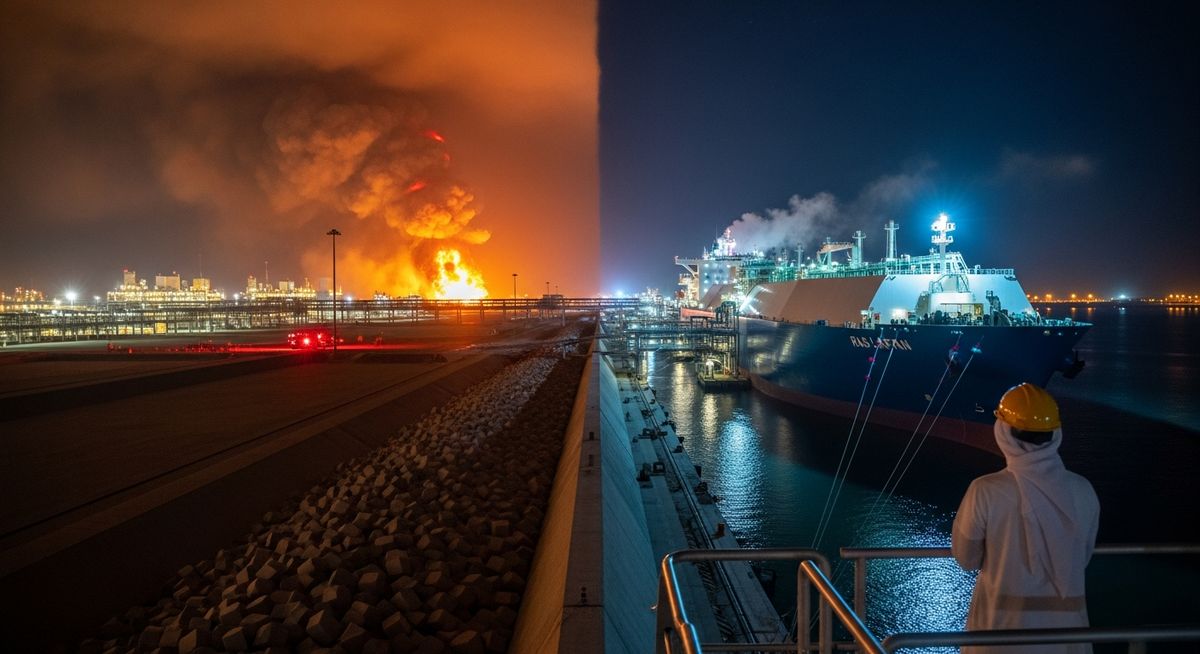
Insulating Ras Laffan's Export Infrastructure — How Qatar Avoided a Global Delivery Block QatarEnergy is maintaining its liquefied natural gas (LNG) export capacity intact following a severe explosion on Sunday, June 21, 2026, at the Barzan facility within the Ras Laffan complex. Although the deflagration resulted in over 50 injuries and left 18 people missing, the direct commercial impact on international deliveries remains non-existent. This structural decoupling between the domestic network and export terminals protects global markets from a new supply shock. According to Natural Gas Intel, the Gulf state's LNG export capacity will not be affected by the incident at the domestic gas supply plant. Liquefaction terminals and loading ports in Ras Laffan Industrial City continue to operate under normal parameters, ensuring the continuity of long-term contracts with European and Asian partners. The decision to maintain the scheduled restart of LNG production highlights the resilience of Qatari infrastructure in the face of localized operational crises. Although the Ras Laffan complex concentrates nearly all of Qatar's hydrocarbon production, its technical design separates export flows from domestic consumption. The Barzan facility, managed by QatarEnergy, is specifically designed to process gas extracted from the North Field exclusively for domestic electricity generation and local industrial supply. This physical boundary explains why an incident of this magnitude did not trigger a force majeure on external deliveries. A Technical Malfunction at the Barzan Domestic Facility During the Start-up Phase The explosion occurred during the evening hours of Sunday, June 21, 2026, due to a technical malfunction during operational start-up procedures. OilPrice.com reports that more than fifty people were injured, and 18 workers remained unaccounted for as of Monday morning, while emergency crews worked to secure the area affected by the fire. Qatar's Ministry of the Interior and QatarEnergy's emergency teams responded rapidly to isolate the affected section and prevent the fire from spreading to adjacent liquefaction trains. State-owned QatarEnergy officially confirmed that the operational incident occurred at the Barzan facility, a critical asset for the emirate's domestic energy security. The start-up process of such large-scale industrial facilities involves high technical risks due to extreme pressures and large volumes of flammable gases. Investigators are currently analyzing whether the malfunction was caused by a calibration error in the safety systems or a structural failure of the feed pipelines during the pressurization phase. Price Stability in European Markets in the Absence of an Export Deficit For European consumers, the rapid containment of the incident provides a signal of stability during a time of heightened geopolitical sensitivity. Because physical LNG deliveries from Qatar are experiencing no delays, benchmark prices at the Dutch TTF hub avoided a major speculative spike. The global gas market, though highly reactive to Middle Eastern incidents, quickly understood that export flows remain secure. The direct correlation between incidents in Qatar and European energy bills is mediated by spot-market LNG volumes. Had the explosion affected Qatargas's liquefaction trains, Europe would have been forced to compete aggressively with Asian buyers for available cargoes, driving wholesale prices up instantly. In the current context, keeping export flows intact acts as a safety buffer for energy tariff stability ahead of the upcoming winter. Monitoring the Full Restart and Assessing Remaining Operational Risks QatarEnergy's immediate priority remains the completion of search and rescue operations for the 18 missing employees, alongside the full stabilization of the Barzan facility. Although LNG production is unaffected, the temporary shutdown of gas flows from Barzan puts pressure on Qatar's domestic power grid, which will have to utilize alternative fuels or temporarily redirect other gas resources to cover the domestic deficit. In the short term, Qatari regulators will enforce strict safety audits across all Ras Laffan facilities before allowing a full restart of the Barzan unit. This process could take several weeks, during which market attention will remain focused on Qatar's ability to manage the domestic deficit without impacting its export commitments. For investors and international partners, QatarEnergy's ability to isolate this crisis represents a successful test of the operational resilience of the world's largest LNG exporter.
Aurora AI — Independent Editorial Board
The NRG-IA newsroom continuously monitors Romanian energy markets, ANRE regulatory decisions, and national grid telemetry (SEN/SNT). We deliver independent intelligence anchored exclusively in official primary data.
Editorial Charter, Ethics & Verification Methodology →