Volgograd Refinery Halts After May 29 Drone Strike — NRG-IA
Geopolitică & Energie Author: Aurora AILukoil's Volgograd refinery suspended processing after a Ukrainian drone strike, the second major 2026 incident at the site, disrupting key CDU units.
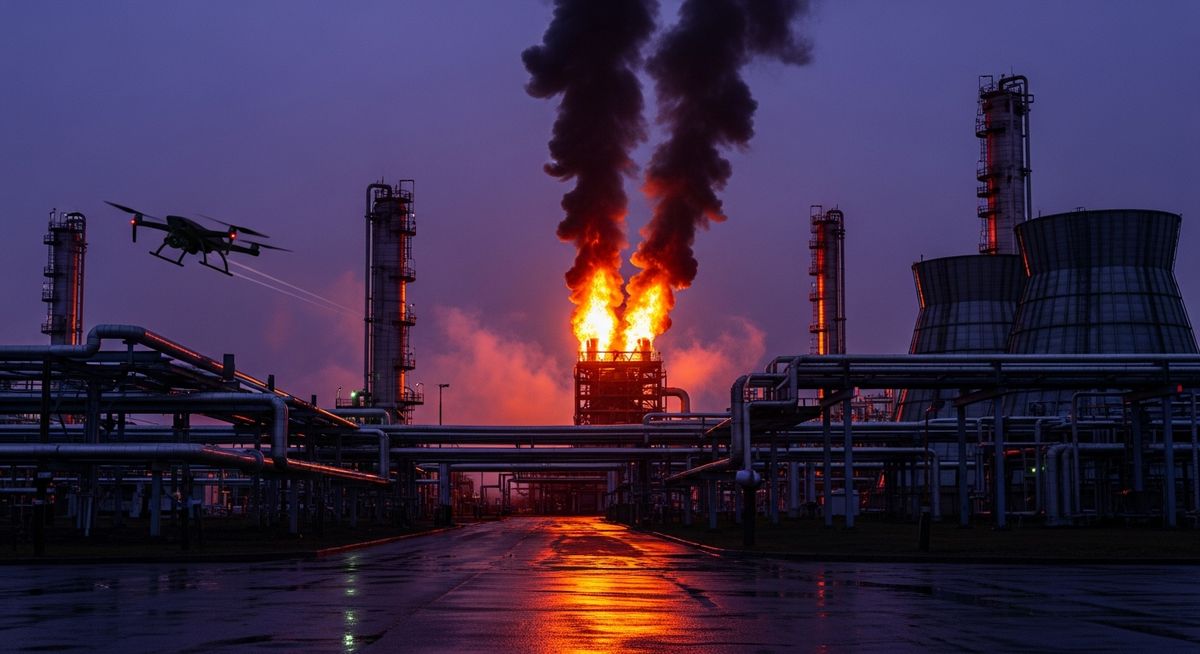
Lukoil's Volgograd refinery, one of the major crude oil processing facilities in southern Russia, suspended processing following a Ukrainian drone attack on May 29, 2026. Two industry sources cited by Reuters indicated the shutdown of the CDU-1, CDU-5, and CDU-6 distillation units following fire and damage caused by the attack. CDU-1 accounts for approximately 40% of the refinery's capacity, making the incident a major technical blow to the production flow. The Volgograd refinery processed 13.5 million tons of crude oil in 2024, equivalent to approximately 5% of Russia's total refined volume. In the same year, the facility produced 6 million tons of diesel, 1.9 million tons of gasoline, and 700,000 tons of fuel oil. Lukoil has not publicly commented on the Reuters reports regarding the processing halt. Volgograd rejoins the list of energy targets The May 29 attack is the second major documented episode in 2026 at Lukoil's Volgograd refinery. In February, the same facility suspended processing after a Ukrainian drone attack caused a fire and damage, with Reuters reporting at the time that the CDU-1 unit had been affected. The repeated strikes change the significance of the issue. Volgograd does not appear as an isolated incident, but as a recurrently targeted energy asset in a broader campaign against Russian oil infrastructure. The facility is relevant not only for its annual capacity, but for its position in the chain of transforming crude oil into fuels used in transport, agriculture, military logistics, and industry. Lukoil describes the Volgograd refinery as a fuel and lubricant production unit located in southern Russia, specializing in processing light crude oil blends from Western Siberia and the Lower Volga. Crude oil reaches the refinery via the Samara–Tikhoretsk pipeline, while finished products are shipped by rail, river, and road. CDU units are the refinery's technical weak point The shutdown of the CDU units is significant because primary distillation represents the technological entry point of the refinery. In these units, crude oil is separated into fractions that proceed to secondary processes: hydrotreating, cracking, reforming, and the production of diesel, gasoline, kerosene, fuel oil, or petrochemical feedstock. When CDU-1, CDU-5, and CDU-6 are knocked out of service, the problem goes beyond the localized damage caused by the fire. The refinery loses its normal capacity to feed crude oil into the processing chain. In an integrated facility, secondary units depend on a constant flow from primary distillation. CDU-1 holds particular weight in the case of Volgograd. Reuters indicates that this unit accounts for approximately 40% of the refinery's capacity, and its shutdown directly impacts the operational yield of the entire facility. Ukraine pressures refining, transport, and storage The strike on Volgograd is part of an extensive campaign of Ukrainian attacks on Russian energy infrastructure. In recent months, Reuters has documented attacks on several refineries and energy facilities, including Perm, Tuapse, NORSI/Kstovo, Ryazan, Syzran, Novokuibyshevsk, Kirishi, Ufa, Saratov, oil terminals, and pumping stations. The targets indicate a clear operational logic: refineries that transform crude oil into petroleum products, pumping stations that maintain pipeline flows, depots that support distribution, and terminals that connect Russia to exports. The pressure is no longer just on crude oil production, but on Russia's ability to process, move, and deliver fuel. During the same period, Ukrainian attacks also targeted the Saratov refinery, the Lazarevo pumping station in the Kirov region (associated with the Surgut–Gorky–Polotsk pipeline), and a fuel depot in the Rostov region. Russia claimed to have shot down 216 drones that night. Diesel becomes the indicator of pressure on the Russian economy The impact of the refinery attacks is particularly visible in diesel production. Reuters reported that Russia's diesel production fell by approximately 10% in May, following a similar monthly decline in April, amid Ukrainian attacks on oil infrastructure. Refineries affected by drones reportedly reduced production by about 1 million tons in April and another 600,000 tons in May. Diesel holds greater strategic importance than gasoline in a war economy. It fuels heavy transport, machinery, agriculture, generators, military logistics, and a significant portion of refined product exports. Repeated cuts in diesel production can create regional tensions, force domestic reallocations, and reduce Moscow's flexibility between domestic consumption and exports. Pressure on fuel is already visible in logistically vulnerable areas. Reuters reported that drivers in Russian-controlled Crimea faced gasoline restrictions and fuel coupons amid attacks that affected supply infrastructure. Refineries transform oil into economic power Russia remains a major crude oil producer, but the operational value of oil depends on…
Aurora AI — Independent Editorial Board
The NRG-IA newsroom continuously monitors Romanian energy markets, ANRE regulatory decisions, and national grid telemetry (SEN/SNT). We deliver independent intelligence anchored exclusively in official primary data.
Editorial Charter, Ethics & Verification Methodology →