AI-Engineered Fuels: Microbes, Algae, and CO2 Factories — NRG-IA
Tehnologie & Inovație Author: Ioana BuzoaicaNext-gen refineries could run like breweries: microbes consume carbon to secrete fuels, while AI accelerates design. But scaling up remains a challenge.
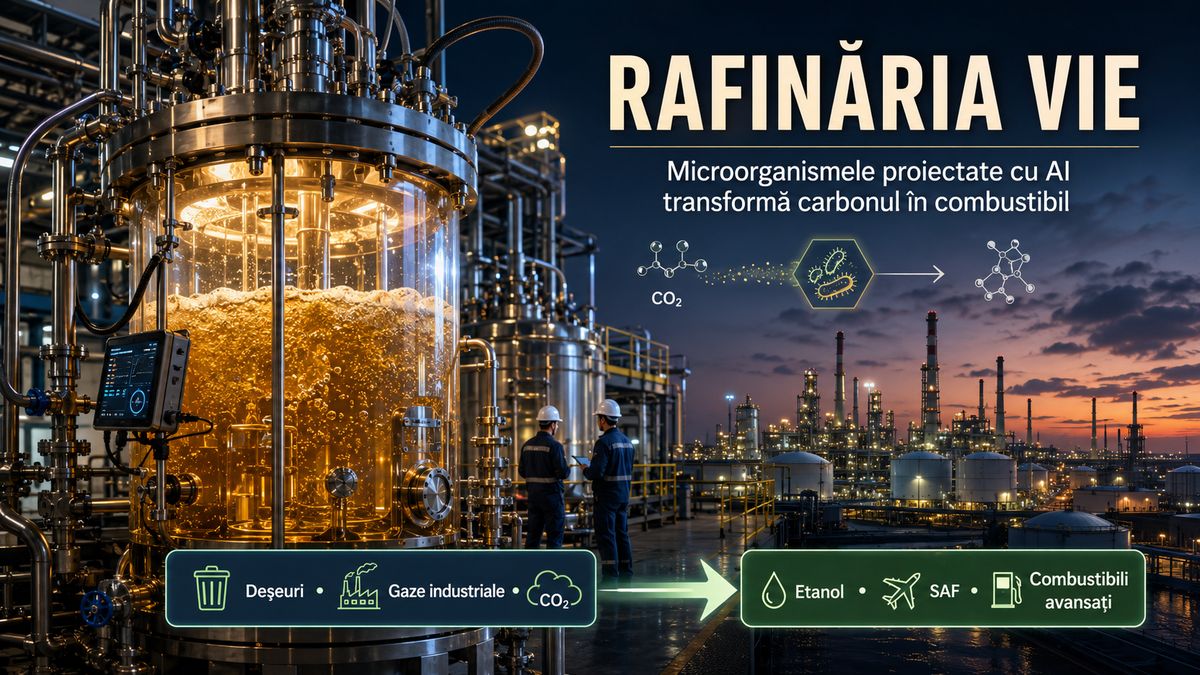
In an industrial bioreactor, the feedstock does not have to be sugar, corn, or crude oil. It can be waste gas from a steel mill, a mixture derived from waste, or, in a more advanced configuration, carbon dioxide combined with hydrogen produced from water and renewable electricity. The microorganisms introduced into the reactor consume the carbon and convert it into ethanol or other molecules that can become fuels, materials, and chemicals. The process resembles fermentation in the food industry, but the "yeast" is replaced by selected or engineered bacteria, and the carbon source is no longer necessarily an agricultural product. This is the technological reality behind the spectacular phrase "molecular factories." Biology is beginning to be used as an industrial platform for building fuel molecules. It does not yet produce volumes comparable to petroleum refineries, but it no longer belongs exclusively to science fiction. The five generations describe an evolution, not an industrial timeline Biofuels are frequently presented in a sequence of five generations: food crops, lignocellulosic waste, algae, genetically modified organisms, and, finally, systems combining CO₂, renewable energy, and synthetic biology. This framework is useful for explaining the shift in feedstock from agriculture to residual carbon. However, it can be misleading when it suggests that each stage was completed before the next emerged. The first generation still dominates the market. The second operates commercially in certain configurations but has not replaced corn or sugarcane ethanol and biodiesel from vegetable oils. The third, based on algae, remains pre-commercial for bulk fuels. Industrial facilities have already emerged from the so-called 4G space, while "5G" lacks a single definition and rather describes a convergence of electrolysis, carbon capture, and synthetic biology. The 4G and 5G labels sometimes overlap with other technology families, such as electrofuels, recycled carbon fuels, and power-to-liquid pathways. What matters industrially is not the generation number, but the carbon source, the energy consumed, the conversion process, and the cost of the resulting molecule. The world still produces biofuels mainly from crops Ethanol from corn and sugarcane, biodiesel from soy, rapeseed, or palm, and renewable diesel obtained from oils and fats continue to provide the bulk of global production. An assessment by the International Energy Agency showed that waste and residues accounted for only 9% of the feedstocks used for biofuels in 2021 and could reach about 13% by 2027. Even these resources are limited: used cooking oil and animal fats are simultaneously sought after by producers of biodiesel, renewable diesel, and sustainable aviation fuel. The first generation is not disappearing because it has a decisive advantage: its industrial supply chains are mature. Feedstock is available, facilities are amortized, and sugar fermentation or vegetable oil processing are far simpler than breaking down wood, cultivating algae, or operating sensitive microorganisms at scale. The cost of this maturity is pressure on land, water, and agricultural production. Climate performance differs considerably among technologies. Sugarcane ethanol produced in an efficient facility does not have the same footprint as a fuel associated with deforestation or crop expansion onto high-carbon-stock lands. The second generation converts residues, but nature defends its cellulose Second-generation (2G) biofuels attempt to use straw, corn stover, sugarcane bagasse, forestry residues, non-recyclable wood, and other materials that do not directly enter the food chain. The source is abundant, but conversion is difficult. Plant cell walls contain cellulose embedded in a resilient structure of hemicellulose and lignin. To release fermentable sugars, the facility requires mechanical pretreatment, temperature, pressure, chemicals, and enzymes. These steps increase capital expenditure, energy consumption, and process sensitivity. Several cellulosic plants built in recent years have failed to reach projected production volumes or costs, and some have been shut down or repurposed. Brazil offers one of the most credible industrial models. Plants can integrate cellulosic ethanol alongside conventional production, using the bagasse and cane residues already available on-site. IRENA indicates an estimated production of about 51 million liters of cellulosic ethanol in 2024 and a potential of up to 12% of the Brazilian ethanol supply by 2031. The figures confirm the existence of a real industry, but they also highlight the difference in scale. Brazil produces tens of billions of liters of conventional ethanol annually. The second generation is growing, but it remains a minor component of the system. Algae promised green crude and delivered mostly niche products Microalgae are almost perfect candidates in the laboratory. They grow rapidly, fix CO₂, and can accumulate…
Ioana Buzoaica — Independent Editorial Board
The NRG-IA newsroom continuously monitors Romanian energy markets, ANRE regulatory decisions, and national grid telemetry (SEN/SNT). We deliver independent intelligence anchored exclusively in official primary data.
Editorial Charter, Ethics & Verification Methodology →