Big Oil Q3 2026 Profits Hit $45.2B on Refining Surge — NRG-IA
Geopolitică & Energie Author: Ioana BuzoaicaWestern oil majors earned $45.2B in Q3 2026 as Middle East conflict caused fuel deficits and soaring refining margins, boosting OMV Petrom's profits.
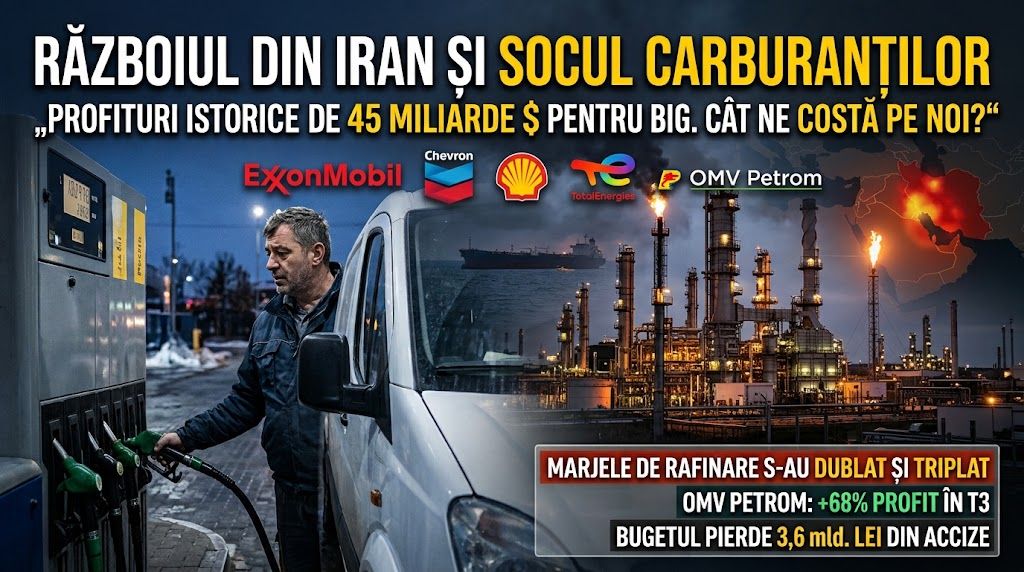
The four largest integrated Western oil and gas producers—US giants ExxonMobil and Chevron, alongside European leaders Shell and TotalEnergies—earned a combined $45.2 billion in profits in the third quarter of 2026, uniformly exceeding Wall Street and City of London expectations. Financial reports released on October 29 and 30, 2026, underscore the magnitude of the wealth transfer triggered by the war with Iran that erupted in February 2026 and ongoing constraints on Russian supplies. While drivers and energy-intensive industries across North America and Europe endured sharp increases in gasoline and diesel prices, companies with integrated upstream and refining operations recorded one of the most profitable quarters in industry history. On Friday, October 30, ExxonMobil reported a third-quarter profit of $15.4 billion, while Chevron announced earnings of $9.9 billion, bringing the combined net income of the two US energy pillars to $25.3 billion in just ninety days. A day earlier in Europe, UK-based Shell posted an adjusted profit of $10.8 billion and raised its quarterly share buyback program to $5 billion, while France's TotalEnergies doubled its profit year-on-year to $9.1 billion. The European picture was rounded out by Spain's Repsol, whose adjusted profit surged 260% in Q3 to reach €2.7 billion. Beyond the sheer scale of the headline numbers, the October 2026 financial data reveals the core economic mechanism behind the current energy crisis. Soaring pump prices and windfall corporate earnings were driven not merely by crude oil benchmark prices, but primarily by a severe bottleneck in the downstream link between wellhead and fuel tank: global refining capacity. Refining Margins of $63 per Barrel Emerged as the Primary Profit Driver The global economy does not run directly on crude oil, but on refined products leaving processing facilities—specifically diesel for freight transport and agriculture, gasoline for personal mobility, and jet fuel for aviation. The war in Iran, compounding existing sanctions and disruptions affecting the Russian energy sector, removed from global market circulation or diverted via circuitous maritime routes not only large volumes of crude oil, but also critical quantities of refined products and medium-to-heavy crude grades—precisely the feedstocks complex refineries are configured to process. Because global refining capacity is inherently inelastic and constructing new facilities takes five to eight years—in a market where numerous Western refineries were closed or converted over the past decade under climate transition pressures—fuel supply was unable to respond swiftly to the geopolitical shock. The direct consequence was a dramatic surge in refining margins, known in the industry as the crack spread, which measures the differential between the cost of crude oil fed into a refinery and the combined market value of the finished petroleum products produced. In the third quarter of 2026, US refining margins climbed to $63 per barrel, 2.4 times higher than levels recorded in 2025. In Europe, Shell's benchmark refining margin hit a record $42 per barrel, boosting the British group's results and explaining why Repsol, one of the Iberian Peninsula's largest refining operators, saw its earnings surge more than three-and-a-half times. Integrated oil companies, extracting crude from their own fields and refining it in their own petrochemical plants, simultaneously captured both high raw material prices and record processing spreads. Why Record US Output Failed to Stop Fuel Price Hikes The financial results posted by ExxonMobil and Chevron also dismantled a key political narrative in Washington. The strategy of the US administration under Donald Trump, built on the doctrine of "energy dominance," operated on the premise that maximizing drilling and domestic hydrocarbon production in the United States would insulate the US market and automatically guarantee low gasoline and diesel prices for domestic consumers, regardless of foreign crises. As market data and analysis published by Reuters at the end of October 2026 illustrate, this approach clashed with the structural reality of global energy trading. Although the US produces record volumes of oil and gas—with output expanding rapidly in the Permian Basin—crude oil and refined fuels are fungible commodities whose prices are set through real-time arbitrage between trading hubs in the US Gulf Coast, Rotterdam, and Singapore. When war in the Middle East creates an acute diesel and gasoline deficit in Europe and Asia, US traders and refiners route exports toward overseas buyers willing to pay top dollar. Consequently, domestic US pricing instantly aligns with elevated global crisis levels. High US output did not deliver cheaper gasoline for American drivers; instead, it provided giants ExxonMobil and Chevron with peak physical volumes to sell at prices and margins inflated by the Persian Gulf conflict. Where the Cash is Going: $50…
Ioana Buzoaica — Independent Editorial Board
The NRG-IA newsroom continuously monitors Romanian energy markets, ANRE regulatory decisions, and national grid telemetry (SEN/SNT). We deliver independent intelligence anchored exclusively in official primary data.
Editorial Charter, Ethics & Verification Methodology →