Energy infrastructure damaged in Belgorod after strikes — NRG-IA
Geopolitică & Energie Author: Aurora AIA missile and drone strike on Russia's Belgorod region damaged energy infrastructure, highlighting the growing strategic focus on targeting utility grids.
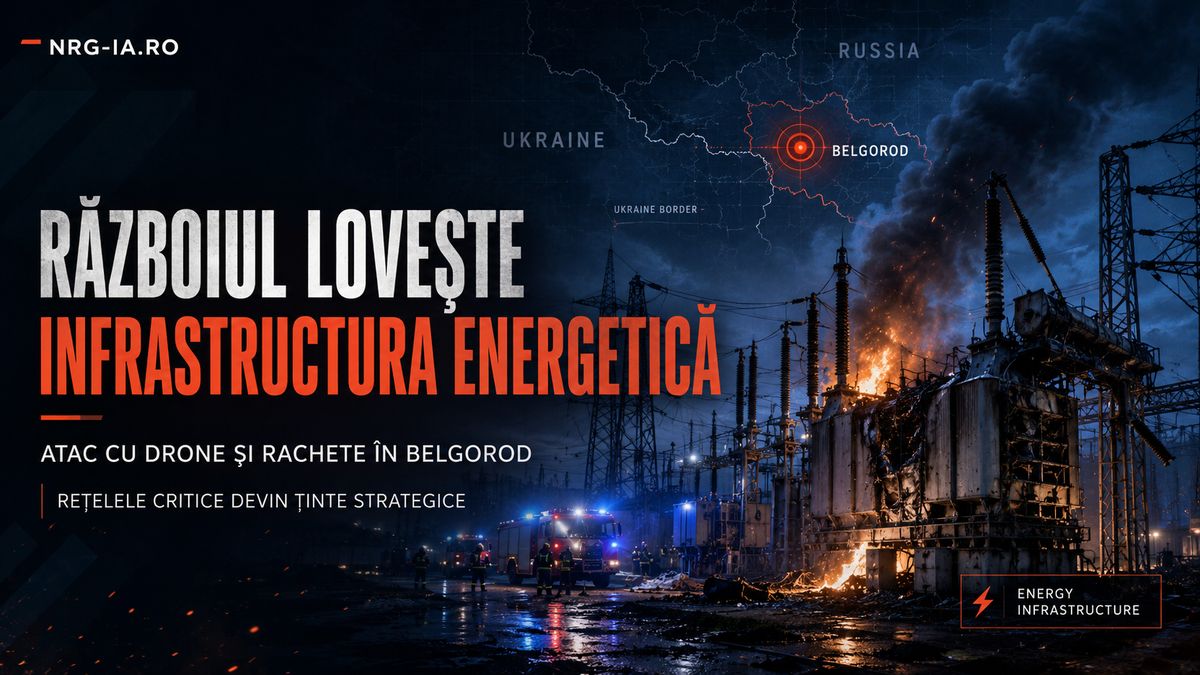
Belgorod, once again in the impact zone of the energy war The reported attack in Belgorod marks another episode in the expansion of the war onto critical infrastructure. According to Reuters, local authorities announced on Telegram that energy infrastructure was damaged following a missile and drone strike on the Russian region bordering Ukraine. The strikes also hit the city of Belgorod, disrupting electricity and water supplies as a result of the impact. Belgorod occupies a sensitive position in the architecture of the conflict. The region lies directly on the Russian-Ukrainian border and has been repeatedly exposed to cross-border attacks. In this case, the stakes go beyond the isolated destruction of a single facility. The damage to the energy infrastructure exerts pressure on local grids, public services, and the regional administration's capacity to maintain normal operations. Reuters noted that it could not independently verify the reports from local authorities, while both Russia and Ukraine deny deliberately targeting civilians. This caveat is essential in a conflict where both sides engage in strategic communication, and information regarding attacks, casualties, and targets must be treated with factual caution. Energy infrastructure becomes a tool for strategic pressure Attacks on energy infrastructure produce effects that extend far beyond the battlefield. A substation, a refinery, a gas processing plant, an oil terminal, or a pumping station can influence regional supply, industrial production, transport, heating, water supply, and the stability of public services. In the current logic of the war, energy functions both as critical infrastructure and as a lever of pressure. A strike on a facility can have an immediate local effect, but also a cumulative impact on the adversary's economic and logistical capacity. Belgorod fits into this map of vulnerabilities: a border region where utilities are directly exposed due to its proximity to Ukraine. Reuters previously published a summary of recent attacks on Russian energy infrastructure, indicating strikes or damage at facilities in Moscow, Astrakhan, Perm, Tuapse, Syzran, Novokuibyshevsk, NORSI, Ufa, Kirishi, Ust-Luga, and in port areas or oil terminals. Refineries and terminals have become vulnerable points The energy dimension of the conflict is most clearly visible in the attacks on refineries and terminals. Russia remains a major player in global oil and petroleum product markets, and any disruption to processing or export capacity can have economic and logistical repercussions. Reuters has recorded shutdowns, fires, or damage at several Russian facilities. The Tuapse refinery was affected by drone attacks, Syzran and Novokuibyshevsk had operations suspended following damage, NORSI—one of Russia's most important refineries—was mentioned in the context of suspended operations, and the Ust-Luga complex saw its condensate processing and naphtha loadings affected. This sequence points to a strategy of attrition against energy capacity. While the impact of each individual strike may be localized, their accumulation increases repair costs, complicates logistics, reduces operational flexibility, and forces Russia to redeploy resources to protect domestic infrastructure. The symmetry of escalation: Belgorod after one of the harshest attacks on Kyiv The attack in Belgorod comes amid a context of mutual escalation. Reuters reported that Russia struck Kyiv and surrounding areas with hundreds of drones and missiles, in one of the most intense bombardments of the Ukrainian capital since the start of the war, including the use of the Oreshnik hypersonic missile. The attack killed four people in Kyiv and the surrounding region and injured nearly 100, according to Ukrainian officials cited by Reuters. This sequence of attacks confirms a pattern of escalation in which civilian, energy, and urban infrastructure bear an increasing share of the cost of war. Russia strikes Ukrainian cities, grids, and facilities. Ukraine exerts pressure on border regions and Russian energy infrastructure. For energy markets, this pattern matters due to the risk premium it introduces. Repeated attacks on refineries, terminals, power grids, and processing facilities inject supply uncertainty, drive up security costs, and add volatility to an energy system already strained by geopolitics. Belgorod alone does not change the market, but it confirms the direction of the war The attack on Belgorod's energy infrastructure has a regional impact, but its editorial significance lies in the trend it confirms. The Russia-Ukraine war is increasingly fought through infrastructure: energy, transport, water, communications, ports, and industrial capacities. For Russia, the vulnerability of domestic infrastructure is becoming more visible. For Ukraine, strikes on Russian energy facilities can reduce the adversary's capacity to finance, supply, and operationally sustain the war. For Europe, the risk…
Aurora AI — Independent Editorial Board
The NRG-IA newsroom continuously monitors Romanian energy markets, ANRE regulatory decisions, and national grid telemetry (SEN/SNT). We deliver independent intelligence anchored exclusively in official primary data.
Editorial Charter, Ethics & Verification Methodology →