Refinery Strikes Reach Moscow, Straining Fuel Markets — NRG-IA
Geopolitică & Energie Author: Ioana BuzoaicaUkrainian strikes on Russian refineries have reached Moscow, targeting critical fuel supply. The impact triggers market pressure and rare fuel imports.
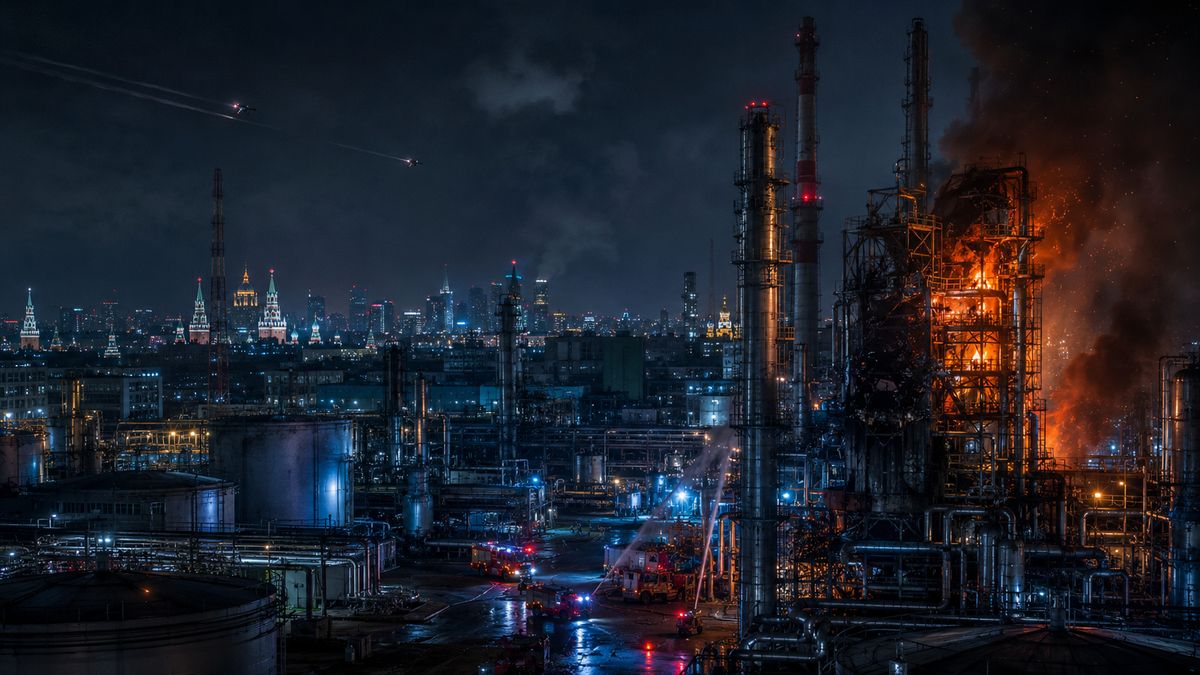
Ukrainian drones have struck Gazprom Neft's refinery in southeastern Moscow for the second time in three days, according to Reuters. The second attack, which occurred on June 18, 2026, damaged processing units and triggered several fires at the site, a facility that plays a direct role in supplying fuel to the Russian capital. The attack elevates the visibility of the Ukrainian campaign against Russian oil infrastructure. It is no longer just about refineries located far from Russia's political center, but an industrial facility located within Moscow itself, approximately 16 kilometers from the Kremlin, according to Reuters. Moscow becomes an energy target, not just a political symbol Striking the Moscow refinery carries a dual significance. The first is operational: the facility helps supply fuel to the capital and the Moscow region. The second is symbolic: critical oil infrastructure has been hit in the political heart of the Russian Federation, at a time when the Kremlin is trying to project control and domestic resilience. Reuters reports that the June 18 attack affected the Euro+ combined unit, commissioned in 2020, which includes a crude distillation section with a capacity of approximately 140,000 barrels per day, equivalent to 47% of the refinery's total capacity. Secondary units, internal pipelines, auxiliary systems, and petroleum product storage tanks were also damaged. The previous attack on June 16 had struck CDU-6, the refinery's other major distillation unit, which has a capacity of approximately 160,000 barrels per day, or 53% of the facility's capacity. The two attacks successively targeted the primary processing components of the Moscow refinery. In 2024, the refinery processed approximately 11.6 million tons of crude oil, equivalent to about 230,000 barrels per day, and produced 2.9 million tons of gasoline, 3.2 million tons of diesel, and 1.3 million tons of bitumen. These figures explain why striking the facility has economic, not just military, relevance. Pressure shifts from the refinery to the fuel market An attack on a refinery does not automatically mean a widespread fuel shortage. Reuters notes that no queues were observed at gas stations in Moscow following the strikes on the refinery. However, market pressure has become visible enough for the Russian antimonopoly authority to demand explanations from a local retailer following a sharp increase in the price of AI-95 gasoline. This is the critical point for the market: the impact of the attacks should not be measured solely in flames, smoke, or damaged capacity, but in how reduced refining capacity translates into prices, logistics, inventories, and administrative decisions. Russia is preparing to import gasoline by sea in June, according to Reuters, in a rare move for one of the world's largest producers and exporters of oil and petroleum products. Sources cited by the agency indicate shipments from Asia, amid shortages caused by repeated attacks on refineries, pipelines, and fuel depots. Shortages are not described as a uniform nationwide phenomenon, but they have been reported in several regions, and some local authorities have confirmed supply issues. The Russian government has maintained restrictions on gasoline exports to preserve volumes for the domestic market during the peak consumption season. Russian refining enters a zone of structural vulnerability The attack on the Moscow refinery is part of a broader campaign against Russian energy infrastructure. Reuters has cataloged several refineries, pipelines, and oil terminals hit in recent months, including major facilities such as Perm, Syzran, Ryazan, Tuapse, Novokuibyshevsk, and Moscow. In May 2026, Reuters reported that fully or partially offline Russian refineries accounted for over 83 million tons per year of capacity, approximately a quarter of Russia's total refining capacity. These same facilities represented over 30% of the country's gasoline production and about 25% of its diesel production. This scale changes the nature of the campaign. Strikes on refineries are no longer just tactical episodes of sabotage, but cumulative pressure on the Russian oil supply chain: processing, finished products, transport, storage, exports, and domestic supply. Russia has vast crude oil production capacity, but the fuel available for the population, the economy, and military logistics depends on refining. Crude oil does not replace gasoline and diesel without functional processing facilities. This is where the vulnerability lies: the attacks do not need to shut down the entire oil sector to produce economic and administrative effects. Fuel quality becomes a crisis management tool The pressure on refining is also reflected in regulation. Kommersant, cited by Reuters, reported that Russia is allowing some refineries to produce fuels with lower environmental specifications for the domestic market, including higher sulfur content and other pollutants, to avoid shortages. This measure…