War Redraws Diesel Map: Africa Shifts Supply to Asia — NRG-IA
Geopolitică & Energie Author: Ioana BuzoaicaAfrica is replacing lost Middle East diesel with Asian imports amid geopolitical risks, lengthening trade routes and intensifying global competition for fuel.
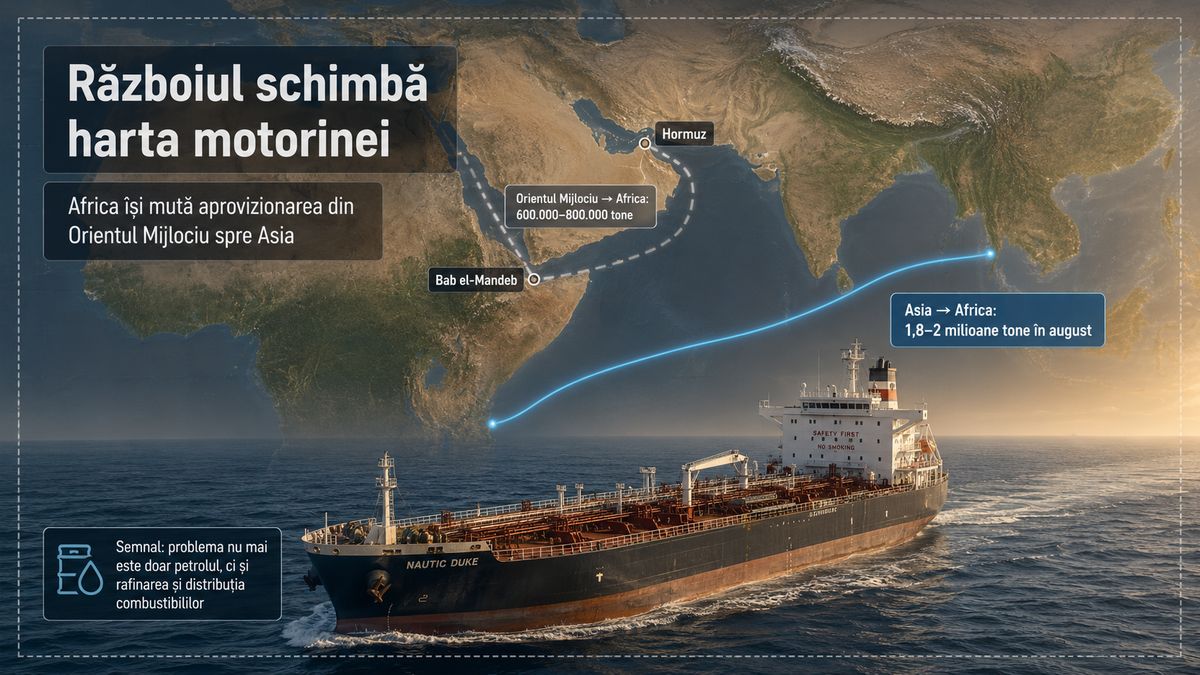
In August, Africa is receiving between 1.8 and 2 million tonnes of diesel from Asia—equivalent to approximately 13.4–14.9 million barrels—marking the highest volume in at least four and a half years. Conversely, shipments from the Middle East have plummeted to just 600,000–800,000 tonnes, a near nine-year low. In a single month, Asia has ended up sending more than twice as much diesel to Africa as the Middle East, in a market where last year roughly half of African diesel imports originated from the Gulf region. This shift is far more significant than it appears. It does not merely show that vessels have been rerouted; it indicates that conflict is beginning to physically alter the pathways of the fuel that keeps transport, agriculture, and much of the real economy moving. Diesel is still available, but it must be brought from further away. This is one of the clearest signals that the current energy crisis can no longer be tracked solely through the price of a barrel of crude. Africa Finds Diesel in Asia Following the Retreat of Gulf Supply The Middle East was the natural supplier for much of Africa. Shipping distances are shorter than from Asia, Gulf refineries operate at massive scale, and Saudi Arabia alone secured a significant share of regional deliveries. The US-Iran conflict and expanding maritime shipping risks have altered this equation. The Strait of Hormuz remains one of the world's most critical energy transit chokepoints, with approximately 20 million barrels per day of crude and petroleum products transiting in 2025. Any decline in maritime security affects not only crude oil, but also the refined fuels that must leave the Gulf. On the other major route, the Bab el-Mandeb and the Red Sea remain exposed to attacks and restrictions associated with the conflict involving Houthi rebels. Vessels avoiding this area are forced to take much longer routes around the Cape of Good Hope, increasing transit times and shipping costs. Compounding these issues is a reduction in certain Saudi exports. The Jazan refinery, which had sent approximately 163,000 tonnes of diesel to Africa in July, did not ship similar volumes to the continent in August, according to data cited by Reuters. The gap was primarily filled by Asia, with India at the forefront, alongside a larger contribution from other Asian refineries with export availability. The Market Functions, but Fuel is Traveling Further The fact that Africa is securing its required diesel is a sign of resilience. The global market has not broken down. When one supplier delivers less, price differentials quickly attract cargo from other regions. Asian refineries produce more for export, African buyers switch sources, and tankers follow the new trade opportunities. The issue, however, is the cost of this adaptation. A system where diesel must be brought from India or other parts of Asia instead of nearby Middle Eastern sources ties up vessels for longer periods, consumes more bunker fuel, and locks up shipping capacity that can no longer be deployed on other routes. Furthermore, every buyer shifting to Asia enters into competition with markets that already depended on those refineries. Africa does not buy in a vacuum; other regions are simultaneously competing for the same available volumes. Having Crude Oil is No Longer Enough The 2026 crisis highlights a fundamental distinction for consumers: crude oil and diesel are not the same thing. A barrel extracted from a field must be transported to a refinery, processed into useful products, and then distributed to the markets where they are consumed. A disruption at any of these stages can keep diesel prices high even if the world continues to produce large volumes of crude. In August, Asian imports of refined petroleum products fell to approximately 5.1 million barrels per day, the lowest level since the start of the conflict and nearly 2 million barrels per day below pre-war levels. At the same time, diesel prices on the Singapore market had risen to about 70% above late-February levels. The issue is thus shifting from the mere existence of the resource to two more concrete questions: how many refineries can produce the necessary fuel, and how easily can it reach the consumer? Conflicts are currently impacting a significant portion of global oil infrastructure. At the end of August, Reuters estimated that over 10% of global refining capacity was offline or disrupted by conflicts. In such a tight market, every lost refinery carries greater weight. Diesel Transmits War Shocks to the Everyday Economy For the general public, the relevance of this shift does not lie in trade balance sheets. Diesel powers the trucks that transport food and goods, agricultural machinery, a major portion of construction, mining, and logistics. In many African economies, diesel generators also provide electricity when the grid falls short. The World Bank estimates that road transport consumes about 80% of the fuel imported by the continent,…
Ioana Buzoaica — Independent Editorial Board
The NRG-IA newsroom continuously monitors Romanian energy markets, ANRE regulatory decisions, and national grid telemetry (SEN/SNT). We deliver independent intelligence anchored exclusively in official primary data.
Editorial Charter, Ethics & Verification Methodology →