Iran Attacks US Bases; Trump Threatens Iranian Power Grid — NRG-IA
Geopolitică & Energie Author: Ioana BuzoaicaThe US-Iran conflict expands beyond military targets near Hormuz, risking regional shipping, global energy markets, and civilian infrastructure.
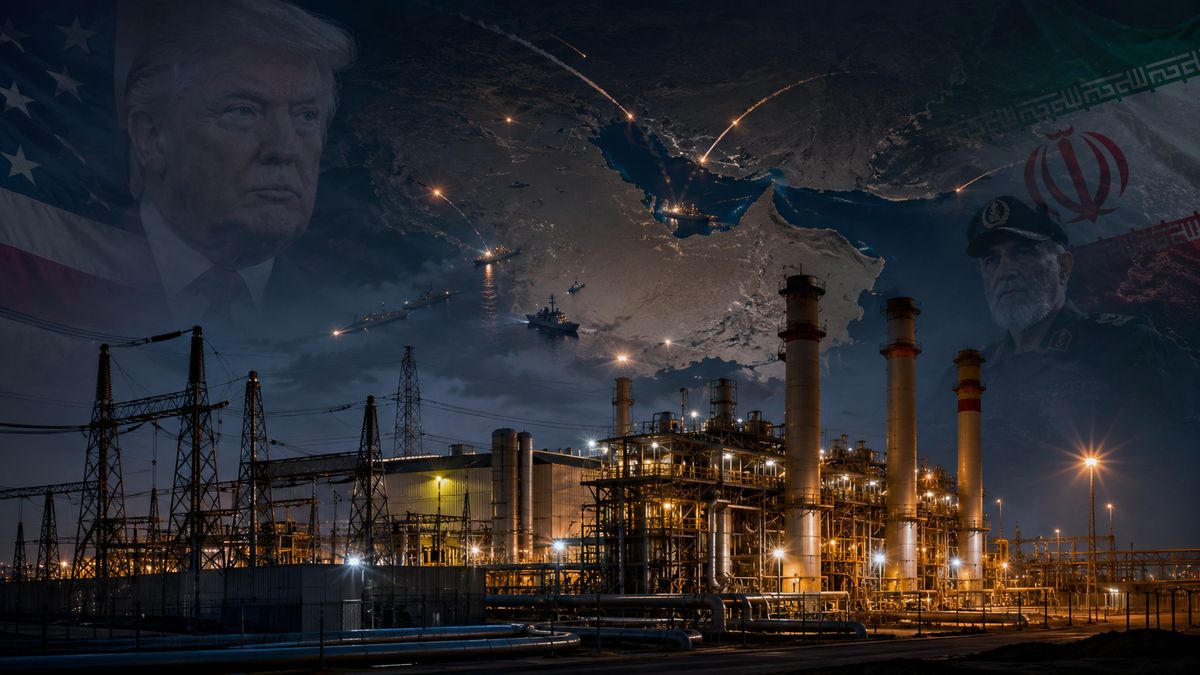
The conflict between the United States and Iran has entered a phase where the boundary between military confrontation, economic pressure, and energy security is becoming increasingly fragile. Iran claims to have attacked US military positions and installations in Bahrain, Kuwait, and Jordan, following a new series of strikes carried out by the United States against Iranian targets. Meanwhile, US President Donald Trump has reinstated the naval blockade on Iran's ports and warned that power plants and bridges could become targets if Tehran refuses to return to negotiations. The escalation is no longer just about control of the Strait of Hormuz or Iranian military capabilities stationed along the coast. The confrontation is expanding to the regional network of US bases and explicitly introduces the infrastructure powering Iran's economy and population into Washington's military calculus. This shift substantially increases the risk of conflict. A strike on a radar, a missile launcher, or a naval facility produces predominantly military effects. Attacking a power plant, however, can simultaneously shut down power to homes, hospitals, water systems, telecommunications, transport, and industrial facilities. Iran expands retaliation to the US military network The US military presence in the Middle East is distributed across a network of bases, ports, surveillance facilities, and air defense systems. Bahrain hosts the headquarters of the US Navy's Fifth Fleet, while Kuwait and Jordan play key roles in Washington's regional logistics and operations. For Iran, these facilities represent the infrastructure that allows the United States to rapidly project military power toward Iranian territory and the Strait of Hormuz. Tehran claims to have attacked US installations in Bahrain and Kuwait, as well as command centers and drone hangars in Jordan. Jordanian authorities reported intercepting several missiles, but the extent of the damage claimed by Iran has not been fully confirmed by independent sources. This gap between the launched attacks and their actual results is crucial. While Iran's capability to launch missiles and drones at multiple states is proven, the effectiveness of these strikes is limited by the defense systems of the United States and its regional allies. Even intercepted attacks, however, produce political and economic consequences. They force host nations to activate their defenses, disrupt air traffic, increase risks to civilian infrastructure, and turn the territories of Washington's allies into direct arenas of confrontation. The threat to power plants changes the nature of US pressure Donald Trump conditioned the threat against power plants and bridges on Iran's refusal to return to negotiations. At this moment, there is no confirmation of an attack order against these targets, but their mere inclusion in the US president's public rhetoric marks an escalation. Iran's electrical grid sustains the operation of its entire economy. Refineries, oil facilities, pumping stations, water networks, hospitals, telecommunications, transport, and industrial production all depend on it. During the summer months, when electricity consumption spikes, the destruction of major power plants or transmission hubs could cause widespread blackouts. The effects would not be limited to reducing Iran's military capability but would cascade to services relied upon by tens of millions of people. A major bridge can serve both civilian and logistical roles. A power plant can supply both a military facility and entire cities. It is precisely this dual-use nature that makes selecting and evaluating such targets far more sensitive than in the case of purely military objectives. International humanitarian law requires parties to distinguish between military objectives and civilian objects, assess the proportionality of an attack, and take measures to minimize harm to the civilian population. Energy infrastructure is protected as long as it does not meet the strict criteria to become a military objective, and predictable civilian impacts must be factored in even when a facility has some military utility. Power outages produce cascading effects. Without electricity, water pumping, refrigeration of medicine and food, hospital operations, communications, and sewage systems can all be compromised. The experience of other conflicts shows that damaging energy infrastructure can rapidly turn a military operation into a widespread humanitarian crisis. The US blockade puts Iranian ports back at the center of the conflict The United States has announced the resumption of a maritime blockade on traffic to and from Iranian ports, alongside new strikes on capabilities Washington deems involved in attacking commercial vessels. The blockade directly targets Iran's ability to export crude oil, petroleum products, and other commodities, as well as its capacity to import equipment and resources necessary for its economy and military operations.…
Ioana Buzoaica — Independent Editorial Board
The NRG-IA newsroom continuously monitors Romanian energy markets, ANRE regulatory decisions, and national grid telemetry (SEN/SNT). We deliver independent intelligence anchored exclusively in official primary data.
Editorial Charter, Ethics & Verification Methodology →