Nuclear Microreactors: 24/7 Power for AI & Defense — NRG-IA
Tehnologie & Inovație Author: Ioana BuzoaicaThe Pentagon is pushing nuclear microreactors into real-world use, driven by the same 24/7 power demands currently facing AI data centers.
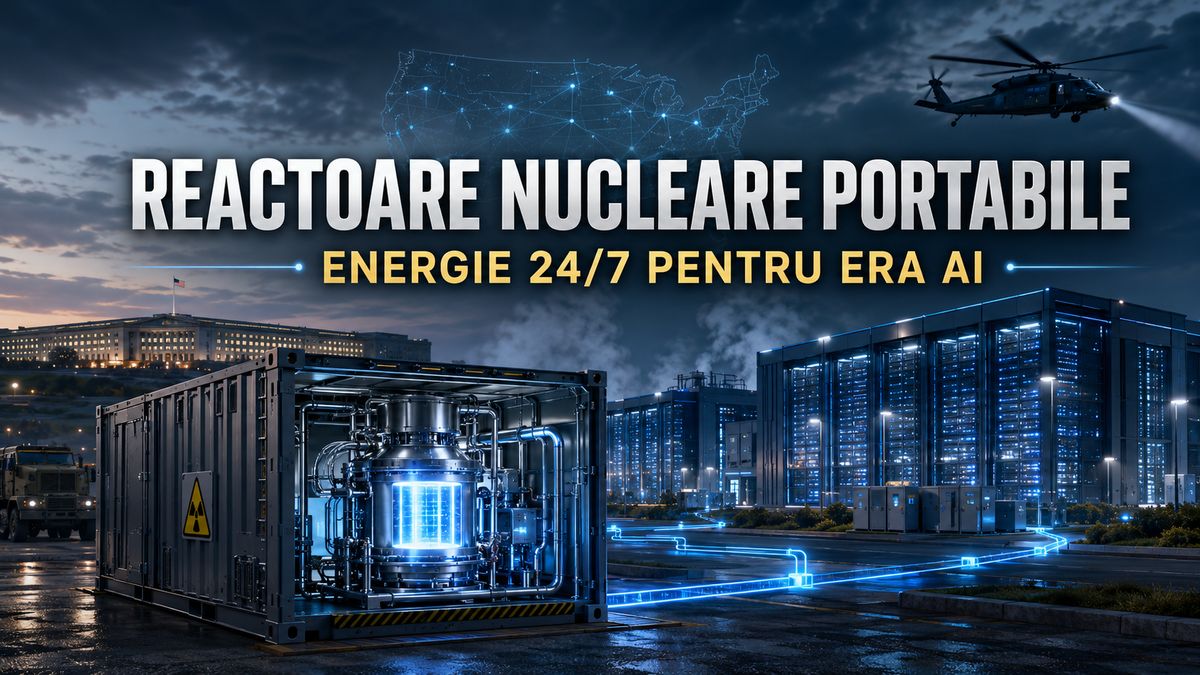
Nuclear microreactors are entering a phase where energy, military technology, and artificial intelligence converge at the same critical juncture: the need for continuous, localized, and resilient power. Reuters notes that US military backing is accelerating microreactor development in the United States, while experts warn that large-scale commercial deployment remains contingent on costs, safety, licensing, and specialized nuclear fuel. Microreactors typically have capacities between 1 MW and 20 MW and are promoted as solutions that can be manufactured faster, assembled modularly, and installed closer to consumers than conventional nuclear reactors or even some larger SMR designs. Energy becomes the physical limit of the AI era Artificial intelligence has shifted the energy conversation into a much more concrete arena. Data centers are no longer just digital infrastructure, but large, geographically concentrated industrial electricity consumers with high demand and a need for continuous power. The IEA estimates that data centers consumed approximately 415 TWh in 2024, representing about 1.5% of global electricity consumption, with their demand projected to more than double by 2030 to around 945 TWh. The IEA points to AI as the primary driver of this growth, alongside the rising demand for digital services. This pressure is changing the criteria used to evaluate energy technologies. For an AI data center, cheap energy matters, but energy available on time can matter even more. Grid connections are delayed, transformers and turbines face long lead times, and the IEA warns that approximately 20% of planned data center projects could be at risk of delay if grid bottlenecks persist. Under this logic, the nuclear microreactor becomes attractive not because of its size, but due to its promise to deliver firm, long-term power close to the consumer, with a small physical footprint and continuous operation. For the AI industry, this combination hits a critical sweet spot: 24/7 electricity, predictability, resilience, and reduced dependence on grid congestion. The Pentagon is testing the container-sized reactor The most prominent US project is Project Pele, led by the Department of Defense's Strategic Capabilities Office. The DOE indicates that the project aims to design, build, and demonstrate a transportable high-temperature gas-cooled nuclear reactor at the Idaho National Laboratory, with an estimated electrical output of 1 to 5 MW. The reactor is to be manufactured by BWX Technologies, transported in 20-foot shipping containers, and connected to the INL microgrid for testing. The military stakes are clear. Remote bases, communication systems, command, defense, weapons, and critical installations currently rely heavily on diesel and vulnerable logistics chains. Reuters notes that the first microreactors are being developed for defense purposes precisely because their size makes them suitable for off-grid power at military installations, communication networks, and weapon systems that currently depend heavily on diesel. For the Pentagon, a portable reactor is more than just a power source. It is a reduction in logistical vulnerability. Every base that can operate for years on a local generation system reduces dependence on fuel convoys, exposed shipments, and supply chains that can become targets in a conflict. TRISO: The tiny fuel changing reactor architecture Project Pele relies on TRISO fuel, one of the central technological building blocks of the new generation of microreactors. The Idaho National Laboratory explains that TRISO particles consist of uranium, carbon, and oxygen, coated with multiple layers, including silicon carbide, for high resistance to temperature, radiation, and corrosive environments. Thousands of poppy-seed-sized particles are integrated into compact fuel forms for advanced reactors. The first batch of TRISO fuel for Project Pele was delivered to the Idaho National Laboratory in December 2025, a step presented by INL as a major milestone for demonstrating the mobile reactor. US officials explicitly linked this progress to the goal of accelerating advanced nuclear technologies and future military resilient energy programs. This technology is relevant to the public because it changes the classic image of a nuclear reactor. The microreactor does not attempt to compete with Cernavodă, Vogtle, or Flamanville in scale. It falls into a different category: compact production, located near the consumer, with long operating cycles and a design focused on passive safety and transportability. Janus takes the microreactor from prototype to real bases Following Project Pele, the US military launched the Janus Program, a phase closer to deployment at military installations. The U.S. Army announced that it has selected nine installations for evaluation as potential microreactor sites: Fort Benning, Fort Bragg, Fort Campbell, Fort Drum, Fort Hood, Fort Wainwright, Holston Army Ammunition Plant, Joint Base…
Ioana Buzoaica — Independent Editorial Board
The NRG-IA newsroom continuously monitors Romanian energy markets, ANRE regulatory decisions, and national grid telemetry (SEN/SNT). We deliver independent intelligence anchored exclusively in official primary data.
Editorial Charter, Ethics & Verification Methodology →