Cernavodă 3 & 4: Fast-tracked, but delayed to 2033-2034 — NRG-IA
Piața de Energie Author: Ioana BuzoaicaRomania fast-tracks Cernavodă 3 & 4 with tax exemptions and land waivers, but delays commercial launch to 2033–2034, leaving a 7-year nuclear capacity gap.
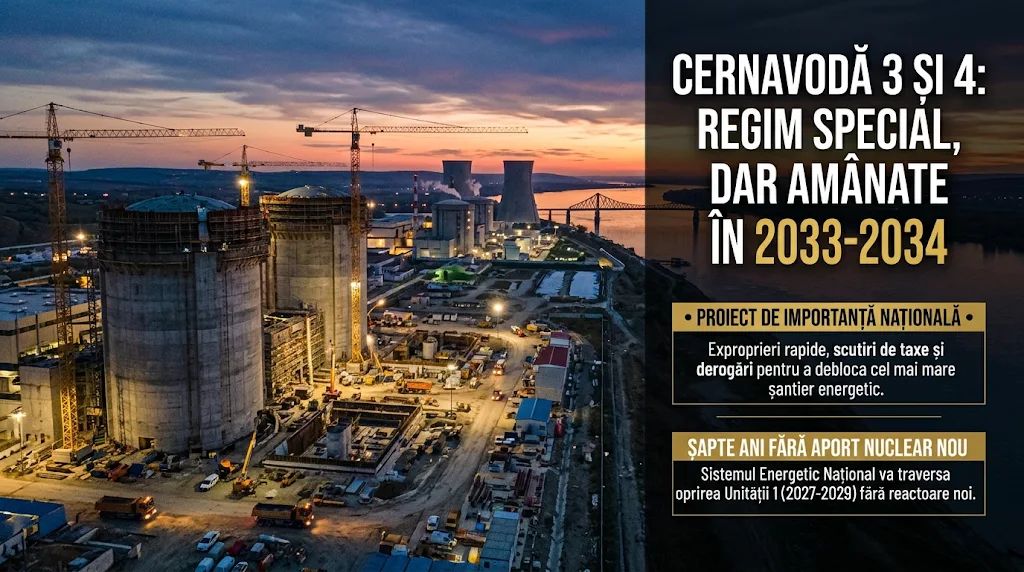
On November 11, 2026, Romania's Ministry of Energy published for public consultation a draft Government Decision designating Units 3 and 4 of the Cernavodă Nuclear Power Plant as a strategic project of national importance in the electricity sector. The document grants Romania's largest baseload power generation investment the strongest fast-track legal framework available under domestic law—ranging from construction tax exemptions to expedited land expropriation and forestland conversion—while simultaneously pushing the official target for commercial operation to 2033 for Unit 3 and 2034 for Unit 4. Compared to the schedule agreed upon in November 2024 at the signing of the Engineering, Procurement, and Construction Management (EPCM) contract—when grid connection for the two CANDU 6 reactors was expected in 2031 and 2032—the updated government documentation confirms a two-year delay. Each unit will have a gross installed capacity of at least 724 MW, adding a combined total of at least 1,448 MW gross and an estimated annual carbon-free electricity generation of roughly 11 million MWh—equivalent to nearly one-fifth of Romania's current annual consumption. This dual administrative and scheduling shift coincided with a week that highlighted the vulnerability of Romania's National Power System in the absence of nuclear output. On November 11 and 12, when one reactor at Cernavodă was shut down and the second operated at half capacity before returning to full power at the end of the week, Romania's real-time electricity imports surpassed 3,000 MW. Tax Exemptions, Accelerated Expropriations, and Waivers for Forests and Protected Areas Classifying Units 3 and 4 as projects of national importance leverages a legal mechanism added to Energy Law No. 123/2012 via Emergency Ordinance No. 134/2024. Originally introduced in 2019 to unblock high-voltage power lines and gas interconnectors and later extended to strategic generation assets, this status designates the investment as a public utility and national security objective, eliminating key administrative and land access bottlenecks ahead of site expansion. In practice, the Ministry of Energy's explanatory memorandum targets a specific obstacle on and around the Cernavodă site. Construction site laydown areas, grid interconnections, access roads, and auxiliary structures for the new reactors require temporary or permanent removal of adjacent plots from the national forest stock and agricultural use in a Dobrogea and Danube region governed by strict environmental protection regimes. Under standard administrative procedures, environmental conservation takes precedence over all other objectives, and forestry approvals can stall major energy construction sites for years. Once the Government Decision is enacted and published in the Official Gazette, project company EnergoNuclear will benefit from an overriding public interest exemption under Emergency Ordinance No. 57/2007 on protected areas—while maintaining European obligations for environmental impact assessment and ecological compensation—alongside expedited expropriation procedures provided by Law No. 255/2010. The special status directly reduces pre-construction development costs as well. The project is exempt from taxes and fees for urban planning certificates, building permits, and mandatory contributions to the State Inspectorate for Construction—providing tangible financial relief for an investment whose total cost is estimated at around €7 billion. Why Commissioning of the New Reactors Is Shifted to 2033 and 2034 Adjusting the target commercial operation dates to 2033 and 2034 aligns the government's official timeline with the actual technical and financial architecture of the project, approved by Nuclearelectrica shareholders on October 29, 2026. The project is not yet in the nuclear island construction phase; it is undergoing Phase II, dedicated to preliminary works, which carries a contractually mandated duration of 30 months. These preliminary works are being executed in partnership with the FCSA Joint Venture—comprising US firms Fluor and Sargent & Lundy, Canada's AtkinsRéalis (owner of CANDU technology), and Italy's Ansaldo Nucleare—with which EnergoNuclear signed an estimated €3.2 billion contract in November 2024. Over this 30-month period, the consortium will complete detailed engineering for a firm budget estimate, navigate licensing stages with the National Commission for Nuclear Activities Control (CNCAN), prepare procurement for long-lead items, and structure project debt financing. Although transmission system operator Transelectrica has already issued the technical grid connection approval for the two new units, transitioning from the preliminary phase to Phase III (actual construction) hinges on two key milestones: the formal Final Investment Decision (FID) and prior approval of the State Aid scheme by the European Commission. Given that these consecutive phases—30 months of preliminary works…
Ioana Buzoaica — Independent Editorial Board
The NRG-IA newsroom continuously monitors Romanian energy markets, ANRE regulatory decisions, and national grid telemetry (SEN/SNT). We deliver independent intelligence anchored exclusively in official primary data.
Editorial Charter, Ethics & Verification Methodology →