Kaleidos: 1-MW Transportable Reactor Gets $750M US Backing — NRG-IA
Tehnologie & Inovație Author: Ioana BuzoaicaRadiant aims to turn nuclear reactors into mass-produced, transportable units. Key markets include military bases, data centers, and remote mines.
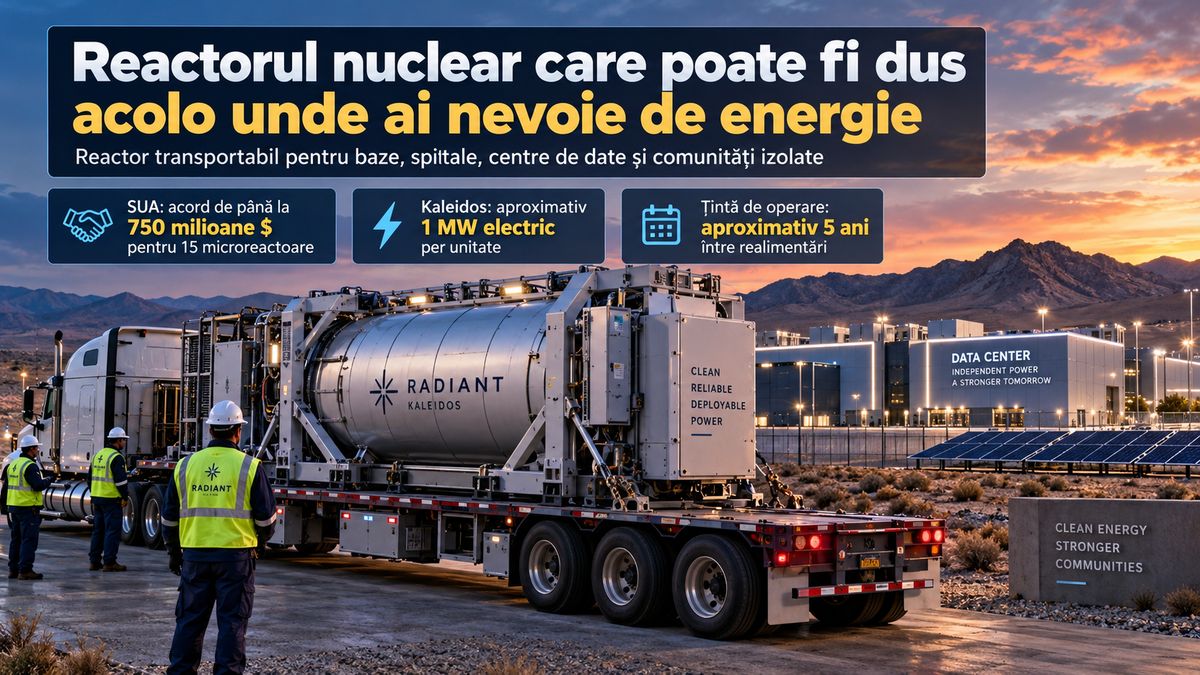
A nuclear power plant is almost inevitably associated with a massive construction site, years of building, and a facility that will remain in the same place for decades. Radiant is trying to radically change this logic: it is building a 1-MW electric reactor compact enough to be transported by road or air and designed to operate for approximately five years between refuelings . The project has already moved past the rendering stage. A Kaleidos unit was transported from California to the Idaho National Laboratory for the DOME testing program, and the US Army has signed an agreement with Radiant worth up to $750 million to develop and deploy 15 microreactors under the Janus program. Funding is tied to achieving technical milestones, and commercial reactors must still undergo testing and licensing. However, the industrial direction is already very clear: nuclear energy is attempting to transition from site-built power plants to reactors manufactured, transported, and installed right next to the consumer . For the energy market, the difference could be massive. The reactor goes to the consumer, instead of the grid going to the reactor A commercial Kaleidos is designed for approximately 1-MW electric . This is a tiny output compared to the 1,000+ MW of a conventional nuclear reactor, but that is precisely the point. Radiant is not trying to replace large nuclear power plants. It wants to bring nuclear energy to places where building a large plant makes no sense, and where continuous grid power is difficult, expensive, or vulnerable. An isolated mine might need electricity hundreds of kilometers away from major energy infrastructure. A data center might wait years for the local grid to secure the necessary capacity. A military base might view continuous diesel supply as a vulnerability. A hospital or emergency response center must keep running even if the surrounding grid fails. In such scenarios, the advantage of a transportable reactor is not just electricity generation. It is the ability to move the energy source next to the consumer . If a site requires more than 1 MW, the concept can be scaled by installing multiple units. This fundamentally changes the logic of nuclear power: capacity can be added in modules as demand grows. Five years between refuelings can eliminate hundreds of fuel shipments For remote sites, the most valuable feature of Kaleidos may be the duration between refuelings. A diesel generator requires constant fueling. Diesel must be purchased, transported, stored, and kept available regardless of weather, distance, or security conditions. Kaleidos is designed for approximately five years of operation before refueling . Radiant's model envisions the unit being returned to the company's factory for this operation, rather than managing the entire fuel cycle at the customer's site. For a consumer connected to a robust grid, this advantage might seem abstract. For a military base or a mining operation in a hard-to-reach region, it could mean eliminating a major portion of energy logistics. Therefore, the primary competitor of such a microreactor is not necessarily a solar farm built in a grid-abundant region. In many of the targeted applications, the real competitor is the diesel generator and the truck that must constantly deliver its fuel . The US Army wants power that keeps running when the grid is gone The Pentagon's interest in microreactors stems from this exact issue. The Janus program aims to reduce the reliance of military installations on external grids that could become unavailable due to attacks, outages, or disasters. Radiant is one of five companies selected for the program. The Army has allocated up to $2.2 billion for the development of this generation of microreactors, with Radiant's agreement reaching up to $750 million for 15 units, contingent on meeting established milestones. For a military base, electricity is not just about lighting. It means communications, command centers, radars, servers, defense systems, and logistical infrastructure. In this context, an energy source that can operate for years between refuelings also becomes a security asset. The same principle applies to civilian sectors where power continuity is critical. A hospital or emergency response center could receive a power source alongside disaster relief infrastructure Idaho National Laboratory lists critical facilities and disaster relief operations among the potential applications for microreactors. Following an earthquake, hurricane, or major wildfire, restoring power lines can take days or weeks. Today, the energy response relies heavily on generators and fuel transported to the affected area. A transportable reactor introduces another possibility: a megawatt-scale power source that can operate locally for a very long period without continuous fuel replenishment. For field hospitals, water pumping systems, communications, and critical infrastructure, this model could reshape the economics of emergency…