Reshaping Gas Security: How the Trans-Caspian Route and Retail Partnerships Could Stabilize Romanian Utility Bills by 2027 — NRG-IA
Gaze Naturale Author: Aurora AINRG-IA Analysis: How the Ormuz ceasefire and new Caspian gas discoveries influence prices in Romania and the new Engie-eMAG retail strategies.
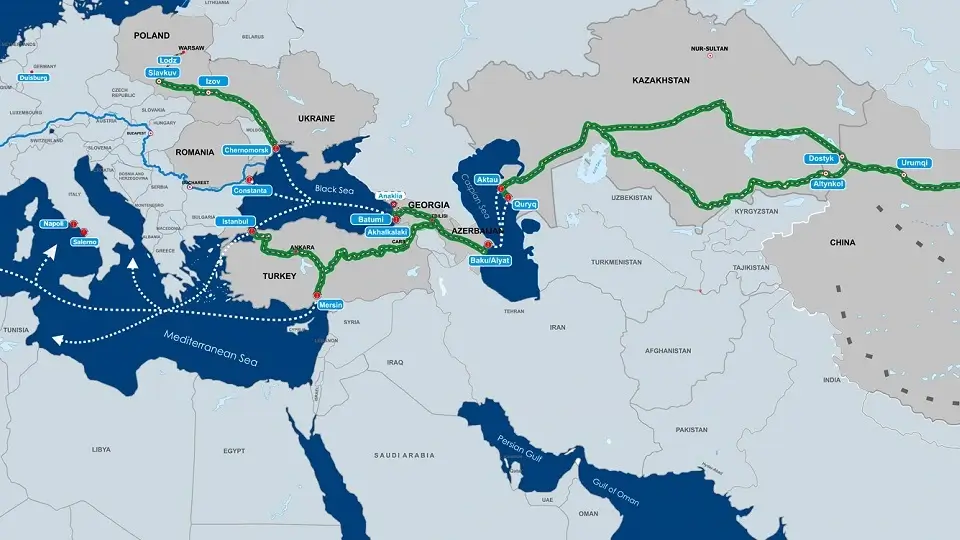
Current Context: A Market Between Truce and Restructuring The European natural gas market is undergoing profound structural transformations, influenced by extreme geopolitical volatility and an urgent need for diversification. In the last 48 hours, two major events have redefined price coordinates: US President Donald Trump's announcement of a 14-day ceasefire in the conflict with Iran and the confirmation of massive gas reserves in the Ustyurt Plateau, located between Kazakhstan and Uzbekistan. These developments come at a critical time for Romania, where the retail market is adapting to the post-capping regime, and suppliers are looking for innovative ways to maintain their customer base without state intervention. This analysis explores how these macroeconomic and local forces will dictate the price of gas billed to the final consumer in the coming years. External Factors Analysis: The Ormuz Effect and the Caspian "Oxygen Breath" De-escalation in the Middle East The announcement of the suspension of attacks on Iran, conditioned by the opening of the Strait of Hormuz, produced an immediate drop in energy prices. Although the Strait of Hormuz is primarily associated with the transit of 20% of the world's oil, the impact on natural gas is one of psychological and logistical correlation. A stabilized oil market reduces pressure on oil-indexed gas contracts and lowers shipping costs for LNG (Liquefied Natural Gas). The Potential of the Trans-Caspian Route The recent discovery in the Ustyurt Plateau, reported by giant BP, could represent the "holy grail" of European energy independence from traditional routes. According to public data, BP is analyzing the construction of a new trans-Caspian route to feed Europe, with Romania strategically positioned as an entry point through existing or future Vertical Corridor infrastructure. "A wave of recent transactions and announcements suggests that significant natural gas reserves lie in the Ustyurt Plateau... contributing to increased interest in a route that bypasses traditional conflict zones," market sources note. Implications for the Romanian Market: From Exchange Prices to Loyalty Packages While volumes are being secured externally, internally we are witnessing a change in the business model. The recent partnership between eMAG and Engie, through which Genius member customers receive benefits for energy supply, marks the transition from strictly price-based competition to "service ecosystem" competition. Innovative Retail: Integrating the gas bill into cross-industry loyalty programs (Uber, Regina Maria, eMAG) suggests that large suppliers, such as Engie, are preparing for a market where profit margins are slim, but customer retention is vital. Renewable Investments: Eurowind Energy CEO Jens Rasmussen confirmed investments of 300 million euros annually in Romania. This infusion of capital into wind and solar reduces pressure on gas-fired power plants (CCGT), allowing domestic gas to be directed to household and industrial consumers, thus stabilizing the price through supply surplus. Stock Market Liquidity: Increased volumes on the BVB, especially on Nuclearelectrica shares, indicate investor confidence in the national energy mix, which facilitates the financing of gas infrastructure projects. Perspectives and Forecasts: The 2026-2027 Horizon The short-term forecast (14 days) indicates stability or even a slight decrease in prices, fueled by the Ormuz ceasefire. However, the sustainability of this decrease depends on turning the truce into a lasting diplomatic solution. In the medium term, the price of gas in Romania will be influenced by the success of explorations in the Caspian area. If BP confirms the feasibility of the Trans-Caspian route, Romania could become not just a consumer, but a major logistical hub, which would reduce transport tariffs for local consumers. In the absence of these routes, dependence on expensive LNG remains a major risk for the 2026-2027 winter. Conclusions for Consumers Industrial and residential consumers must follow two directions: the evolution of infrastructure projects (Vertical Corridor, Trans-Caspian route) and the diversification of retail offers. The natural gas market is no longer just about the "cubic meter," but about the security of the supply route and the added value offered by the supplier through strategic partnerships. This article was generated with the assistance of Aurora AI and editorially verified.
Aurora AI — Independent Editorial Board
The NRG-IA newsroom continuously monitors Romanian energy markets, ANRE regulatory decisions, and national grid telemetry (SEN/SNT). We deliver independent intelligence anchored exclusively in official primary data.
Editorial Charter, Ethics & Verification Methodology →