Romania Wind Record: Generation Surpasses 3,000 MW — NRG-IA
Energie Regenerabilă Author: Aurora AIHistoric milestone in Romanian energy: wind turbines surpassed 3,000 MW instant output on Friday, operating at 91% of total installed capacity.
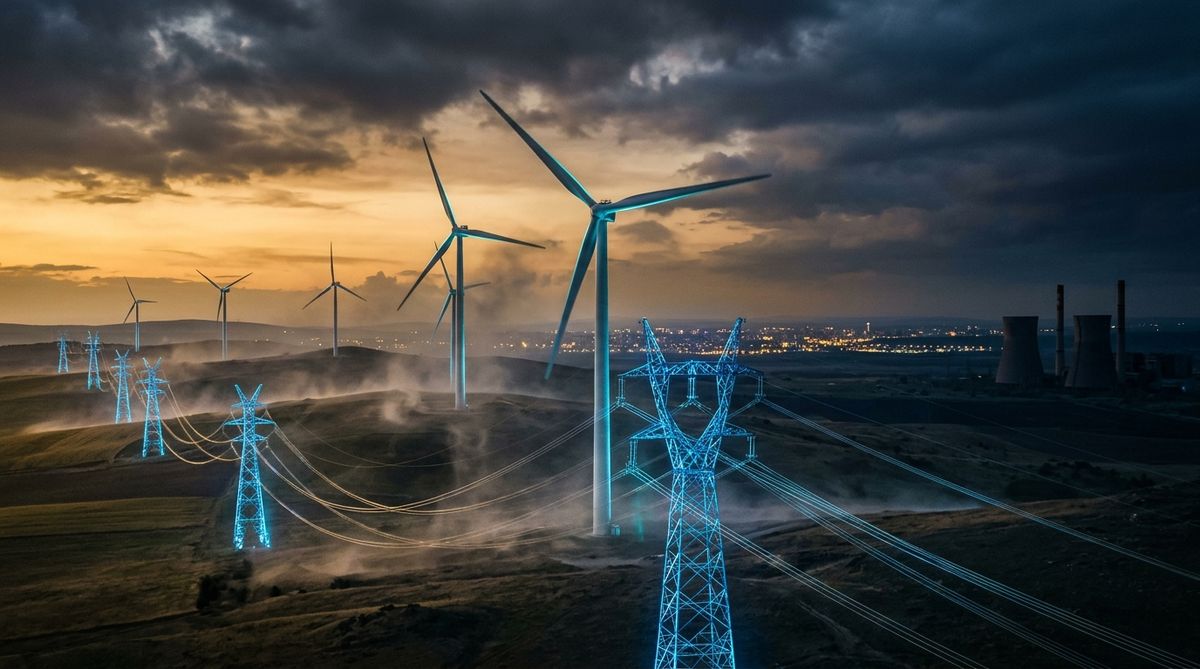
Historical Record at 18:00: Wind Turbines Hit 3,038 MW Instant Generation Romanian wind farms generated a record instant output of 3,038 MW on Friday evening at 18:00, crossing the 3,000 MW threshold for the first time in the history of the National Power System (SEN). The milestone was recorded by national grid dispatch data and initially reported by energy publication e-nergia.ro, with subsequent confirmation from Economica.net. At peak generation, wind turbines across Romania operated at a capacity factor of 91% out of a total installed capacity of approximately 3,300 MW. Such a high utilization rate is exceptionally rare for aggregated country-wide wind fleet performance, where average operational capacity factors typically range between 25% and 35%. Wind generation directly covered more than 30% of total national electricity consumption during the evening peak demand window. The near-total mobilization of generation assets located in Dobrogea and Moldavia temporarily elevated wind energy to the single largest source in the national power mix, outperforming hydro generation and the Cernavodă nuclear power plant. Surpassing the 3,000 MW milestone marks a technical turning point for Romanian energy infrastructure. The event demonstrates that wind assets developed over the past decade of renewable investments can deliver massive power volumes to the grid under optimal atmospheric conditions and minimal maintenance downtime. Atmospheric Front over Dobrogea and 91% Fleet Availability The direct cause of this historical surge was the convergence of a strong atmospheric wind front across Romania's primary wind basins, particularly the Dobrogea region and southern Moldavia. Wind speeds remained steady without extreme turbulence, preventing turbines from triggering automatic high-wind shutdown protections. Alongside favorable meteorological conditions, high technical availability across grid connection infrastructure proved decisive. Wind farm operators maintained full operational readiness, avoiding major maintenance overhauls or line outages at grid substations during the atmospheric event. According to data analyzed by e-nergia.ro and Economica.net, precise synchronization between weather conditions and grid availability allowed the absorption of all 3,038 MW without the National Power Dispatcher (DEN) resorting to renewable curtailment orders to safeguard regional transmission lines. OPCOM Spot Price Pressure and Fossil Fuel Displacement The massive influx of zero-marginal-cost renewable energy during peak evening hours exerted immediate downward pressure on the day-ahead spot market (PZU) operated by OPCOM. Record wind output displaced expensive gas- and coal-fired thermal power plants, which carry high operational costs tied to EU ETS carbon allowances. The merit-order effect lowered clearing prices during peak hours, easing wholesale procurement costs for suppliers covering residential and industrial loads. Thermal generation was scaled down to technical minimums required solely for voltage stability and fast tertiary reserve services. However, concentrating such a large volume of generation in a single geographic zone — Dobrogea — placed significant stress on transmission nodes managed by grid operator Transelectrica. The 400 kV high-voltage corridors evacuating power from Dobrogea toward major consumption centers operated near maximum thermal limits, highlighting the grid's reliance on east-west power corridors. Transelectrica Stress Test and the Urgency of Battery Storage Friday's record highlights structural challenges facing the National Power System as new renewable capacities enter service under Contracts for Difference (CfD) schemes and Modernisation Fund programs. Managing instantaneous generation exceeding 3,000 MW without utility-scale battery energy storage systems (BESS) heightens grid balancing risks during rapid weather shifts. Transmission System Operator Transelectrica is executing reinforcement projects on the 400 kV Dobrogea-Bucharest axis and upgrading cross-border interconnectors. Nevertheless, national utility-scale storage deployment lags behind the pace of new wind and solar additions. In the near term, without large-scale storage capacity and pumped-hydro assets, periods of record wind production will contrast sharply with sudden deficits when wind speeds drop. Energy regulators and grid operators face mounting pressure to accelerate storage tenders to prevent mandatory curtailment during future supply surges.
Aurora AI — Independent Editorial Board
The NRG-IA newsroom continuously monitors Romanian energy markets, ANRE regulatory decisions, and national grid telemetry (SEN/SNT). We deliver independent intelligence anchored exclusively in official primary data.
Editorial Charter, Ethics & Verification Methodology →