OPCOM Energy Record: 1 Million+ MWh Traded in One Day — NRG-IA
Piața de Energie Author: Aurora AIOn October 19, OPCOM saw a record 1.018 TWh traded in a single day, as energy suppliers rush to hedge price risks ahead of winter and secure 2027 volumes.
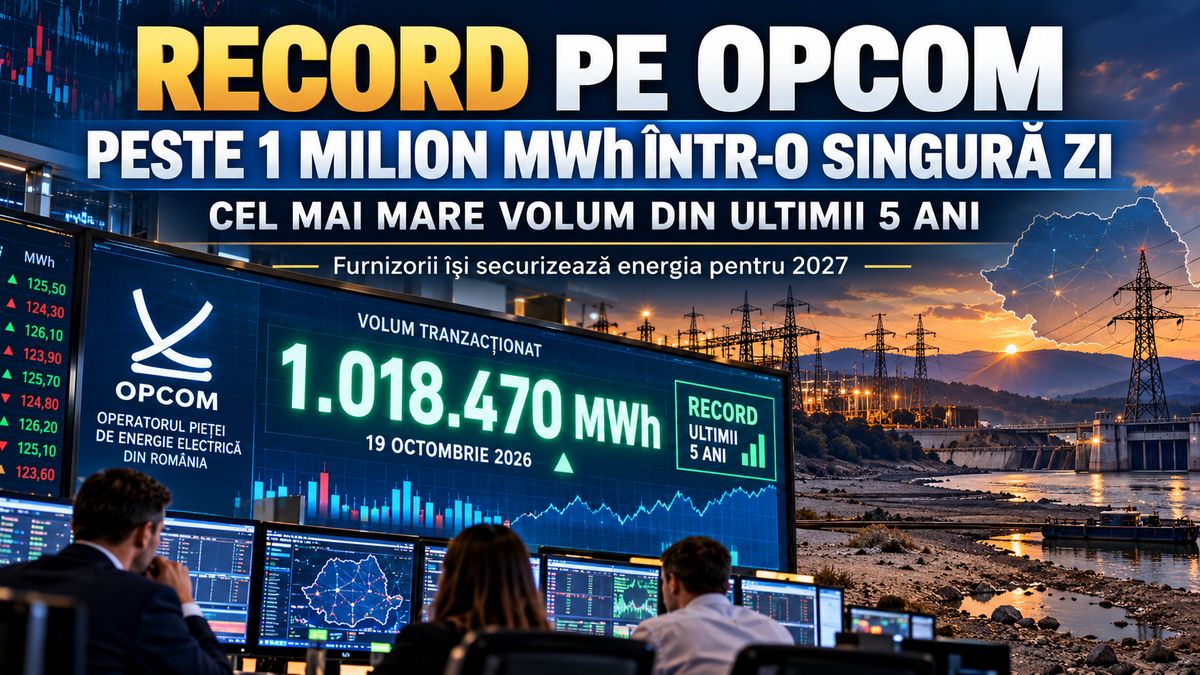
On October 19, 2026, Romanian power exchange OPCOM recorded a daily traded volume of 1,018,470 MWh on its Centralised Market for Bilateral Electricity Contracts under the Extended and Flexible Trading Mode (PCCB-LE-Flex). Exceeding one terawatt-hour—equivalent to Romania's entire national electricity consumption over nearly seven average autumn days—this amount marks the highest daily volume logged on this market segment since April 2021. The scale of transactions reported by the exchange operator marks a turning point for the operation of Romania's wholesale electricity market, following several years in which regulatory interventions, windfall taxes on generators, and price caps froze medium- and long-term forward contracting. The return of such substantial liquidity to the OPCOM platform indicates that major producers and suppliers have resumed using forward instruments to hedge their commercial portfolios for late 2026 and full-year 2027. The significance of this record session extends beyond market statistics, directly impacting end-user price formation across the economy. Unlike the Day-Ahead Market, where spot prices swing wildly based on hourly weather fluctuations, bilateral contracts concluded on PCCB-LE-Flex establish the baseline cost of power supplied by utilities to industrial plants, commercial chains, and residential customers. Five years since the last comparable peak and the exit from the forward market deadlock To understand the weight of the 1,018,470 MWh threshold reached on October 19, the surge must be viewed against the broader structural evolution of the Romanian power market over the past decade. The last time the bilateral contracts platform crossed such a daily volume was in the spring of 2021, just prior to the outbreak of the European energy crisis and the subsequent wave of emergency decrees that heavily regulated prices and established the Centralised Electricity Procurement Mechanism (MACEE). Under rigid allocation schemes and windfall taxation, liquidity on forward markets contracted severely. Generators were reluctant to commit volumes over long horizons amid fiscal uncertainty, while suppliers could not enter firm commitments without clarity on state budget compensation settlements. This market distortion funneled a disproportionate share of power trading onto the spot market, exposing the entire economic chain to extreme peak-hour volatility. The PCCB-LE-Flex trading mechanism allows market participants to customize delivery profiles according to actual demand—whether baseload or peak—and provides flexibility in structuring collateral and execution schedules. That market players traded over one million megawatt-hours in a single day underscores that competitive exchange mechanisms are regaining their position as the primary channel for power allocation in Romania. Why suppliers are buying heavily now: Danube drought and costly peak imports The surge in medium- and long-term procurement is no coincidence; it is a defensive move by suppliers hedging against physical vulnerabilities in the National Power System. Romania is experiencing a prolonged autumn hydrological drought. Data from October 20 confirms that Danube water flows at the entry point into the country remain exceptionally low, severely restricting generation at Hidroelectrica, the market's cheapest and most flexible power producer. This constraint in the hydro sector, combined with scheduled maintenance outages at conventional thermal units and the intermittent output of wind and solar assets, forces Romania to rely steadily on power imports to meet domestic demand. System stress peaks during the evening window between 18:00 and 22:00, when national demand climbs toward 8,000 MW as solar generation drops to zero, as well as during nighttime hours when weak wind speeds leave capacity shortfalls in the grid. The severity of this imbalance prompted energy authorities and transmission system operator Transelectrica to activate and maintain a special grid safety mechanism through October 30, 2026. Facing elevated spot prices during hours when Romania imports expensive electricity from neighboring grids, suppliers recognized that entering winter with unhedged portfolios posed severe financial risks, opting instead to lock in required volumes through firm bilateral contracts. Impact on 2027 energy bills and pressure on corporate working capital Moving over 1 TWh of volume from market exposure into signed forward contracts carries direct implications for end consumers. For large industrial energy users and SMEs, substantial supplier purchasing on PCCB-LE-Flex unlocks predictable, fixed-price commercial offers for 2027, shielding them from monthly price adjustments tied to volatile Day-Ahead Market quotations. For residential consumers, the weighted average prices suppliers secure on OPCOM form the core baseline for next year's tariff structures. The larger the share of customer demand a utility can hedge early through…
Aurora AI — Independent Editorial Board
The NRG-IA newsroom continuously monitors Romanian energy markets, ANRE regulatory decisions, and national grid telemetry (SEN/SNT). We deliver independent intelligence anchored exclusively in official primary data.
Editorial Charter, Ethics & Verification Methodology →