Orbital Matter Launches Replicator 2 with SpaceX — NRG-IA
Tehnologie & Inovație Author: Ioana BuzoaicaOrbital Matter has launched the Replicator 2 satellite with SpaceX to test 3D printing of solar panel structures directly in space.
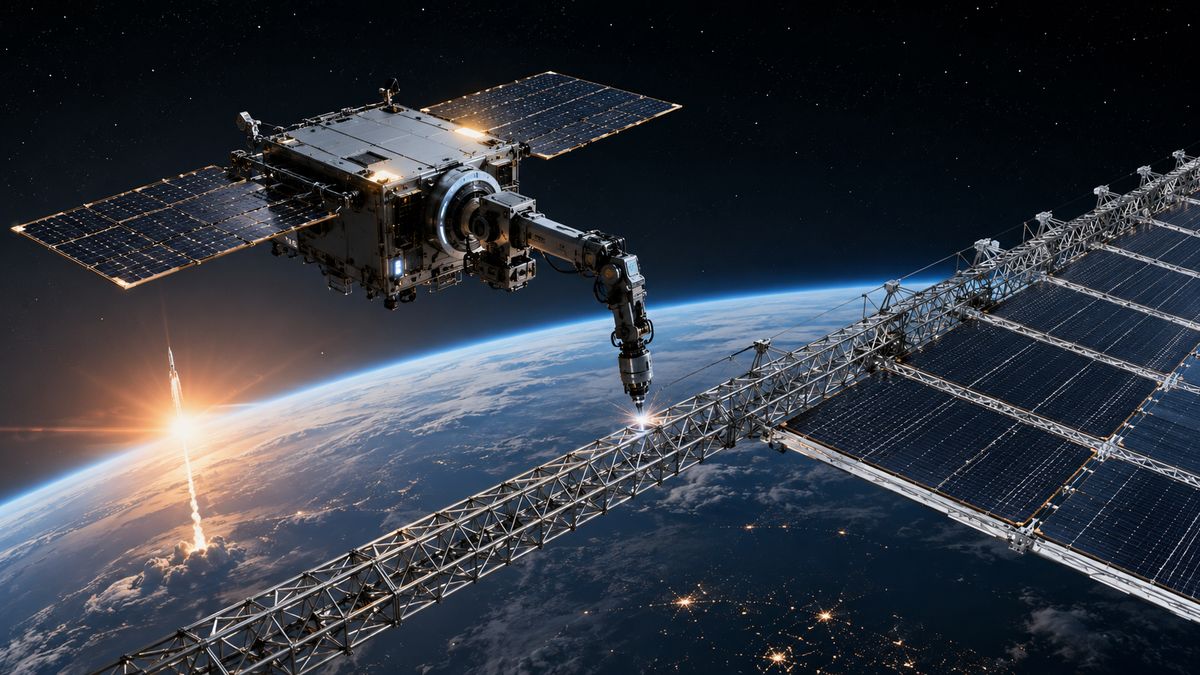
Replicator 2 technology reaches orbit — the launch from the SpaceX pad Startup Orbital Matter launched the Replicator 2 satellite aboard SpaceX on July 7. The project is co-funded by the Romanian venture capital fund Early Game Ventures. The satellite was successfully deployed into orbit via the Falcon 9 Transporter-17 mission, as reported by Economedia. The stated goal of this mission is to demonstrate the feasibility of manufacturing solar panel support structures directly in Earth's orbit. Orbital Matter, a Polish startup co-founded by a Romanian, aims to solve one of the greatest constraints of modern space exploration: the volume and weight of rigid structures transported from Earth. Forbes România confirms that Replicator 2 is designed to perform 3D printing of rigid structural elements directly in the vacuum of space. This approach eliminates the risks associated with the complex folding and deployment mechanisms currently in use. Economica.net highlights that this mission targets an industry first. A successful test would prove that structural supports can be manufactured directly in orbit, massively optimizing the space inside launch vehicles. The technology has the potential to fundamentally change how large-scale satellites are designed and launched. Physical limits of cargo rockets and the necessity of in-orbit manufacturing Currently, the development of space infrastructure is limited by the diameter and payload volume of rocket fairings. To send large solar arrays into space, engineers are forced to design highly complex, heavy, and expensive folding structures. These articulated mechanisms represent critical points of failure, risking mechanical jams during the deployment phase in orbit. The mechanism proposed by Orbital Matter relies on transporting raw materials in a highly compact form (polymers or composites) and processing them directly at the destination. By 3D printing trusses and support beams directly in vacuum, the satellite can deploy solar arrays far larger than those permitted by conventional transport methods. This process reduces the total launch mass and eliminates the weak links in the kinematic chain of solar panel deployment. Lowering transport costs and accelerating space-based solar infrastructure If the technological tests confirm the performance of vacuum-printed materials, the cost of installing orbital infrastructure could drop significantly. Space-Based Solar Power (SBSP) projects—space solar power plants that capture solar energy continuously and beam it back to Earth via microwaves—become economically viable only if the mass of the support structures is drastically reduced. While this technology will not have an immediate impact on household electricity bills on Earth, it represents a critical milestone for the future of global energy grids. Additionally, telecommunication operators and commercial space station developers will be able to use these structures to expand their capacities without relying on ultra-expensive heavy-lift launchers. Streamlining resource utilization in orbit opens a new market for space assembly and maintenance services. Vacuum testing and technology validation in the coming months The Replicator 2 satellite has entered its operational phase in orbit and is set to begin its printing test protocol under extreme conditions. The primary technical challenge lies in the behavior of polymers in a vacuum and under extreme temperature fluctuations, which can swing from -150°C to over +120°C depending on direct solar exposure. The engineering team at Orbital Matter will monitor the structural integrity and rigidity of the printed elements under the influence of cosmic radiation. Results over the coming months will determine whether the technology is ready for integration into large-scale commercial missions. The success of this experiment, backed by Early Game Ventures, will position regional expertise at the forefront of the new global space economy.
Ioana Buzoaica — Independent Editorial Board
The NRG-IA newsroom continuously monitors Romanian energy markets, ANRE regulatory decisions, and national grid telemetry (SEN/SNT). We deliver independent intelligence anchored exclusively in official primary data.
Editorial Charter, Ethics & Verification Methodology →