Hidroelectrica reservoirs fall below 50% entering winter — NRG-IA
Piața de Energie Author: Ioana BuzoaicaHidroelectrica's reservoir levels drop below 50%, forcing output cuts to save reserves. Low Danube flows and a Cernavoda outage spur costly imports.
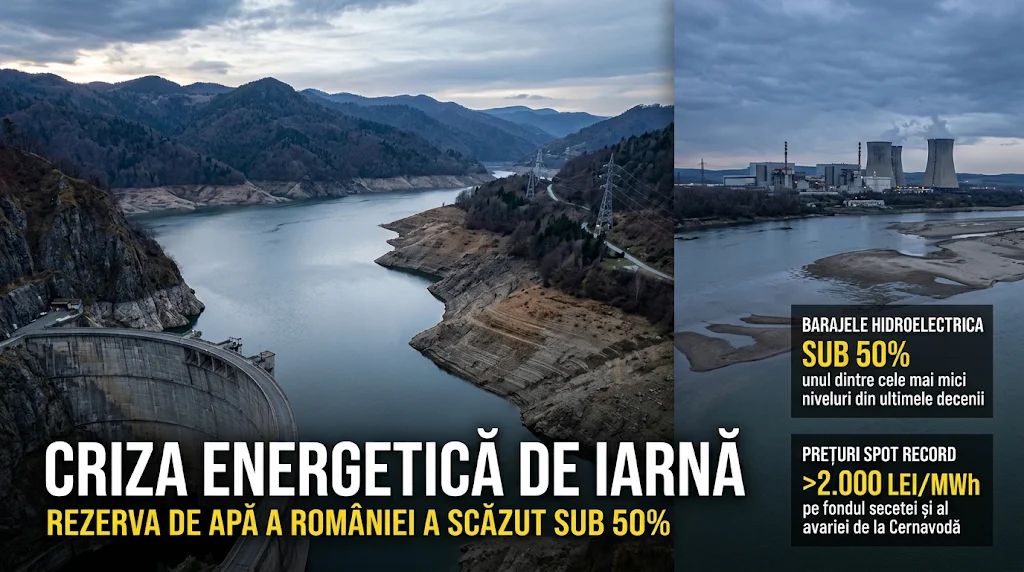
Romania enters the 2026–2027 cold season with its primary energy safety buffer reduced to less than half capacity, after fill levels in reservoirs operated by Hidroelectrica dropped below the 50% threshold—one of the lowest early-November levels recorded in the past three decades. The situation was officially confirmed on Monday, November 9, by the company's CEO, Dan Plaveti, who announced that the state-owned producer has transitioned to a restrictive and disciplined operation of dams to protect a water resource that has become strictly limited following prolonged autumn drought. The depletion of hydro reserves hits the National Power System at a moment of multiple supply-side vulnerabilities in domestic baseload power. According to data from the National Institute of Hydrology and Water Management, the Danube's flow at the entrance into the country, at the Baziaș section, remains at nearly one-third of the multi-year November average, severely constraining power output from the Iron Gates hydropower plants, while the unscheduled outage of Cernavodă Unit 1 on Monday evening—just three days after restarting—removed 700 MW of nuclear capacity from the grid. The combined effect of these constraints immediately translated into wholesale electricity costs. On the Day-Ahead Market operated by OPCOM in Bucharest, peak hourly prices rose on Monday to a seasonal record of RON 2,073 per megawatt-hour, equivalent to EUR 388 per megawatt-hour, forcing Romania to rely on costly imports during evening hours when solar generation vanishes and national consumption reaches its peak. Reservoirs shift from commercial operation to strategic reserve for winter peaks In Romania's energy architecture, major hydropower schemes with storage reservoirs in mountainous regions—such as Vidraru, Izvorul Muntelui, or Fântânele—act as a high-capacity natural battery, capable of ramping up within minutes to balance the system and cover demand peaks. When stored water volume drops below 50% before the winter freeze, when precipitation turns to snow and no longer immediately replenishes basins, Hidroelectrica is forced to conserve every cubic meter of water for critical freeze or blizzard conditions in January and February, even if current market prices would make power generation highly lucrative now. This deliberate curtailment of turbines in reservoir-based plants overlaps with a forced drop in output at run-of-river hydropower facilities, which depend directly on daily river and Danube flows. With Danube discharge reduced to roughly one-third of typical November levels, the Iron Gates I and II complex is operating well below its installed capacity, leaving a major deficit of cheap baseload power in Romania's load curve. The hydrological deterioration in the second half of the year marks a sharp reversal from the performance recorded in the first half of 2026. According to preliminary operational reports submitted to the Bucharest Stock Exchange, Hidroelectrica achieved a 10% year-on-year increase in gross electricity production in the first nine months of the year compared to 2025, reaching 9,601 gigawatt-hours—of which 9,416 gigawatt-hours came from hydro sources—and total group sales of 11,310 gigawatt-hours, up 12%. However, severe drought conditions from August through October—which had also previously caused an unprecedented 101-day outage at Cernavodă—swiftly eroded the gains accumulated in spring and depleted reservoirs right before peak demand season. Loss of nuclear baseload and dependence on expensive peak-hour imports The lack of maneuverability in the hydro sector is compounded by the fact that the national system cannot fully rely on nuclear baseload energy. The shutdown of Cernavodă Unit 1 on the evening of November 9, caused by a fault in the conventional island while the reactor had reached 520 MW output, leaves domestic demand coverage reliant on gas-fired plants, available coal units, volatile wind power, and cross-border electricity flows. Although Romania is in a comfortable position regarding thermal fuel storage—entering November with underground gas storage at 88.11% capacity, above the European average—the capacity of domestic hydrocarbon-fired plants is insufficient to simultaneously cover the hydro and nuclear shortfalls during evening hours. As a result, the Romanian grid becomes a net importer from coupled Central and South-Eastern European markets precisely during the hourly windows when the entire region suffers from low wind and solar generation, automatically absorbing marginal prices exceeding EUR 300 per megawatt-hour set by Europe's most expensive thermal units. For electricity suppliers and the state budget, persistent high spot prices on OPCOM and rising balancing market costs inflate the procurement bill needed to cover household and economic demand. On the Bucharest Stock Exchange, investor concerns regarding Q4 hydro output curtailment and the drought's impact on sector earnings have already…
Ioana Buzoaica — Independent Editorial Board
The NRG-IA newsroom continuously monitors Romanian energy markets, ANRE regulatory decisions, and national grid telemetry (SEN/SNT). We deliver independent intelligence anchored exclusively in official primary data.
Editorial Charter, Ethics & Verification Methodology →