US SPR Falls to 1982 Low of 293.4 Million Barrels — NRG-IA
Geopolitică & Energie Author: Ioana BuzoaicaUS SPR has fallen to 293.4M barrels, the lowest since 1982, amid the Hormuz crisis. The drawdown limits response capacity for a potential second shock.
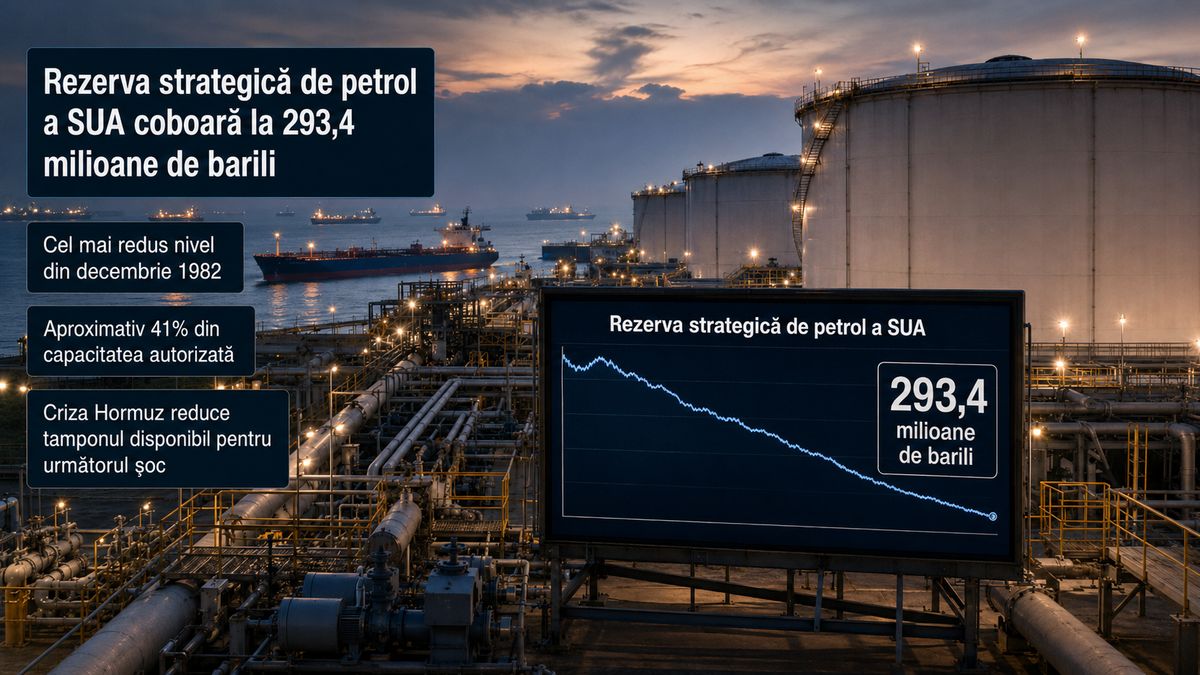
The United States' Strategic Petroleum Reserve has fallen to 293.4 million barrels , following a drawdown of approximately 5.3 million barrels in a single week. This marks the lowest level for the US reserve since December 1982 , at a time when the global oil market continues to bear the brunt of shipping disruptions through the Strait of Hormuz. The historical comparison is almost exact down to the last million barrels. On December 31, 1982, the reserve held 293.214 million barrels. The level reported for August 14, 2026, is only about 186,000 barrels higher . Relative to its current authorized capacity of approximately 714 million barrels, the reserve stands at about 41% . The decline is not the result of a single week of consumption. Around the start of the current emergency operation, the SPR held approximately 415 million barrels. By mid-August, the physical inventory had decreased by about 122 million barrels , equivalent to a drop of nearly 30% in less than five months. The United States is thus deploying one of the world's most critical strategic energy buffers during an exceptional supply disruption. The issue is not whether America is "running out of oil," but how much immediate response capacity it retains if the current crisis drags on or is followed by another major shock . The Hormuz Crisis Triggered the Largest Coordinated Release in IEA History In March, the 32 member states of the International Energy Agency agreed to release 400 million barrels of oil and petroleum products to the market, the largest collective action of its kind in IEA history. The contribution announced by the United States was 172 million barrels from the Strategic Petroleum Reserve. The decision followed the collapse of flows through the Strait of Hormuz, one of the global oil system's critical chokepoints. In 2025, an average of approximately 20 million barrels per day of crude oil and petroleum products transited the strait, equivalent to about a quarter of global maritime oil trade. The IEA estimates that in March, April, and May 2026, flows through Hormuz dropped to an average of just 2.7 million barrels per day . The Agency described the shock as the largest supply disruption in the history of the global oil market. By July 21, IEA member states had released approximately 290 million barrels from the 400-million-barrel collective program. The crisis continues to reverberate in August. Reuters reported on August 17 that traffic through Hormuz remained severely restricted, and Brent closed the session at $90.87/barrel , following a $2.35 gain that day. The US Has Drawn Down Approximately 122 Million Barrels from the Reserve in Less Than Five Months The pace of the US drawdown is remarkably fast. EIA data shows approximately 415.4 million barrels in the SPR for the week ending March 20. By early May, the inventory had already fallen below 393 million, and by August 7, it had reached 298.694 million. The latest operational data from the Department of Energy for August 14 puts the level at 293.4 million. The difference compared to March is approximately 122 million barrels . Relative to the accelerated drawdown period from April to mid-August, the average pace is around 6.3 million barrels per week , although actual deliveries vary considerably from week to week. Physically, this oil is no longer in the SPR caverns and cannot be used immediately for another emergency response. This is precisely where the short-term strategic cost of the intervention lies. The 172 Million Barrels Are Primarily Loaned, Not Sold Outright However, the current program differs fundamentally from an outright liquidation of the reserve. The Department of Energy has structured the operation predominantly as emergency exchanges . Companies are currently receiving oil from the strategic reserve and are contractually obligated to return the volume at a later date, along with an additional premium of barrels. The mechanism thus functions as a physical oil loan. The government accepts a lower inventory during the crisis, and companies must later return more oil than they received. The initial contracts for 45.2 million barrels mandate the return of approximately 55 million barrels . Another tranche of 53.3 million barrels secured a premium of about 15.1 million barrels for the government, equivalent to roughly 28% above the delivered volume. The Department of Energy has indicated an average premium of approximately 26% across several contracted tranches. Returns are scheduled to begin in late 2026 and continue in the following years, with some contracts extending through 2028. In the long term, this architecture may allow the SPR to recover more barrels than it delivered. In the short term, however, the oil is out of the reserve precisely while the crisis that prompted the drawdown remains unresolved . The Strategic Issue Is the Gap Between Drawdown and Return This is where the drop to 293.4 million barrels becomes relevant beyond a mere…
Ioana Buzoaica — Independent Editorial Board
The NRG-IA newsroom continuously monitors Romanian energy markets, ANRE regulatory decisions, and national grid telemetry (SEN/SNT). We deliver independent intelligence anchored exclusively in official primary data.
Editorial Charter, Ethics & Verification Methodology →