Romania imports 3.4 GW as power prices top RON 1,190/MWh — NRG-IA
Piața de Energie Author: Ioana BuzoaicaRomania enters October with offline nuclear reactors, low hydro, and surging imports, pushing day-ahead power prices up 30% to RON 1,190/MWh.
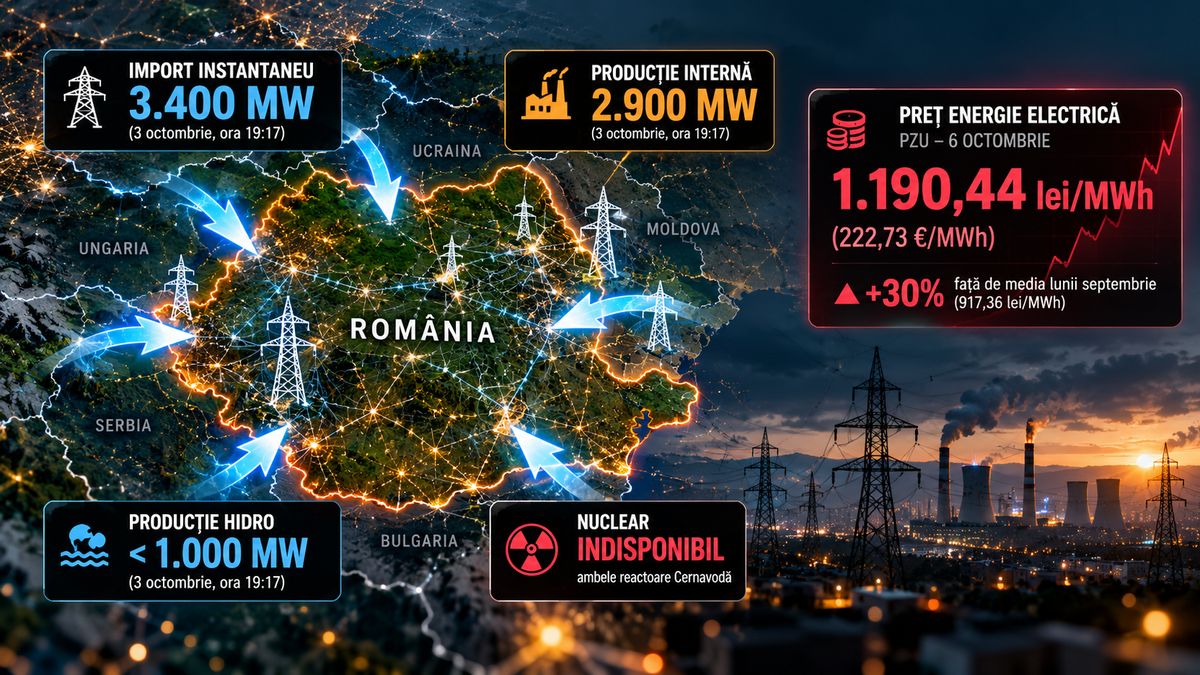
On Saturday evening, Romania found itself in a rare situation on the energy market: it was importing more electricity than it was producing. Around 7:17 PM, domestic generation had dropped to approximately 2,900 MW , while instantaneous imports neared 3,400 MW , according to Transelectrica data cited by Economica. The imbalance occurred over the weekend, when consumption is typically lower than on weekdays, highlighting how much Romania's available generation base has shrunk. For Tuesday, October 6, the market is also sending a strong price signal. OPCOM indicates a baseload price of RON 1,190.44/MWh (equivalent to €222.73/MWh ) on the Day-Ahead Market, for a traded volume of 43,215.3 MWh . In September, the weighted average price on the same market was RON 917.36/MWh . Today's price is therefore nearly 30% above the previous month's average . Romania has lost one of its most stable generation sources The most significant change is the temporary absence of nuclear power from the energy mix. With both reactors at Cernavodă offline, Romania has lost approximately one-fifth of its electricity generation capacity. Reuters reports that the nuclear outage coincides with drought-reduced hydropower generation and the seasonal decline in solar output as autumn sets in. Nuclear energy possesses a critical characteristic for grid stability: it delivers constant baseload power, including during evenings, nights, and periods with no wind or sun. Its absence must be compensated for by other sources available during those exact hours. On the evening of October 3, this compensation came largely from imports. The situation was exacerbated by low hydropower output. During the interval when imports neared 3,400 MW, hydropower plants were supplying under 1,000 MW , and wind generation was virtually non-existent. Solar is available by day, but the grid must find other sources by evening Romania has rapidly installed solar capacity in recent years, which can cover a highly significant portion of consumption during the day. The issue arises after sunset. Solar generation drops off rapidly just as evening demand peaks. If wind output is low, hydro reservoirs are depleted, and nuclear reactors are offline, the grid must quickly secure thousands of megawatts from other sources. Reuters notes that Romania added over 1.5 GW of new renewable capacity and around 1 GW of storage in 2026, but the need for flexibility remains significantly higher. Transelectrica confirms that imports are utilized during periods when domestic generation is insufficient to meet demand. Transelectrica CEO Ștefăniță Munteanu explained to Reuters that power can be imported when domestic production falls short, adding that this situation puts additional pressure on interconnection lines. However, the grid continues to be kept in balance. This is the essential function of European interconnections: power can flow between grids to temporarily cover a country's deficit when its own generation is insufficient. The challenge for Romania is the sheer scale of the deficit during certain hours. Imports exceeded total domestic generation The 3,400 MW figure is significant precisely because it represents instantaneous imported power, not energy accumulated over a day. At that same hour, Romania was producing approximately 2,900 MW. For every 100 MW generated domestically, the grid was importing about 117 MW. According to Transelectrica data cited by Economica, import levels neared the maximum capacity of approximately 4,000 MW available under those specific conditions. Interconnection with neighboring grids allowed the deficit to be covered. However, the episode highlights a key vulnerability ahead of the cold season: if multiple major domestic sources become unavailable simultaneously, Romania must secure large volumes of power on the regional market during the exact hours when other states may also need them. Prices for October 6 surpass RON 1,190/MWh Grid tightness is also reflected in the market. For power delivered on October 6, OPCOM shows a baseload average price of RON 1,190.44/MWh . Individual intervals show massive intraday spreads: prices spike in certain 15-minute intervals to over RON 2,000/MWh , peaking at over RON 2,160/MWh , before dropping sharply in other periods. These figures represent wholesale market prices and do not directly translate to the final consumer bill. However, they indicate the cost of available power when the market must balance supply and demand for the following day. The difference compared to September is substantial. Compared to the previous month's weighted average of RON 917.36/MWh, the October 6 price of RON 1,190.44/MWh is higher by approximately RON 273/MWh . Romania's challenge is securing power exactly when it is needed Romania possesses significant generation capacity and continues to add renewables and batteries. However, the October episode highlights the gap between installed capacity and available power at a given hour…
Ioana Buzoaica — Independent Editorial Board
The NRG-IA newsroom continuously monitors Romanian energy markets, ANRE regulatory decisions, and national grid telemetry (SEN/SNT). We deliver independent intelligence anchored exclusively in official primary data.
Editorial Charter, Ethics & Verification Methodology →