Romania adds 2.5 GW of solar, wind and storage in 2026 — NRG-IA
Energie Regenerabilă Author: Ioana BuzoaicaRomania added 2.5 GW of new capacity in 2026, 99% from solar, wind, and batteries. The focus now shifts to grid capacity and flexibility.
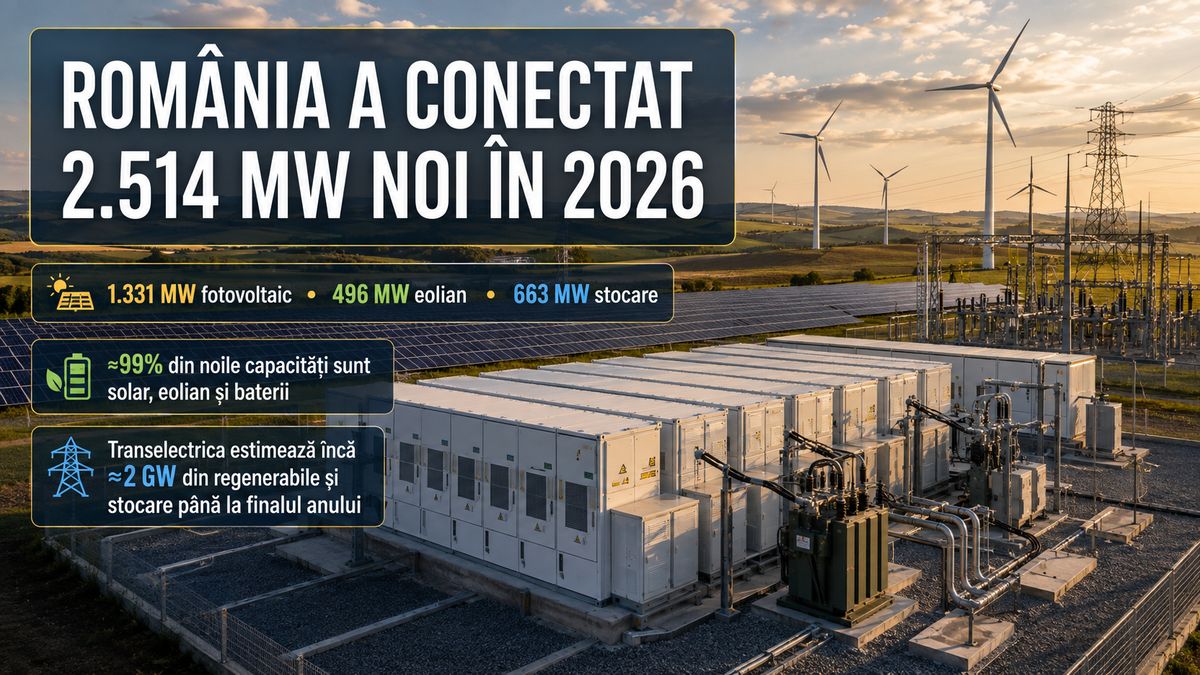
Romania has connected 2,514 MW of new generation and storage capacity to the power grid since the beginning of 2026 , according to data released by Transelectrica on August 20. The 2,500 MW threshold was crossed with the grid connection of the IS Părău storage facility, which has a capacity of 76.76 MW and 150.288 MWh. Out of the total reported for this year, 1,331 MW are solar PV capacities, 496 MW wind, and 663 MW storage installations , meaning that approximately 99% of the newly connected capacities are renewables or batteries. The structure of these 2.5 GW signals more than just a new grid connection record. The Romanian energy system is entering a phase where the development of solar and wind generation is accompanied by a rapid expansion of storage—the technology required to shift energy from hours of abundant production to periods of higher demand and prices. Only 20 MW of the new capacities reported by Transelectrica come from hydrocarbons and 5 MW from biogas. The breakdown by category sums up to 2,515 MW, 1 MW above the official total of 2,514 MW—a discrepancy likely due to the rounding of aggregated data. The official reference total remains the one communicated by the transmission system operator. Batteries have transitioned from isolated projects to utility-scale investments The 663 MW of storage connected in 2026 represent one of the most significant components of the new investment wave. The scale becomes clear when compared to the situation at the beginning of the year: as of January 1, 2026, Transelectrica reported approximately 494 MW of storage nationwide, with an energy capacity of 913.68 MWh . The company's periodic data showed 924.43 MW and 1,762.5 MWh as early as July 1, and by the beginning of August, the capacity of storage installations had reached approximately 989 MW. This momentum confirms that batteries are no longer just a niche associated with individual renewable projects, but are becoming a distinct component of the energy infrastructure. A battery's power, expressed in MW, indicates how quickly it can absorb or inject energy. Its energy capacity, expressed in MWh, shows how much energy it can store. These two metrics must be analyzed together. The new facility at Părău, for example, has 76.76 MW and 150.288 MWh, corresponding to a theoretical discharge duration at full power of nearly two hours. This profile is highly relevant for the current Romanian system: batteries can absorb part of the electricity surplus during hours of high solar generation and shift it to the evening peak, participate in balancing, and reduce the amplitude of rapid fluctuations between generation and consumption. The 2,514 MW does not represent 2,514 MW of permanently available generation The figure announced by Transelectrica describes grid-connected capacities , not actual additional generation at any given moment, nor a net increase of the same size in the national power plant fleet. The distinction is essential. The 663 MW of batteries do not represent primary electricity generation, but rather the capacity to store and reinject energy. Furthermore, Transelectrica specifies that the projects included in the 2,514 MW total are in various stages: some have commercial operation licenses, while others are undergoing internal functional tests or compliance testing. The capacities are connected both to the Transmission Grid managed by Transelectrica and to the distribution operators' networks. Nor is the gross increase in connections identical to the net expansion of the national generation fleet. As of January 1, 2026, Transelectrica reported a gross installed capacity in power plants of approximately 19,368 MW , excluding storage. By July 1, the total had reached approximately 19,733 MW , a net increase of about 365 MW. Behind this difference lie two simultaneous trends: new capacities are coming online, particularly solar PV, while other plants are being decommissioned, reducing their available capacity, or leaving the reported structure. Solar PV capacity increased from approximately 3,094 MW at the beginning of the year to 3,840 MW as of July 1, while coal capacity fell during the same period from approximately 2,095 MW to 1,620 MW. The new mix is also starting to shift the system balance In the first half of 2026, net domestic electricity consumption was virtually unchanged compared to the same period in 2025, with a variation of approximately -0.1%, while net domestic production increased by about 7%. Transelectrica reported a roughly 20% increase in renewable generation and an approximately 18% rise in hydro production. At the same time, physical electricity exports surged by 52%, while physical imports remained nearly stable, with a slight increase of about 0.4%. These developments coincide with the rapid expansion of new capacities, but the system's performance cannot be attributed solely to projects connected in 2026. Actual generation depends simultaneously on weather conditions, hydro…
Ioana Buzoaica — Independent Editorial Board
The NRG-IA newsroom continuously monitors Romanian energy markets, ANRE regulatory decisions, and national grid telemetry (SEN/SNT). We deliver independent intelligence anchored exclusively in official primary data.
Editorial Charter, Ethics & Verification Methodology →