Transelectrica: 2.5 GW added in 2026. Grid reshaped — NRG-IA
Piața de Energie Author: Ioana BuzoaicaTranselectrica added 2.5 GW in 2026. Romania must now balance variable renewables, storage, and dispatchable power to meet real-time demand.
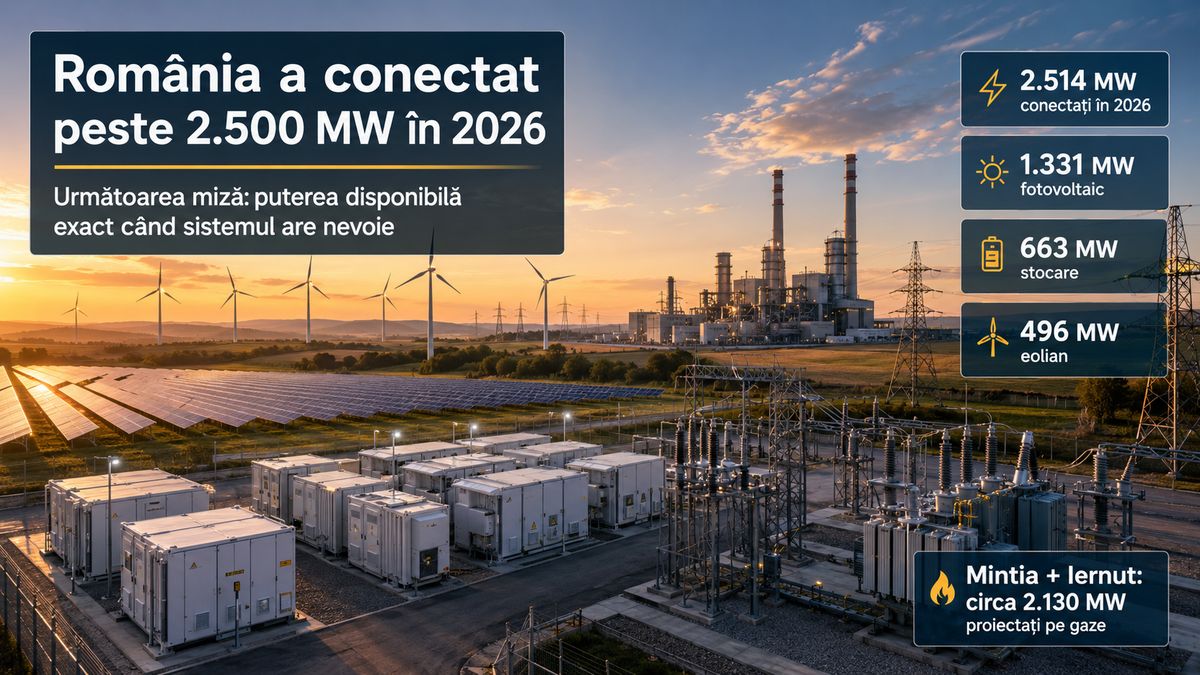
Since the beginning of the year, Romania has connected 2,514 MW of new generation and storage capacity , according to Transelectrica. However, the breakdown of this record says more about the future of the energy system than the headline figure itself. Of the new capacity, 1,331 MW is solar PV, 496 MW is wind, and 663 MW represents battery storage. Nearly 99% of the officially reported total thus comes from variable renewables and storage, while only 20 MW is registered under hydrocarbons and 5 MW under biogas. The 2,500 MW threshold was crossed with the connection of the Părău storage facility, which has a capacity of 76.76 MW and 150.288 MWh of energy storage . However, Transelectrica notes that the facilities included in this balance are at different stages: some hold commercial operating licenses, while others are still undergoing functional or compliance testing. Romania is therefore adding capacity at a remarkable pace, but it is not adding 2,514 MW that can generate simultaneously and continuously at the dispatcher's command. Solar, wind, and batteries serve different functions, and the distinction between them becomes critical in a system where conventional generation is declining and demand must be met second by second. The 2,500 MW of new capacity represents three different energy realities A megawatt of solar PV produces when there is sufficient solar radiation. A megawatt of wind produces depending on the wind. A megawatt of battery capacity expresses the rate at which the facility can absorb or discharge stored energy, not a primary source that continuously generates electricity. For the Părău facility, the ratio between the 150.288 MWh of storage capacity and the 76.76 MW output theoretically corresponds to a duration of nearly two hours at nominal power. This calculation indicates the order of magnitude of the energy capacity, excluding losses and operational limitations. This difference explains why the system can simultaneously experience record-high installed capacities and periods requiring substantial imports. At the beginning of August, the licensed installed capacity in the National Power System (SEN) had exceeded 20,200 MW . Dispatchable solar capacity alone had surpassed 4,100 MW, excluding the thousands of MW installed by prosumers. Nevertheless, on August 11 at 7:25 PM, when national consumption exceeded 8,000 MW , domestic generation stood at 5,873 MW, and Romania was importing 2,151 MW . These two figures do not contradict each other. They measure different things: the nominal capacity of all existing installations and the power actually available at a given moment. August demonstrated the difference between capacity and availability in real time The summer of 2026 presented the Romanian energy system with an unusually harsh test. Both units at Cernavodă became unavailable, with Unit 2 undergoing a controlled shutdown on August 13 due to a significant and continuous drop in the Danube's water levels. Authorities subsequently intervened with hydrotechnical works and dredging to secure the necessary cooling conditions for the plant. The temporary loss of approximately 1,400 MW of nuclear power from the energy balance highlighted how much the value of capacity varies depending on the timing. On a bright, sunny day, the more than 4 GW of dispatchable solar can cover a very large share of daytime consumption. After sunset, this generation rapidly drops to zero. Wind can spectacularly offset the deficit on a favorable evening—on August 20, wind generation exceeded 2,100 MW—but it cannot be scheduled to appear exactly when the dispatcher needs it. Batteries introduce a new piece to this equation: they can absorb available energy during high-production hours and shift it to peak consumption periods. They thus narrow the gap between when energy is generated and when it is used. However, for deficits that persist for many hours or days, the system also requires other resources: pumped-storage hydro, nuclear, interconnections, demand response, longer-duration storage, and dispatchable generation. This is where Mintia and Iernut become decisive. Mintia can add approximately 1,700 MW of dispatchable capacity The new gas-fired power plant at Mintia has a designed capacity of approximately 1,700 MW , enough to make it one of the largest single sources of electricity generation in Romania. The plant is not currently supplying these 1,700 MW in commercial operation. In August, Mass Global Energy Rom completed the necessary steps to operate as a producer during the trial period, with testing scheduled to phase in gradually. The difference compared to solar and wind lies in the function such a plant can perform once operational: the output of a combined-cycle gas turbine (CCGT) can be controlled and adjusted to meet grid demand. On a windless evening after sunset, this capability is worth far more than the same nominal MW figure that is unavailable at that moment. However, Mintia shifts part of…
Ioana Buzoaica — Independent Editorial Board
The NRG-IA newsroom continuously monitors Romanian energy markets, ANRE regulatory decisions, and national grid telemetry (SEN/SNT). We deliver independent intelligence anchored exclusively in official primary data.
Editorial Charter, Ethics & Verification Methodology →