Romania: 3.27GW Export at Noon, 1.24GW Import in Evening — NRG-IA
Piața de Energie Author: Ioana BuzoaicaRomania went from a net export of 3,270 MW to a net import of 1,236 MW in seven hours, highlighting the grid's structural need for flexibility.
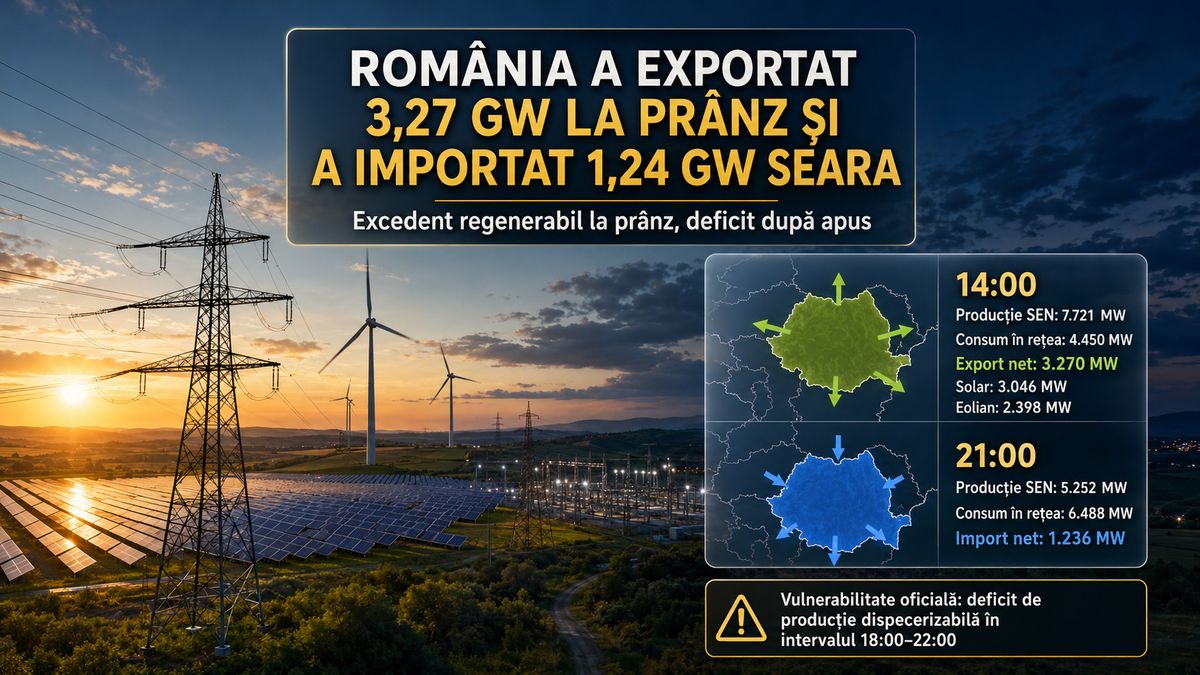
On August 28, Romania provided one of the clearest demonstrations yet of its energy system's transformation. At 14:00, total generation in the National Power Grid (SEN) reached approximately 7,721 MW, while visible grid consumption stood at around 4,450 MW. The difference translated into a net export balance of approximately 3,270 MW . Seven hours later, the situation was almost completely reversed. By 21:00, consumption had climbed to approximately 6,488 MW, domestic generation had dropped to 5,252 MW, and Romania was importing around 1,236 MW . Between these two points in time, the system's balance shifted by more than 4,500 MW . This is not just a spectacular snapshot of a sunny and windy day. It is the picture of a structural shift: for a few hours, Romania can have more renewable power available than the consumption drawn from the grid, and yet, on the very same evening, it may require substantial imports. At noon, wind and solar exceeded visible grid consumption Around 14:00, solar generation monitored in the SEN was approximately 3,046 MW , while wind generation reached around 2,398 MW . Together, these two sources supplied approximately 5,444 MW , nearly 1,000 MW above the grid consumption of about 4,450 MW recorded at the time. However, total generation was even higher, as other sources were also active in the system. The result was a net export of approximately 3,270 MW. The surplus was not a brief peak lasting only a few minutes. Historical data from Transelectrica's flows shows export balances exceeding 3 GW for several consecutive hours: approximately 3,011 MW at 12:00, 3,124 MW at 13:00, 3,270 MW at 14:00, and 3,127 MW at 15:00. However, there is an essential caveat. The consumption displayed by the system does not perfectly represent all electricity consumed in Romania at that moment. A portion of the energy produced by prosumers is consumed directly behind the meter, reducing the amount of electricity drawn from the grid. Therefore, the precise phrasing is that the wind and solar generation monitored in the SEN exceeded the visible or grid-drawn consumption , not necessarily Romania's entire physical consumption. Yet, this distinction does not diminish the scale of the phenomenon. The system had to simultaneously manage over 5.4 GW of monitored wind and solar power under conditions of low consumption and a surplus of over 3 GW relative to visible domestic demand. After sunset, the balance reversed in less than two hours The shift began to manifest after 18:00. At that point, solar generation had already dropped to approximately 953 MW , and wind to around 1,702 MW. Romania was still exporting, but the net balance had shrunk to about 612 MW. An hour later, solar output had plummeted to just 116 MW. Consumption had risen to approximately 6,404 MW, while total generation had fallen to around 5,378 MW. Romania transitioned to a net import of approximately 1,025 MW . By 20:00, solar generation was virtually zero, consumption reached approximately 6,635 MW, and net imports rose to about 1,171 MW. By 21:00, imports reached around 1,236 MW. The very same country that just a few hours earlier could send over 3 GW across its borders now required more than 1 GW from neighboring grids. This is one of the clearest illustrations of the mismatch challenge inherent in a system with growing solar capacity: electricity can be abundant precisely when consumption is relatively low, and then become scarce just a few hours later when the sun sets and evening demand peaks. The Government identified the exact window when the system shifted to imports The coincidence with a government decision on that very day makes this episode all the more relevant. On August 28, the Executive extended special measures for security of electricity supply, identifying the primary vulnerability of the National Power Grid as the deficit of dispatchable generation between 18:00 and 22:00 . Operational data from that same day illustrates this transition almost perfectly. At 18:00, Romania was still exporting about 612 MW. By 19:00, it was already importing over 1 GW. Imports remained above this level for the subsequent hours. The context was further complicated by the fact that nuclear generation was shown as zero in operational data, and hydropower was very low at noon, at around 282 MW at 14:00. Drought and low water levels on the Danube had impacted the availability of key capacities. The Government specifically cited the lack of sufficient dispatchable generation during evening hours and the risk of limited imports in a tense regional environment. Following this logic, authorities decided to temporarily maintain certain lignite-fired capacities that were scheduled for decommissioning, in order to preserve sufficient available power during periods when renewables cannot meet demand. The apparent paradox is thus easily explained: a system can have a massive surplus at 14:00 while simultaneously requiring dispatchable capacity for…
Ioana Buzoaica — Independent Editorial Board
The NRG-IA newsroom continuously monitors Romanian energy markets, ANRE regulatory decisions, and national grid telemetry (SEN/SNT). We deliver independent intelligence anchored exclusively in official primary data.
Editorial Charter, Ethics & Verification Methodology →