ANRE Approves 669 MW Storage Amid Evening Deficit — NRG-IA
Piața de Energie Author: Aurora AIANRE approved 669 MW of storage, equal to 62% of Romania's battery fleet, amid evening deficits and the Cernavoda nuclear shutdown.
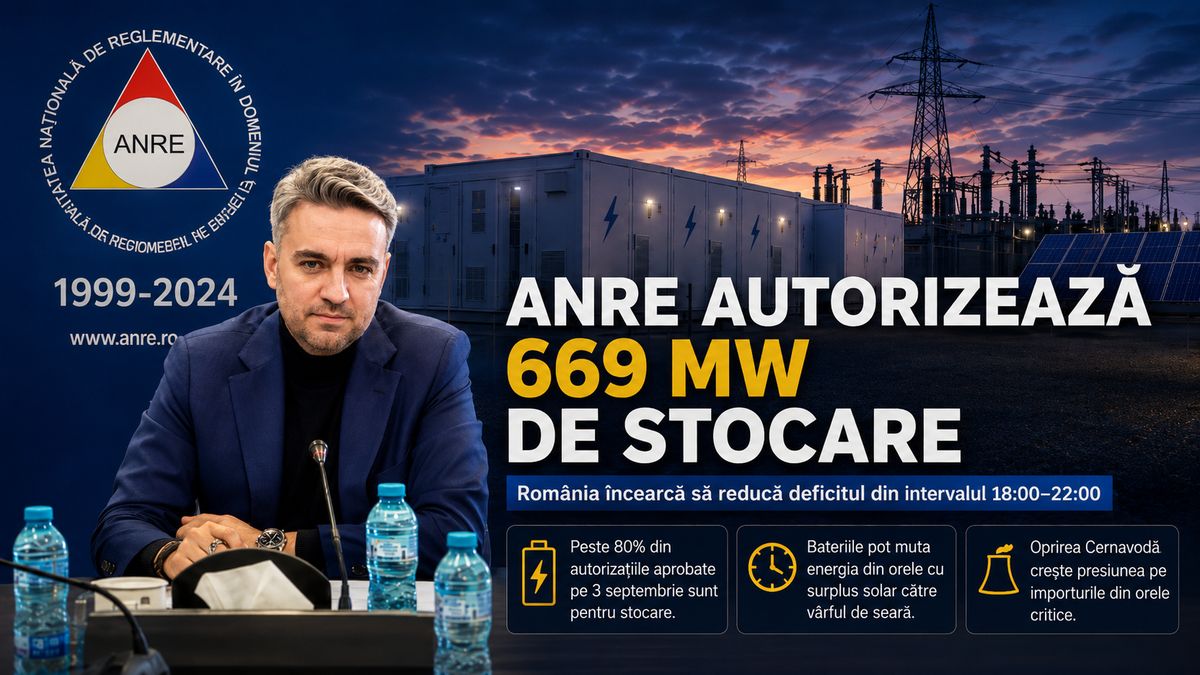
A single ANRE meeting has put on track for construction a storage capacity equivalent to nearly two-thirds of Romania's entire currently installed battery fleet. Out of approximately 811 MW for which the National Energy Regulatory Authority approved establishment permits on September 3, around 669 MW represents storage: about 429 MW in stand-alone installations and another 240 MW co-located with other energy capacities, according to public data shared by ANRE President George-Sergiu Niculescu. This share is unusual: over 82% of the capacity authorized in a single day is dedicated to storage. Documents published by ANRE confirm a wave of stand-alone installations and hybrid battery projects in Stejari, Ișalnița, Corund, Mașca, Cristești, Tudor Vladimirescu, Pechea, and Făget, among others. During the same meeting, licenses were also granted for the commercial operation of already constructed capacities. This moment is more significant than mere administrative statistics. Romania is experiencing one of the clearest demonstrations in recent years that the power system's challenge is no longer just how much energy it can generate in a day, but whether that energy is available precisely during the hours when consumers need it most. Romania already has over 1 GW of batteries, but the gap between day and evening remains massive As of September 1, Romania's storage facilities totaled 1,084.72 MW of installed capacity and 2,310 MWh of energy capacity , according to Transelectrica data cited by Profit.ro . Compared to August 1, capacity had increased by 9.6%, and storable energy had grown by 17% from 1,974.7 MWh. The 669 MW just authorized by ANRE thus represents approximately 62% of the total storage capacity already installed in the system. However, an establishment permit does not mean immediate availability: projects must be built, grid-connected, and then licensed for operation. No aggregate MWh value has been published for this 669 MW batch, meaning the duration for which these new batteries can support the grid cannot be calculated solely from the approved capacity. However, already operational capacities have demonstrated the role they can play during critical hours. On August 13, amid nuclear outages, Romania's batteries reached an average hourly output of 666 MW between 21:00 and 22:00 , and 644 MW the following evening. These figures are on par with a nuclear unit at Cernavoda in terms of instantaneous power, even though batteries can only sustain such output for as long as they have stored energy. This highlights the fundamental difference between MW and MWh. Power (MW) indicates how much the battery can deliver at any given moment; stored energy (MWh) shows how long it can sustain that delivery. Batteries can shift energy within the same day and shave peak demand, but they do not generate new energy fuel and cannot substitute for weeks of lost baseload production. Romania can export over 3,000 MW at noon and become import-dependent after sunset On August 28, the Romanian power grid provided a clear snapshot of this new energy reality. At midday, dispatchable wind and solar plants were generating a combined 5,300 MW , while grid-measured consumption was around 4,500 MW. Romania was a net exporter at over 3,200 MW , with power flowing to all neighboring grids. A few hours later, the energy equation shifted. Solar generation vanished at sunset, consumption climbed toward the evening peak, and the system had to rapidly source hydro, thermal, wind, battery power, or imports. The Government has officially defined this issue. In its decision to extend the special framework for the security of the National Power System (SEN) until September 30, the Executive identified the shortage of dispatchable generation between 18:00 and 22:00 as the primary vulnerability of the National Power Grid , compounded by the risk of limited import capacities. This gap between midday and evening is precisely the economic sweet spot where storage becomes strategic. Batteries can absorb a portion of the energy available during peak solar hours and discharge it after sunset. Instead of forcing the grid to cover the entire deficit through flexible power plants or neighboring countries, part of the shortfall can be met with energy generated just hours earlier. In a coupled European market, one cannot track individual units of electricity as if Romania were exporting a specific electron at noon and buying it back in the evening. However, the economic mechanism is clear: countries with larger storage capacities can absorb more energy during hours of abundance and monetize it when the regional grid faces tighter conditions. The Cernavoda shutdown made the flexibility deficit far more visible The current situation is amplified by the complete unavailability of nuclear generation from Cernavoda. Both units were shut down due to extremely low Danube water levels, and on September 3, State Secretary Cristian Bușoi stated that hydrological…
Aurora AI — Independent Editorial Board
The NRG-IA newsroom continuously monitors Romanian energy markets, ANRE regulatory decisions, and national grid telemetry (SEN/SNT). We deliver independent intelligence anchored exclusively in official primary data.
Editorial Charter, Ethics & Verification Methodology →