Romania's Battery Storage Capacity Surges to 1,630 MWh — NRG-IA
Energie Regenerabilă Author: Ioana BuzoaicaRomania's battery storage capacity has surged to 878 MW and 1,630 MWh, marking the start of a major investment wave in grid flexibility.
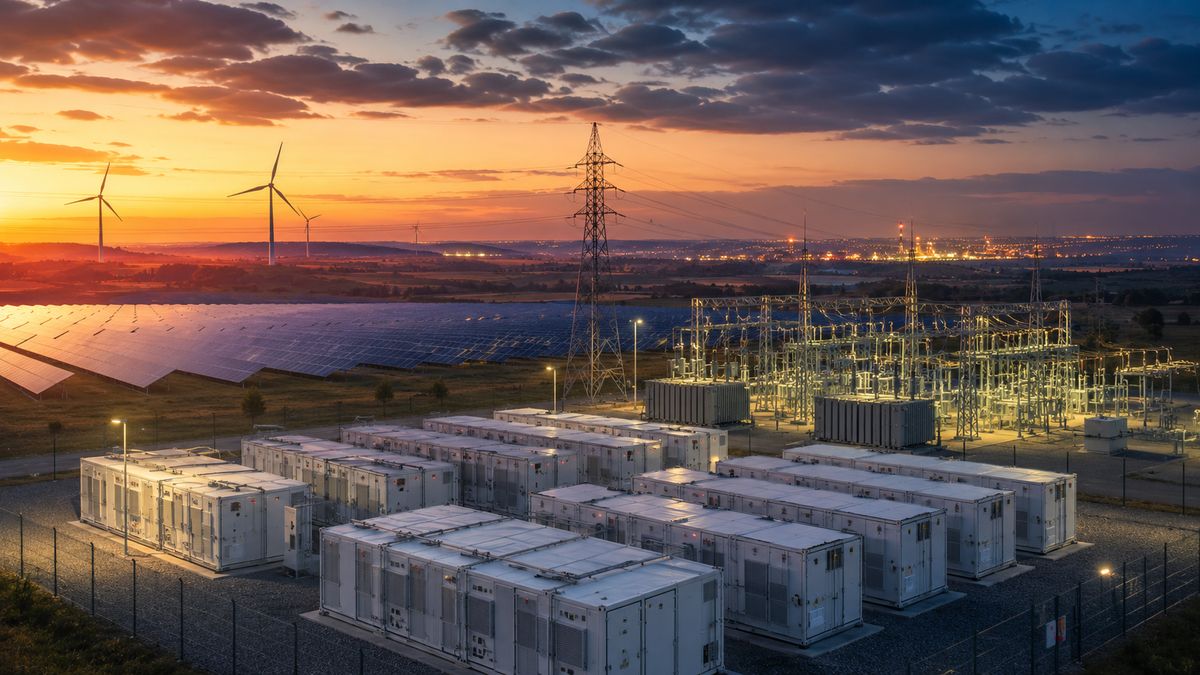
Romania is rapidly building an energy infrastructure that was virtually non-existent just a few years ago. As of June 20, 2026, operational battery storage systems totaled 878 MW of power and 1,630 MWh of energy capacity , after approximately 500 MWh were added in just two months. Compared to the beginning of the year, when approximately 494 MW and 914 MWh were registered, the market has grown by nearly 80%. While not yet a mathematical doubling, the leap is significant enough to show that batteries have transitioned from experimental projects into a fully-fledged sector of the Romanian energy landscape. In May 2026, Romania had approximately 599 MW and 1,130 MWh installed. Just a few weeks later, capacity already exceeded 1.6 GWh. This pace reflects the commissioning of projects scale-sized at hundreds of megawatt-hours, capable of influencing not just the output of a single solar farm, but also market operations and the balancing of the national grid. Batteries shift energy from cheap to expensive hours The expansion of storage is a direct result of the transforming energy mix. Romania is rapidly installing solar panels, both in commercial utility-scale projects and on prosumer rooftops. However, solar generation is concentrated in the middle of the day, precisely during intervals when demand does not always peak. On sunny days, solar generation can push prices very low, sometimes into negative territory. In the evening, as the sun sets, the grid rapidly loses a massive volume of generation while households and businesses continue to consume. Batteries step in between these two moments. They charge when there is a surplus and discharge a few hours later, when solar generation drops and demand and prices rise. This simple transfer profoundly changes the value of energy. A megawatt-hour available at noon, when the market is oversupplied, can be worth far less than the same megawatt-hour delivered during the evening peak. Storage does not generate new energy and cannot replace power plants. Its role is to temporarily store already-produced energy and make it available to the grid when it is most needed. From technical containers to critical system assets Batteries are useful far beyond capturing hourly price spreads. They can react almost instantaneously to imbalances between generation and demand, allowing them to help maintain frequency and balance the grid. In an electrical grid, generation must constantly match demand. When a discrepancy arises, the transmission system operator requires capacity that can rapidly ramp up or down the energy injected into the grid. Conventional power plants need time to adjust their output. A battery can respond in fractions of a second. This speed makes it a highly valuable tool for frequency regulation, reserves, and ancillary services. Batteries can also reduce the amount of renewable energy that must be curtailed when the grid cannot absorb it. Instead of a solar farm curtailing its output, a portion of that energy can be stored and delivered later. However, this benefit depends on location, grid capacity, and how the facility is operated. A battery built in an already congested area does not automatically resolve transmission bottlenecks. 200–400 MWh projects are scaling up the market Growth over the past year has been driven by the emergence of projects far larger than the installations built during the market's initial phase. In Florești, Cluj County, Nova Power & Gas connected a system of approximately 200 MW and 400 MWh , which became the largest operational project in Romania at the time of its commissioning. Another major project, developed by Güriş in the western part of the country, adds approximately 100 MW and over 200 MWh . Together, a few large-scale installations account for a significant share of the entire national capacity. The next wave is already in the pipeline. The European Bank for Reconstruction and Development announced up to €44 million in financing for a 127 MW and 254 MWh project, one of the first utility-scale standalone systems of this size developed in Romania. The distinction between a standalone project and one co-located with a solar farm is significant. A battery paired with a solar plant primarily optimizes that specific facility's output. A standalone system can buy and sell energy based on broader market conditions and provide services directly to the power grid. The Romanian market offers the exact volatility investors are looking for Romania has become highly attractive for battery storage because the spreads between midday and peak-hour prices are frequently very wide. At midday, solar generation can drive prices down sharply. In the evening, as solar output drops off, Romania often relies on more expensive thermal plants or imports electricity at high prices. Batteries can generate revenue by buying energy during cheap hours and selling it during expensive ones. They can also participate in balancing markets, where rapid…
Ioana Buzoaica — Independent Editorial Board
The NRG-IA newsroom continuously monitors Romanian energy markets, ANRE regulatory decisions, and national grid telemetry (SEN/SNT). We deliver independent intelligence anchored exclusively in official primary data.
Editorial Charter, Ethics & Verification Methodology →